


 Cart
Cart
 sales@molnova.com



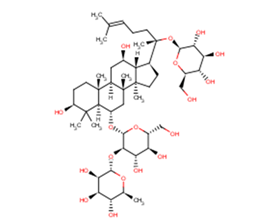
Ginsenoside Re
CAS No. 52286-59-6
Ginsenoside Re( Ginsenoside B2 | Ginsenoside RE | NSC308877 | Panaxoside RE )
Catalog No. M18719 CAS No. 52286-59-6
Ginsenoside Re may have properties that inhibit or prevent the growth of tumors.
Purity : >98% (HPLC)
 COA
Datasheet
HNMR
HPLC
MSDS
Handing Instructions
COA
Datasheet
HNMR
HPLC
MSDS
Handing Instructions
| Size | Price / USD | Stock | Quantity |
| 1 mL x 10 mM in DMSO | 60 | In Stock |


|
| 2MG | 29 | In Stock |
|
| 5MG | 41 | In Stock |
|
| 10MG | 58 | In Stock |
|
| 25MG | 93 | In Stock |
|
| 50MG | 138 | In Stock |
|
| 100MG | 203 | In Stock |
|
| 200MG | 300 | In Stock |
|
| 500MG | Get Quote | In Stock |
|
| 1G | Get Quote | In Stock |
|
Biological Information
-
Product NameGinsenoside Re
-
NoteResearch use only, not for human use.
-
Brief DescriptionGinsenoside Re may have properties that inhibit or prevent the growth of tumors.
-
DescriptionGinsenoside Re is a PPARγ agonist found in species of Panax. It inhibis formation of gastric mucosal lesions, decreases neutrophil infiltration, stimulates CD4+ T cell production, suppresses histamine release in mast cells, and prevents stress-induced anxiety, depression and cognitive deficits.(In Vitro):Ginsenoside Re is a well-known traditional Chinese medicine, which decreases the β-site amyloid precursor protein cleaving enzyme 1 (BACE1) mRNA and protein levels and inhibits BACE1 activity in the N2a/APP695 cells. Ginsenoside Re also significantly increases the PPARγ protein and mRNA levels.To prevent Ginsenoside Re from having a cytotoxic effect on the N2a/APP695 cells, the cell viability is first determined by the MTT assay. The N2a/WT and N2a/APP695 cells are treated with increasing concentrations of Ginsenoside Re (0-200 μM) for 24 h. Ginsenoside Re concentrations under 100 μM do not affect the viability of the N2a/WT and N2a/APP695 cells, whereas the 150 μM Ginsenoside Re concentration markedly decreases the survival rate of the N2a/WT and N2a/APP695 cells. Incubation with Ginsenoside Re at a 200 μM concentration for 24 h reduces the viability of the N2a/WT and N2a/APP695 cells by 15.58% and 26.82%, respectively. These data indicate that Ginsenoside Re treatment within the range of 0-100 μM for 24 h is safe for the N2a/WT and N2a/APP695 cells (P>0.05). (In Vivo):Ginsenoside Re reduces insulin resistance in 3T3-L1 adipocytes and high-fat diet (HFD) rats through inhibition of JNK and NF-κB activation. Intraperitoneal injection of lipopolysaccharide (LPS) at a dose of 20 mg/kg is lethal to mice, and 70% to 80% of the mice die within 60 h. However, pretreatment of the mice with Rg1 or Ginsenoside Re increases their survival rates in a dose-dependent manner. With the doses of Rg1 or Ginsenoside Re increase from 2.5 to 5 mg/kg, the survival rate is elevated from 60% to 90% (Rg1) or from 30% to 40% (Ginsenoside Re). All the mice administered Rg1 at a minimal dose of 10 mg/kg are protected from death compared to 80% survival of mice treated with an equal dose of Ginsenoside Re. To protect all the mice, 20 mg/kg Ginsenoside Re is needed. To investigate the anti-inflammatory potential of Rg1 and Ginsenoside Re, 1 mg/kg Rg1 or Ginsenoside Re is injected into rats and then challenged the animals with LPS. The injection procedure itself causes a transient stress-induced increase in body temperature of ~1.2°C in each group. Thereafter, LPS-challenged rats without pretreatment develope a robust biphasic fever, with the first peak reaching ~1.5°C at 2 h and the second peak reaching 1.8°C at 4 h. In contrast, the temperature changes for the Rg1-, Ginsenoside Re-, and TAK-242-treated groups are only 0.9, 1.2, and 0.8°C at 2 h and 1.3, 1.4, and 1.0°C at 4 h, respectively. Pretreatment with Rg1, Ginsenoside Re, or TAK-242 significantly attenuates LPS-induced alterations in body temperature.
-
In Vitro——
-
In Vivo——
-
SynonymsGinsenoside B2 | Ginsenoside RE | NSC308877 | Panaxoside RE
-
PathwayGPCR/G Protein
-
TargetProstaglandin Receptor
-
RecptorOthers
-
Research AreaOthers-Field
-
Indication——
Chemical Information
-
CAS Number52286-59-6
-
Formula Weight947.14
-
Molecular FormulaC48H82O18
-
Purity>98% (HPLC)
-
SolubilityDMSO : ≥ 50 mg/mL; 52.79 mM
-
SMILES[C@@H]1([C@@H]([C@@H]([C@H]([C@@H](O1)C)O)O)O)O[C@H]1[C@@H](O[C@@H]([C@H]([C@@H]1O)O)CO)O[C@@H]1[C@H]2C([C@H](CC[C@@]2([C@@H]2[C@@](C1)([C@@]1(CC[C@@H]([C@H]1[C@@H](C2)O)[C@](C)(CCC=C(C)C)O[C@H]1[C@@H]([C@H]([C@@H]([C@H](O1)CO)O)O)O)C)C)C)O)(C)C
-
Chemical Name(2S,3R,4R,5R,6S)-2-(((2R,3R,4S,5S,6R)-2-(((6R,8R,9R,10R,12S,13R,14R,17S)-3,12-dihydroxy-4,4,8,10,14-pentamethyl-17-((S)-6-methyl-2-(((2S,3R,4S,5S,6R)-3,4,5-trihydroxy-6-(hydroxymethyl)tetrahydro-2H-pyran-2-yl)oxy)hept-5-en-2-yl)hexadecahydro-1H-cyclopenta[a]phenanthren-6-yl)oxy)-4,5-dihydroxy-6-(hydroxymethyl)tetrahydro-2H-pyran-3-yl)oxy)-6-methyltetrahydro-2H-pyran-3,4,5-triol
Shipping & Storage Information
-
Storage(-20℃)
-
ShippingWith Ice Pack
-
Stability≥ 2 years
Reference
1. Nam Y, et al. J Appl Toxicol. 2015 Aug;35(8):927-44.
molnova catalog



related products
-
E7046
E7046 is an orally bioavailable and specific EP4 antagonist, with IC50 of 13.5 nM and Ki of 23.14 nM. E7046 exhibits anti-tumor activities.
-
Vidupiprant
Vidupiprant is an effective dual antagonist of CRTH2 and prostanoid D receptor with IC50s of 8 nM and 35 nM in human plasma.
-
Methyl 4-hydroxycinn...
Methyl p-coumarate (Methyl 4-hydroxycinnamate), an orally active esterified derivative of p-Coumaric acid (pCA), can be isolated from the flower of?Trixis michuacana?var?longifolia.
