


 Cart
Cart
 sales@molnova.com



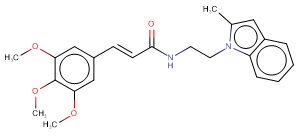
TG4-155
CAS No. 1164462-05-8
TG4-155( —— )
Catalog No. M20218 CAS No. 1164462-05-8
TG4-155 is a brain penetrant EP2 antagonist (KB = 2.4 nM) that is over 1000-fold less effective at EP4 (KB = 11.4 μM) and a panel of other receptors and channels.
Purity : >98% (HPLC)
 COA
Datasheet
HNMR
HPLC
MSDS
Handing Instructions
COA
Datasheet
HNMR
HPLC
MSDS
Handing Instructions
| Size | Price / USD | Stock | Quantity |
| 1 mL x 10 mM in DMSO | 52 | In Stock |


|
| 2MG | 30 | In Stock |
|
| 5MG | 48 | In Stock |
|
| 10MG | 86 | In Stock |
|
| 25MG | 188 | In Stock |
|
| 50MG | 323 | In Stock |
|
| 100MG | 479 | In Stock |
|
| 200MG | 682 | In Stock |
|
| 500MG | Get Quote | In Stock |
|
| 1G | Get Quote | In Stock |
|
Biological Information
-
Product NameTG4-155
-
NoteResearch use only, not for human use.
-
Brief DescriptionTG4-155 is a brain penetrant EP2 antagonist (KB = 2.4 nM) that is over 1000-fold less effective at EP4 (KB = 11.4 μM) and a panel of other receptors and channels.
-
DescriptionTG4-155 is a brain penetrant EP2 antagonist (KB = 2.4 nM) that is over 1000-fold less effective at EP4 (KB = 11.4 μM) and a panel of other receptors and channels.
-
In VitroTG4-155 inhibits the serotonin 5-HT2B receptor with IC50=2.6 μM and hERG (human Ether-à-go-go-Related Gene) with IC50=12 μM.PGE2 (0.1-10 μM) stimulation significantly enhances human prostate cancer cell line PC3 cell growth in a concentration-dependent manner with a maximal response being obtained at approximately 1 μM. This PGE2-induced cancer cell proliferation is significantly suppressed by TG4-155 (0.01-1μM ; 48 hours) in a concentration-dependent manner. Cell Viability Assay Cell Line:PC3 cells Concentration:48 hours Incubation Time:0.01, 0.1, and 1 μM Result:Significantly suppressed PGE2-induced cancer cell proliferation in a concentration-dependent manner.
-
In VivoAdministration of TG4-155 (5 mg/kg, i.p.; at 1 and 12 h) significantly reducesstatus epilepticus (SE)-induced neurodegeneration scores in C57BL/6 mice.TG4-155 (3 mg/kg; i.p.) displays a bioavailability of 61% (i.p. route compared with i.v.), a plasma half-life (t1/2) of 0.6 h, and a brain/plasma ratio of 0.3 in C57BL/6 mice. Animal Model:C57BL/6 mice (8-12 wk old)Dosage:5 mg/kg Administration:I.p.; at 1 and 12 h Result:Administration significantly reduced SE-induced neurodegeneration scores by 91% in hippocampal subregions CA1, by 80% in CA3, and by 63% in hilus.Animal Model:C57BL/6 miceDosage:3 mg/kg Administration:I.p.Result:Displayed a bioavailability of 61% (i.p. route compared with i.v.), t1/2 of 0.6 h, and a brain/plasma ratio of 0.3.
-
Synonyms——
-
PathwayGPCR/G Protein
-
TargetProstaglandin Receptor
-
RecptorEP2
-
Research Area——
-
Indication——
Chemical Information
-
CAS Number1164462-05-8
-
Formula Weight394.47
-
Molecular FormulaC23H26N2O4
-
Purity>98% (HPLC)
-
SolubilityDMSO:125 mg/mL?(316.89 mM)
-
SMILESCOc1cc(\C=C\C(=O)NCCn2c(C)cc3ccccc23)cc(OC)c1OC
-
Chemical Name(E)-N-[2-(2-methylindol-1-yl)ethyl]-3-(345-trimethoxyphenyl)prop-2-enamide
Shipping & Storage Information
-
Storage(-20℃)
-
ShippingWith Ice Pack
-
Stability≥ 2 years
Reference
1.Jiang J Ganesh T Du Y et al. Small molecule antagonist reveals seizure-induced mediation of neuronal injury by prostaglandin E2 receptor subtype EP2[J]. Proceedings of the National Academy of Sciences 2012 109(8):3149-3154.
molnova catalog



related products
-
ONO-AE3-208
ONO-AE3-208 is an EP4 antagonist. It suppresses cell migration, invasion, and metastasis of prostate cancer.
-
Tafluprost
Tafluprost, a prostaglandin analog, is the selective agonist of fluoroprostaglandin (FP) receptor PGF2α.Tafluprost showed significant IOP-lowering effects without any safety concerns in patients with various types of glaucoma and OH in daily clinical practice and tafluprost is highly effective in any therapeutic pattern.
-
MK-1029
ADC-3680 is a potent, selective prostaglandin D2 receptor (DP2, CRTH2) antagonist for the treatment of asthma.
