


 Cart
Cart
 sales@molnova.com



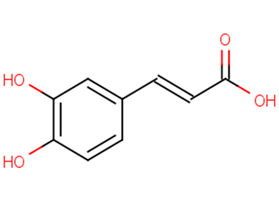
Caffeic Acid
CAS No. 331-39-5
Caffeic Acid( —— )
Catalog No. M18430 CAS No. 331-39-5
Caffeic Acid is an orally bioavailable, hydroxycinnamic acid derivative and polyphenol, with potential anti-oxidant, anti-inflammatory, and antineoplastic activities.
Purity : >98% (HPLC)
 COA
Datasheet
HNMR
HPLC
MSDS
Handing Instructions
COA
Datasheet
HNMR
HPLC
MSDS
Handing Instructions
| Size | Price / USD | Stock | Quantity |
| 1 mL x 10 mM in DMSO | 28 | In Stock |


|
| 100MG | 27 | In Stock |
|
| 200MG | Get Quote | In Stock |
|
| 500MG | Get Quote | In Stock |
|
| 1G | Get Quote | In Stock |
|
Biological Information
-
Product NameCaffeic Acid
-
NoteResearch use only, not for human use.
-
Brief DescriptionCaffeic Acid is an orally bioavailable, hydroxycinnamic acid derivative and polyphenol, with potential anti-oxidant, anti-inflammatory, and antineoplastic activities.
-
DescriptionCaffeic Acid is an orally bioavailable, hydroxycinnamic acid derivative and polyphenol, with potential anti-oxidant, anti-inflammatory, and antineoplastic activities.
-
In Vitro——
-
In Vivo——
-
Synonyms——
-
PathwayMAPK/ERK Signaling
-
TargetJNK
-
RecptorOthers
-
Research AreaOthers-Field
-
Indication——
Chemical Information
-
CAS Number331-39-5
-
Formula Weight180.16
-
Molecular FormulaC9H8O4
-
Purity>98% (HPLC)
-
SolubilityDMSO : 106.7 mg/mL 592.25 mM
-
SMILESc1cc(c(cc1/C=C/C(=O)O)O)O
-
Chemical Name——
Shipping & Storage Information
-
Storage(-20℃)
-
ShippingWith Ice Pack
-
Stability≥ 2 years
Reference
1. Pradhananga S, Shim WS. Eur J Pharmacol. 2015 Sep 5;762:313-21.
molnova catalog



related products
-
[D-Arg1,D-Phe5,D-Trp...
Broad spectrum neuropeptide inverse agonist and antagonist. Potent full inverse agonist for the ghrelin receptor (EC50 = 5.2 nM); diminishes constitutive ghrelin receptor signaling. Also antagonist at tachykinin, bradykinin, CCK and bombesin receptors. Induces apoptosis and inhibits cancer cell growth in vitro.
-
CC-401 hydrochloride
CC-401 hydrochloride is a potent, selective, ATP-competitive pan-JNK inhibitor with Ki of 25-50 nM.
-
JNK-IN-11
JNK-IN-11 (compound 1) is a potent inhibitor of JNK, with IC50 values of 2.2 μM, 21.4 μM, and 1.8 μM for JNK1, JNK2, and JNK3, respectively, showing potential for Alzheimer's and Parkinson's disease research.
