


 Cart
Cart
 sales@molnova.com



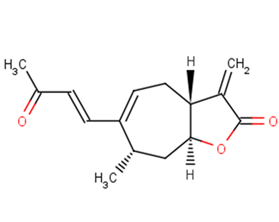
Xanthatin
CAS No. 26791-73-1
Xanthatin( —— )
Catalog No. M18336 CAS No. 26791-73-1
Xanthatin has antibacterial and antifungal activies against MRSA.
Purity : >98% (HPLC)
 COA
Datasheet
HNMR
HPLC
MSDS
Handing Instructions
COA
Datasheet
HNMR
HPLC
MSDS
Handing Instructions
| Size | Price / USD | Stock | Quantity |
| 1 mL x 10 mM in DMSO | 116 | In Stock |


|
| 5MG | 93 | In Stock |
|
| 10MG | 169 | In Stock |
|
| 25MG | 282 | In Stock |
|
| 100MG | Get Quote | In Stock |
|
| 200MG | Get Quote | In Stock |
|
| 500MG | Get Quote | In Stock |
|
| 1G | Get Quote | In Stock |
|
Biological Information
-
Product NameXanthatin
-
NoteResearch use only, not for human use.
-
Brief DescriptionXanthatin has antibacterial and antifungal activies against MRSA.
-
DescriptionXanthatin has cytotoxic activity. Xanthatin has antibacterial and antifungal activies against MRSA. Xanthatin may have therapeutic potential against NSCLC. Xanthatin can inhibit murine melanoma B16-F1 cell proliferation possibly associated with activation of Wnt/β-catenin pathway and its activity against melanoma tumor might also be relevant to inhibition of angiogenesis.
-
In Vitro——
-
In Vivo——
-
Synonyms——
-
PathwayMetabolic Enzyme/Protease
-
TargetP450
-
RecptorWnt/β-catenin
-
Research AreaOthers-Field
-
Indication——
Chemical Information
-
CAS Number26791-73-1
-
Formula Weight246.3
-
Molecular FormulaC15H18O3
-
Purity>98% (HPLC)
-
Solubility——
-
SMILESCC1CC2C(CC=C1C=CC(=O)C)C(=C)C(=O)O2
-
Chemical Name——
Shipping & Storage Information
-
Storage(-20℃)
-
ShippingWith Ice Pack
-
Stability≥ 2 years
Reference
molnova catalog



related products
-
Hypaconitine
Hypaconitine an active and highly toxic constituent derived from Aconitum species has anti-inflammatory activity is widely used to treat rheumatism.
-
Tauroursodeoxycholic...
Tauroursodeoxycholic acid is the more hydrophilic form of ursodeoxycholic acid, which is the more abundant naturally produced bile acid in humans.
-
1-Ethynylpyrene
1-Ethynylpyrene is an aryl acetylenic inhibitor of CYTP450 1A1(IC50=0.18 μM), 1A2(IC50 = 0.32 μM), and 2B1(IC50 = 0.04 μM).
