


 Cart
 sales@molnova.com




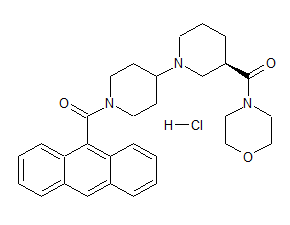
CP-640186 hydrochloride
CAS No. 591778-70-0
CP-640186 hydrochloride( —— )
Catalog No. M17551 CAS No. 591778-70-0
CP-640186 HCl is an isozyme-nonselective acetyl-CoA carboxylase (ACC) inhibitor, including rat liver ACC1 (IC50: 53 nM) and rat skeletal muscle ACC2 (IC50: 61 nM); with higher metabolic stability than CP-610431.
Purity : >98% (HPLC)
 COA
Datasheet
HNMR
HPLC
MSDS
Handing Instructions
| Size | Price / USD | Stock | Quantity |
| 1 mL x 10 mM in DMSO | 61 | In Stock |


|
| 2MG | 33 | In Stock |
|
| 5MG | 53 | In Stock |
|
| 10MG | 93 | In Stock |
|
| 25MG | 185 | In Stock |
|
| 50MG | 332 | In Stock |
|
| 100MG | 548 | In Stock |
|
| 200MG | Get Quote | In Stock |
|
| 500MG | Get Quote | In Stock |
|
| 1G | Get Quote | In Stock |
|
Biological Information
-
Product NameCP-640186 hydrochloride
-
NoteResearch use only, not for human use.
-
Brief DescriptionCP-640186 HCl is an isozyme-nonselective acetyl-CoA carboxylase (ACC) inhibitor, including rat liver ACC1 (IC50: 53 nM) and rat skeletal muscle ACC2 (IC50: 61 nM); with higher metabolic stability than CP-610431.
-
DescriptionCP-640186 HCl is an isozyme-nonselective acetyl-CoA carboxylase (ACC) inhibitor, including rat liver ACC1 (IC50: 53 nM) and rat skeletal muscle ACC2 (IC50: 61 nM); with higher metabolic stability than CP-610431.
-
In VitroCP-640186 (20 μM; 48 h) treatment can inhibit H460 cell growth.CP-640186 (0.1 nM-100 μM; 2 h) treatment increases fatty acid metabolism in a concentration-dependent manner in C2C12 cells and muscle strips. CP-640186 (0.62-1.8 μM; 2 h) treatment inhibits fatty acid synthesis and TG synthesis in HepG2 cells. Cell Proliferation Assay Cell Line:Human fibroblasts and H460 cells Concentration:20 μM Incubation Time:48 hours Result:Led to a ~30% decrease in cell number compared to vehicle-treated controls.Cell Viability Assay Cell Line:C2C12 cells and muscle strips Concentration:0.1 nM-100 μM Incubation Time:2 hours Result:Stimulated palmitate acid oxidation with an EC50 of 57 nM and a maximal stimulation of 280% in C2C12 cells.Stimulated palmitate acid oxidation with an EC50 of 1.3 μM and a maximal stimulation of 240% in isolated rat epitrochlearis muscle.Cell Viability Assay Cell Line:HepG2 cells Concentration:0.62-1.8 μM Incubation Time:6 hours Result:Inhibited fatty acid synthesis and TG synthesis in HepG2 cells with EC50s of 0.62 μM and 1.8 μM, respecticely.
-
In VivoCP-640186 (oral gavage; 4.6-21 mg/kg; once) demonstrates acute efficacy.CP-640186 (intravenous injection and oral gavage; Intravenous dose, 5 mg/kg; oral dose, 10 mg/kg; once) shows lowe drug exposure in the rat than the ob/ob mouse at equal doses.CP-640186 (oral gavage; 100 mg/kg; once) treatment shows a complete shift from carbohydrate utilization to fatty acid utilization as a source of energy at high exposure level. Animal Model:Male ob/ob miceDosage:4.6-21 mg/kg Administration:Oral gavage; 4.6-21 mg/kg; once Result:Demonstrated acute efficacy for up to 8 h after oral administration, exhibiting ED50 values of 4.6, 9.7, and 21 mg/kg, at 1, 4, and 8 h, respectively, after treatment.Animal Model:Male Sprague-Dawley rats Dosage:Intravenous dose, 5 mg/kg; oral dose, 10 mg/kg Administration:Intravenous injection and oral gavage; intravenous dose, 5 mg/kg; oral dose, 10 mg/kg; once Result:Showed a plasma half-life of 1.5 h, a bioavailability of 39%, a Clp of 65 ml/min/kg, a Vdss of 5 liters/kg, an oral Tmax of 1.0 h, an oral Cmax of 345 ng/mL, and an oral AUC0-∞ of 960 ng?h/mL.Animal Model:Male ob/ob mice Dosage:Intravenous dose, 5 mg/kg; oral dose, 10 mg/kg Administration:Intravenous injection and oral gavage; Intravenous dose, 5 mg/kg; oral dose, 10 mg/kg; once Result:Showed a plasma half-life of 1.1 h, a bioavailability of 50%, a Clp of 54 ml/min/kg, an oral Tmax of 0.25 h, an oral Cmax of 2177 ng/mL, and an oral AUC0-∞ of 3068 ng?h/mL.Animal Model:Twenty male Sprague-Dawley rats (350-400 g) fasted and then refed a high sucrose diet for 2 days; additional eight rats fasted for 24 h Dosage:100 mg/kg Administration:Oral gavage; 100 mg/kg; once Result:Resulted in time-dependent reductions in RQ (a ratio of CO2 production to O2 consumption) of up to 64%.
-
Synonyms——
-
PathwayOthers
-
TargetOther Targets
-
RecptorACC1| ACC2
-
Research AreaMetabolic Disease
-
Indication——
Chemical Information
-
CAS Number591778-70-0
-
Formula Weight522.08
-
Molecular FormulaC30H35ClN3O3
-
Purity>98% (HPLC)
-
SolubilityDMSO : ≥ 48 mg/mL; 91.94 mM
-
SMILESC1C[C@H](CN(C1)C1CCN(CC1)C(=O)c1c2ccccc2cc2ccccc12)C(=O)N1CCOCC1.Cl
-
Chemical Name——
Shipping & Storage Information
-
Storage(-20℃)
-
ShippingWith Ice Pack
-
Stability≥ 2 years
Reference
1. Harwood HJ Jr, et al. J Biol Chem. 2003 Sep 26;278(39):37099-111.
molnova catalog


related products
-
Nicotredole
Nicotredole (Tryptamide) is an orally active anti-inflammatory and analgesic agent. Nicotredole exhibits evident antiinflammatory effects of potency comparable with Phenylbutazone. Nicotredole has only weak ulcerogenic activity.
-
Hydrocinnamic alcoho...
Hydrocinnamic alcohol exists in storax and fern balsam, also present in Vaccinium species fruits, guava fruit and peel, blackberry, other fruits, rum, white wine, shitake mushroom, matsutake mushroom and peated malt. It is a flavoring ingredient.
-
Leucokinin VII
Leucokinin VII
