


 Cart
Cart
 sales@molnova.com



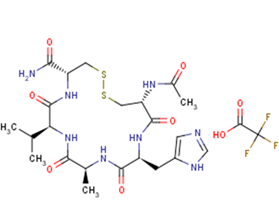
Exherin trifluoroacetate
CAS No. 1135237-88-5
Exherin trifluoroacetate( —— )
Catalog No. M17151 CAS No. 1135237-88-5
Exherin (ADH-1) is a cyclic pentapeptide vascular-targeting agent with potential antineoplastic and antiangiogenic activities.
Purity : >98% (HPLC)
 COA
Datasheet
HNMR
HPLC
MSDS
Handing Instructions
COA
Datasheet
HNMR
HPLC
MSDS
Handing Instructions
| Size | Price / USD | Stock | Quantity |
| 1 mL x 10 mM in DMSO | 91 | In Stock |


|
| 2MG | 35 | In Stock |
|
| 5MG | 56 | In Stock |
|
| 10MG | 91 | In Stock |
|
| 25MG | 170 | In Stock |
|
| 50MG | 235 | In Stock |
|
| 100MG | 350 | In Stock |
|
| 200MG | 498 | In Stock |
|
| 500MG | Get Quote | In Stock |
|
| 1G | Get Quote | In Stock |
|
Biological Information
-
Product NameExherin trifluoroacetate
-
NoteResearch use only, not for human use.
-
Brief DescriptionExherin (ADH-1) is a cyclic pentapeptide vascular-targeting agent with potential antineoplastic and antiangiogenic activities.
-
DescriptionExherin (ADH-1) is a cyclic pentapeptide vascular-targeting agent with potential antineoplastic and antiangiogenic activities. ADH-1 selectively and competitively binds to and blocks N-cadherin, which may result in disruption of tumor vasculature, inhibition of tumor cell growth, and the induction of tumor cell and endothelial cell apoptosis.(In Vitro):ADH-1 (0.2 mg/mL) blocks collagen I-mediated changes in pancreatic cancer cells, and is highly effective at preventing cell motility that is induced by expression of N-cadherin. ADH-1 (0, 0.1, 0.2, 0.5 and 1.0 mg/mL) induces apoptosis in a dose-dependent and N-cadherin-dependent manner.(In Vivo):ADH-1 (50 mg/kg) significantly prevents tumor growth and metastasis in a mouse model for pancreatic cancer. ADH-1 prevents tumor cell invasion and metastasis in an orthotopic model for pancreatic cancer using N-cadherin overexpressing BxPC-3 cells. ADH-1, at the dosages evaluated, does not display either antiangiogenic activity in a rat aortic ring assay or antitumor potential in a PC3 subcutaneous xenograft tumor model. ADH-1 (10 mL/kg, i.p.) augmentation of melanoma tumor growth is overcome through its ability to make regionally infused melphalan more effective. ADH-1 mediated augmentation of melanoma tumor growth is not altered by regionally infused temozolomide. In A375, but not DM443 xenografts, ADH-1 treatment increases phosphorylation of AKT at serine 473. ADH-1 slightly diminishes N-cadherin expression in both xenografts.
-
In VitroADH-1 (0.2 mg/mL) blocks collagen I-mediated changes in pancreatic cancer cells, and is highly effective at preventing cell motility that is induced by expression of N-cadherin. ADH-1 (0, 0.1, 0.2, 0.5 and 1.0 mg/mL) induces apoptosis in a dose-dependent and N-cadherin-dependent manner.
-
In VivoADH-1 (50 mg/kg) significantly prevents tumor growth and metastasis in a mouse model for pancreatic cancer. ADH-1 prevents tumor cell invasion and metastasis in an orthotopic model for pancreatic cancer using N-cadherin overexpressing BxPC-3 cells. ADH-1, at the dosages evaluated, does not display either antiangiogenic activity in a rat aortic ring assay or antitumor potential in a PC3 subcutaneous xenograft tumor model. ADH-1 (10 mL/kg, i.p.) augmentation of melanoma tumor growth is overcome through its ability to make regionally infused melphalan more effective. ADH-1 mediated augmentation of melanoma tumor growth is not altered by regionally infused temozolomide. In A375, but not DM443 xenografts, ADH-1 treatment increases phosphorylation of AKT at serine 473. ADH-1 slightly diminishes N-cadherin expression in both xenografts.
-
Synonyms——
-
PathwayTGF-beta/Smad
-
TargetTGFBR
-
RecptorN-cadherin
-
Research AreaCancer
-
Indication——
Chemical Information
-
CAS Number1135237-88-5
-
Formula Weight684.71
-
Molecular FormulaC24H35F3N3O3S2
-
Purity>98% (HPLC)
-
SolubilityDMSO : ≥ 43 mg/mL 62.80 mM
-
SMILESS1SC[C@H](NC(=O)[C@@H](NC(=O)[C@@H](NC(=O)[C@@H](NC(=O)[C@H](C1)NC(=O)C)Cc1nc[nH]c1)C)C(C)C)C(=O)N.C(=O)(C(F)(F)F)O
-
Chemical Name——
Shipping & Storage Information
-
Storage(-20℃)
-
ShippingWith Ice Pack
-
Stability≥ 2 years
Reference
1.Perotti A,etal.Ann Oncol. 2009 Apr;20(4):741-5.
molnova catalog



related products
-
ITD-1
ITD-1 is a potent, selective TGF-β inhibitor that induces type II TGFβ receptor (TGFBR2) degradation with IC50 of 0.85 uM.
-
FT-011
A novel anti-fibrotic agent that prevents TGF-beta-stimulated production of collagen in cultured renal mesangial cells (55-70% inhibition at 30 uM).
-
JL5
JL5 is a novel potent, selective BMP receptor inhibitor with IC50 of 1, <5 and 2 nM for ALK2/ACVR1, ALK3/BMPR1A and ALK6/BMPR1B, respectively.
