


 Cart
Cart
 sales@molnova.com



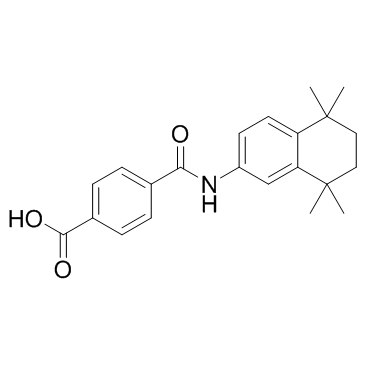
Tamibarotene
CAS No. 94497-51-5
Tamibarotene( Amnolake | NSC 608000 | Retinobenzoic Acid | Tamibarotene )
Catalog No. M16769 CAS No. 94497-51-5
Tamibarotene is a synthetic retinoic acid receptor (RAR) agonist with high specificity for RARα and RARβ over RARγ.
Purity : >98% (HPLC)
 COA
Datasheet
HNMR
HPLC
MSDS
Handing Instructions
COA
Datasheet
HNMR
HPLC
MSDS
Handing Instructions
| Size | Price / USD | Stock | Quantity |
| 1 mL x 10 mM in DMSO | 37 | In Stock |


|
| 10MG | 37 | In Stock |
|
| 25MG | 55 | In Stock |
|
| 50MG | 67 | In Stock |
|
| 100MG | 91 | In Stock |
|
| 200MG | 144 | In Stock |
|
| 500MG | 244 | In Stock |
|
| 1G | 362 | In Stock |
|
Biological Information
-
Product NameTamibarotene
-
NoteResearch use only, not for human use.
-
Brief DescriptionTamibarotene is a synthetic retinoic acid receptor (RAR) agonist with high specificity for RARα and RARβ over RARγ.
-
DescriptionTamibarotene is a synthetic retinoic acid receptor (RAR) agonist with high specificity for RARα and RARβ over RARγ.
-
In Vitro——
-
In Vivo——
-
SynonymsAmnolake | NSC 608000 | Retinobenzoic Acid | Tamibarotene
-
PathwayMetabolic Enzyme/Protease
-
TargetRetinoid Receptor
-
RecptorRARα| RARβ
-
Research AreaCancer
-
Indication——
Chemical Information
-
CAS Number94497-51-5
-
Formula Weight351.44
-
Molecular FormulaC22H25NO3
-
Purity>98% (HPLC)
-
SolubilityEthanol: 70 mg/mL (199.18 mM); DMSO: 70 mg/mL (199.18 mM)
-
SMILESO=C(O)C1=CC=C(C(NC2=CC=C3C(C)(C)CCC(C)(C)C3=C2)=O)C=C1
-
Chemical Name4-[(5,5,8,8-Tetramethyl-6,7-dihydronaphthalen-2-yl)carbamoyl]benzoic acid
Shipping & Storage Information
-
Storage(-20℃)
-
ShippingWith Ice Pack
-
Stability≥ 2 years
Reference
1. Sanda T, et al. Leukemia, 2005, 19(6), 901-909.
molnova catalog



related products
-
BX-517
BX-517 is a potent and selective inhibitor of PDK1.
-
CD2665
CD2665 is an antagonist of RAR-beta/gamma (Ki: 110 nM and 306 nM for RARγ and RARβ).
-
Fenretinide
Fenretinide (4-HPR) is a synthetic retinoid deriverative. 4-HBR is shown to exhibit binding to the retinoic acid receptors (RAR) at concentrations necessary to induce cell death.
