


 Cart
Cart
 sales@molnova.com



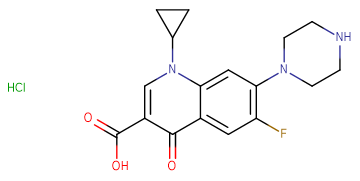
Ciprofloxacin hydrochloride
CAS No. 93107-08-5
Ciprofloxacin hydrochloride( BAY-o 9867 | NSC 620634 )
Catalog No. M16662 CAS No. 93107-08-5
A broad-spectrum antimicrobial carboxyfluoroquinoline.
Purity : >98% (HPLC)
 COA
Datasheet
HNMR
HPLC
MSDS
Handing Instructions
COA
Datasheet
HNMR
HPLC
MSDS
Handing Instructions
| Size | Price / USD | Stock | Quantity |
| 500MG | 37 | In Stock |


|
| 1G | 53 | In Stock |
|
Biological Information
-
Product NameCiprofloxacin hydrochloride
-
NoteResearch use only, not for human use.
-
Brief DescriptionA broad-spectrum antimicrobial carboxyfluoroquinoline.
-
DescriptionA broad-spectrum antimicrobial carboxyfluoroquinoline.(In Vitro):Ciprofloxacin (Bay-09867) monohydrochloride (5-50 μg/mL; 0-24 h; tendon cells) inhibits cell proliferation and causes cell cycle arrest at the G2/M phase.Ciprofloxacin (Bay-09867) monohydrochloride shows potent activity against Y. pestis and B. anthracis with MIC90 of 0.03 μg/mL and 0.12 μg/mL, respectively.(In Vivo):Ciprofloxacin (Bay-09867) monohydrochloride (30 mg/kg; i.p.; for 24 hours; BALB/c mice) has protection against Y. pestis in murine model of pneumonic plague.Ciprofloxacin (Bay-09867) monohydrochloride (100 mg/kg; i.g.; daily, for 4 weeks; C57BL/6J mice) accelerates aortic root enlargement and increases the incidence of aortic dissection and rupture by decreases LOX level and increases MMP levels and activity in the aortic wall.Ciprofloxacin (Bay-09867) monohydrochloride (100 mg/kg; i.g.; daily, for 4 weeks; C57BL/6J mice) induces DNA damage and release of DNA to the cytosol, mitochondrial dysfunction, and activation of cytosolic DNA sensor signaling. Ciprofloxacin lactate increases apoptosis and necroptosis in the aortic wall.
-
In VitroCiprofloxacin (Bay-09867) monohydrochloride (5-50 μg/mL; 0-24 h; tendon cells) inhibits cell proliferation and causes cell cycle arrest at the G2/M phase.Ciprofloxacin (Bay-09867) monohydrochloride shows potent activity against Y. pestis and B. anthracis with MIC90 of 0.03 μg/mL and 0.12 μg/mL, respectively. Cell Viability Assay Cell Line:Tendon cells Concentration:5, 10, 20 and 50 μg/mL Incubation Time:24 hours Result:Decreased the cellularity of tendon cells.Cell Cycle Analysis Cell Line:Tendon cells Concentration:50 μg/mL Incubation Time:24 hours Result:Arrested cell cycle at the G2/M phase and inhibited cell division in tendon cells.Western Blot Analysis Cell Line:Tendon cells Concentration:50 μg/mL Incubation Time:0, 6, 12, 17 and 24 hours Result:Down-regulated the expression of CDK-1 and cyclin B protein and mRNA. Up-regulatedthe expression of PLK-1 protein.
-
In VivoCiprofloxacin (Bay-09867) monohydrochloride (30 mg/kg; i.p.; for 24 hours; BALB/c mice) has protection against Y. pestis in murine model of pneumonic plague.Ciprofloxacin (Bay-09867) monohydrochloride (100 mg/kg; i.g.; daily, for 4 weeks; C57BL/6J mice) accelerates aortic root enlargement and increases the incidence of aortic dissection and rupture by decreases LOX level and increases MMP levels and activity in the aortic wall. Ciprofloxacin (Bay-09867) monohydrochloride (100 mg/kg; i.g.; daily, for 4 weeks; C57BL/6J mice) induces DNA damage and release of DNA to the cytosol, mitochondrial dysfunction, and activation of cytosolic DNA sensor signaling. Ciprofloxacin lactate increases apoptosis and necroptosis in the aortic wall. Animal Model:BALB/c mice Dosage:30 mg/kg Administration:Intraperitoneal injection; for 24 hours Result:Reduced the lung bacterial load in murine model of pneumonic plague.Animal Model:C57BL/6J mice Dosage:100 mg/kg Administration:Oral gavage; daily, for 4 weeks Result:Had aortic destruction that was accompanied by decreased LOX expression and increased MMP expression and activity.Animal Model:C57BL/6J mice Dosage:100 mg/kg Administration:Oral gavage; daily, for 4 weeks Result:Caused mitochondrial DNA and nuclear DNA damage, leading to mitochondrial dysfunction and ROS production. Increased apoptosis and necroptosis in the aortic wall.
-
SynonymsBAY-o 9867 | NSC 620634
-
PathwayCell Cycle/DNA Damage
-
TargetDNA gyrase
-
RecptorDNA gyrase| Topo II| Topo IV
-
Research Area——
-
Indication——
Chemical Information
-
CAS Number93107-08-5
-
Formula Weight367.8
-
Molecular FormulaC17H18FN3O3·HCl
-
Purity>98% (HPLC)
-
SolubilityDMSO: 10 mM
-
SMILESCl.OC(=O)C1=CN(C2CC2)C2=CC(N3CCNCC3)=C(F)C=C2C1=O
-
Chemical Name——
Shipping & Storage Information
-
Storage(-20℃)
-
ShippingWith Ice Pack
-
Stability≥ 2 years
Reference
1.Lee JK, et al. Microbiol Immunol. 2005;49(7):647-53.
molnova catalog



related products
-
Norfloxacin
Norfloxacin(Norxacin) is a broad-spectrum antibiotic that is active against both Gram-positive and Gram-negative bacteria.
-
Balofloxacin
Balofloxacin is a quinolone antibiotic, inhibiting the synthesis of bacterial DNA by interference with the enqyme DNA gyrase.
-
Enoxacin Sesquihydra...
Enoxacin is a broad-spectrum 6-fluoronaphthyridinone antibacterial agent.
