


 Cart
Cart
 sales@molnova.com



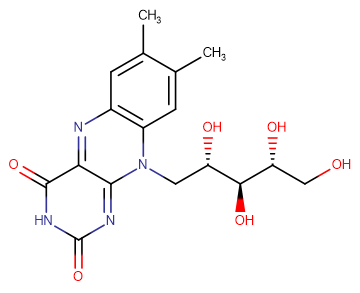
Riboflavin
CAS No. 83-88-5
Riboflavin( Riboflavin, Vitamin B2, Vitamin G | Lactoflavin )
Catalog No. M16112 CAS No. 83-88-5
Nutritional factor found in milk, eggs, malted barley, liver, kidney, heart, and leafy vegetables.
Purity : >98% (HPLC)
 COA
Datasheet
HNMR
HPLC
MSDS
Handing Instructions
COA
Datasheet
HNMR
HPLC
MSDS
Handing Instructions
| Size | Price / USD | Stock | Quantity |
| 1 mL x 10 mM in DMSO | 28 | In Stock |


|
| 100MG | Get Quote | In Stock |
|
| 200MG | Get Quote | In Stock |
|
| 500MG | Get Quote | In Stock |
|
| 1G | 31 | In Stock |
|
Biological Information
-
Product NameRiboflavin
-
NoteResearch use only, not for human use.
-
Brief DescriptionNutritional factor found in milk, eggs, malted barley, liver, kidney, heart, and leafy vegetables.
-
DescriptionNutritional factor found in milk, eggs, malted barley, liver, kidney, heart, and leafy vegetables. The richest natural source is yeast. It occurs in the free form only in the retina of the eye, in whey, and in urine; its principal forms in tissues and cells are as flavin mononucleotide and flavin-adenine dinucleotide.
-
In VitroCell Viability Assay Cell Line:HL60 cells Concentration:5-10 μM Incubation Time:24 h Result:Didn't affect cell viability with no UV irradiation.Western Blot Analysis Cell Line:HL60 cells Concentration:5-50 μM Incubation Time:24 h Result:Increased the ratio Bax/Bcl2 and decreased the level of inhibitory apoptosis protein type 1 (IAP1).Caused overexpression of Fas and FasL.Decreased the expression of TNFR1 and TRADD at the concentration of 10-50 μM.Inhibited the cell survival relevant kinases phospho-JNK, phospho-MEK, phospho-ERK.Increased the expression of p21 and decreased the expression of PCNA, STATs 1 and STATs 2.
-
In VivoAnimal Model:Swiss albino miceDosage:10 mg/kg Administration:Oral gavage (p.o.), dailyResult:Increased the growth rate of pregnant and newbron mice.Increased the percent conception and average litter size of pregnant mices.Improved the percent zinc absorption in male mices.Increased the levels of zinc and iron in organs in male and female mices.Increased the percent hemoglobin and the blood zinc value of female mices.Animal Model:Female Wistar rats Dosage:1-600 mg/kg Administration:Oral gavage (p.o.), one time Result:Reduced flinching behavior during phase 2 in formalin-injected mice by doses of 1-50 mg/kg.Produced a significant antihyperalgesic effect in carrageenan-injected mice by doses of 6.25-150 mg/kg.Reduced carrageenan-induced edema by doses of 50-150 mg/kg.
-
SynonymsRiboflavin, Vitamin B2, Vitamin G | Lactoflavin
-
PathwayMetabolic Enzyme/Protease
-
TargetVitamin
-
RecptorVB2
-
Research AreaOther Indications
-
Indication——
Chemical Information
-
CAS Number83-88-5
-
Formula Weight376.37
-
Molecular FormulaC17H20N4O6
-
Purity>98% (HPLC)
-
SolubilityDMSO: 0.1 mg/mL (0.26 mM); Water; Ethanol: insoluble
-
SMILESCC1=CC2=C(C=C1C)N(C3=NC(=O)NC(=O)C3=N2)C[C@@H]([C@@H]([C@@H](CO)O)O)O
-
Chemical Name7,8-dimethyl-10-[(2S,3S,4R)-2,3,4,5-tetrahydroxypentyl]benzo[g]pteridine-2,4-dione
Shipping & Storage Information
-
Storage(-20℃)
-
ShippingWith Ice Pack
-
Stability≥ 2 years
Reference
1.Solovieva IM, et al. FEMS Microbiol Lett. 2005 Feb 1;243(1):51-8.
molnova catalog



related products
-
Panthenol
Panthenol (pantothenol) is the alcohol analog of pantothenic acid (vitamin B5), and is thus a provitamin of B5.
-
Phenprocoumon
Phenprocoumon is an antagonist of vitamin K(IC50:1 μM).
-
Calcifediol
The major circulating metabolite of vitamin D3.
