


 Cart
Cart
 sales@molnova.com



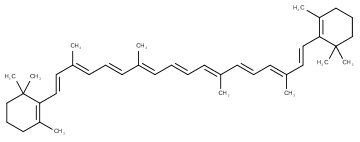
Beta-Carotene
CAS No. 7235-40-7
Beta-Carotene( Food Orange 5 | KPMK | Lucarotin | NSC 62794 | Provatene | Provitamin A | Solatene )
Catalog No. M15771 CAS No. 7235-40-7
β-Carotene is an organic compound and classified as a terpenoid. It is a precursor (inactive form) of vitamin A.
Purity : >98% (HPLC)
 COA
Datasheet
HNMR
HPLC
MSDS
Handing Instructions
COA
Datasheet
HNMR
HPLC
MSDS
Handing Instructions
| Size | Price / USD | Stock | Quantity |
| 1 mL x 10 mM in DMSO | 35 | In Stock |


|
| 100MG | Get Quote | In Stock |
|
| 200MG | 32 | In Stock |
|
| 500MG | 41 | In Stock |
|
| 1G | 52 | In Stock |
|
Biological Information
-
Product NameBeta-Carotene
-
NoteResearch use only, not for human use.
-
Brief Descriptionβ-Carotene is an organic compound and classified as a terpenoid. It is a precursor (inactive form) of vitamin A.
-
Descriptionβ-Carotene is an organic compound and classified as a terpenoid. It is a precursor (inactive form) of vitamin A.(In Vitro):β-Carotene up-regulates PPAR-γ expression and ROS production in MCF-7 cancer cells.β-Carotene (1-100 μM; 72 hours) remarkably decreases the survival of MCF-7 cells in a dose-dependent manner.β-Carotene (50 μM; 24-72 hours) significantly enhances the expression levels of PPAR-γ mRNA and protein in a time-dependent manner.β-Carotene down-regulates the COX-2 but up-regulates the p21 mRNA level and protein expression in a time dependent manner.β-Carotene significantly increases the percentage of early apoptosis and the effect was partly attenuated by pre-incubation with GW9662 (HY-16578) or GSH (HY-D0187).β-Carotene induces cytochrome C release.
-
In Vitroβ-Carotene up-regulates PPAR-γ expression and ROS production in MCF-7 cancer cells.β-Carotene (1-100 μM; 72 hours) remarkably decreases the survival of MCF-7 cells in a dose-dependent manner.β-Carotene (50 μM; 24-72 hours) significantly enhances the expression levels of PPAR-γ mRNA and protein in a time-dependent manner.β-Carotene down-regulates the COX-2 but up-regulates the p21 mRNA level and protein expression in a time dependent manner.β-Carotene significantly increases the percentage of early apoptosis and the effect was partly attenuated by pre-incubation with GW9662 (HY-16578) or GSH (HY-D0187).β-Carotene induces cytochrome C release. Cell Viability Assay Cell Line:MCF-7 cells Concentration:1 μM, 10 μM, 20 μM, 50 μM, 100 μM Incubation Time:72 hours Result:Decreased the numbers of viable cells to 70% and 50% at 20 μMand 50 μM, respectively.RT-PCR Cell Line:MCF-7 cells Concentration:50 μM Incubation Time:24 hours, 48 hours, 72 hours Result:Up-regulated the PPAR-γ mRNA.Western Blot Analysis Cell Line:MCF-7 cells Concentration:50 μM Incubation Time:24 hours, 48 hours, 72 hours Result:Up-regulated PPAR-γ protein expression levels.Apoptosis Analysis Cell Line:MCF-7 cells Concentration:50 μM Incubation Time:72 hours Result:Induced MCF-7 cells apoptosis.
-
In Vivo——
-
SynonymsFood Orange 5 | KPMK | Lucarotin | NSC 62794 | Provatene | Provitamin A | Solatene
-
PathwayMetabolic Enzyme/Protease
-
TargetVitamin
-
RecptorVA
-
Research AreaMetabolic Disease
-
Indication——
Chemical Information
-
CAS Number7235-40-7
-
Formula Weight536.87
-
Molecular FormulaC40H56
-
Purity>98% (HPLC)
-
SolubilityEthanol: 5 mg/mL warmed (9.31 mM); DMSO: 4 mg/mL warmed (7.45 mM)
-
SMILESCC(/C=C/C1=C(C)CCCC1(C)C)=C\C=C\C(C)=C\C=C\C=C(C)\C=C\C=C(C)\C=C\C2=C(C)CCCC2(C)C
-
Chemical Name(all-E)-1,1'-(3,7,12,16-Tetramethyl-1,3,5,7,9,11,13,15,17-octadecanonaene-1,18-diyl)bis(2,6,6-trimethylcyclohexene)
Shipping & Storage Information
-
Storage(-20℃)
-
ShippingWith Ice Pack
-
Stability≥ 2 years
Reference
1.Kasperczyk S, et al. Toxicol Appl Pharmacol. 2014 Oct 1;280(1):36-4
molnova catalog



related products
-
Warfarin sodium
An anticoagulant that acts by inhibiting the synthesis of vitamin K-dependent coagulation factors.
-
Sodium L-ascorbyl-2-...
L-Ascorbicacid, 2-(dihydrogen phosphate), sodium salt (1:3) can be used as antioxidant.
-
Calcitriol
Calcitriol is the hormonally active form of vitamin D.
