


 Cart
Cart
 sales@molnova.com



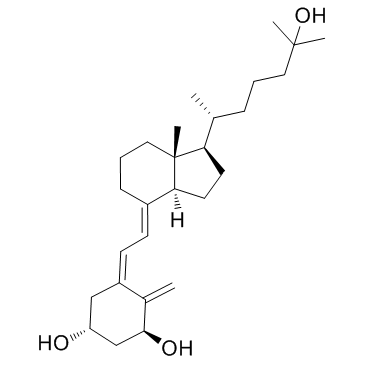
Calcitriol
CAS No. 32222-06-3
Calcitriol( 1α,25-dihydroxy Vitamin D3 )
Catalog No. M14049 CAS No. 32222-06-3
Calcitriol is the hormonally active form of vitamin D.
Purity : >98% (HPLC)
 COA
Datasheet
HNMR
HPLC
MSDS
Handing Instructions
COA
Datasheet
HNMR
HPLC
MSDS
Handing Instructions
| Size | Price / USD | Stock | Quantity |
| 2MG | 63 | In Stock |


|
| 5MG | 118 | In Stock |
|
| 10MG | 187 | In Stock |
|
| 25MG | 360 | In Stock |
|
| 50MG | 436 | In Stock |
|
| 100MG | 641 | In Stock |
|
| 200MG | 910 | In Stock |
|
| 500MG | Get Quote | In Stock |
|
| 1G | Get Quote | In Stock |
|
Biological Information
-
Product NameCalcitriol
-
NoteResearch use only, not for human use.
-
Brief DescriptionCalcitriol is the hormonally active form of vitamin D.
-
DescriptionCalcitriol is the hormonally active form of vitamin D.(In Vitro):Calcitriol exerts antiproliferative effects on cervical cancer cells in vitro. Cells decrease by 12.8% when treated with 100 nM Calcitriol for 6 days, compare with control. Inhibition of cell proliferation becomes more pronounced with the increase in Calcitriol concentration. The decrease is 26.1% and 31.6% for 200 and 500 nM Calcitriol, respectively. Treatment with Calcitriol for 72 h induces an evident accumulation of cells in the G1 phase, with approximately 66.18% in 200 nM and 78.10% in 500 nM, compare with the control (24.36%). Calcitriol treatment significantly decreases HCCR-1 protein expression compare with the control in a time- and dose-dependent manner. Calcitriol significantly increases ERα mRNA in a dose dependent manner with an EC50 of 9.8×10⁻⁹ M. (In Vivo):Chronic treatment with Calcitriol (150 ng/kg per day for 4.5 months) improves the relaxations (pD2: 6.30±0.09, Emax: 68.6±3.9% in Calcitriol-treated OVX, n=8). Renal blood flow in OVX rats is reduced in both kidneys, and the flow is restored by Calcitriol treatment. The increased expression of COX-2 and Thromboxane-prostanoid (TP) receptor in OVX rat renal arteries is reduced by chronic calcitriol administration. High- and low-dose Calcitriol treatment significantly decreases the systolic blood pressure (SBP) in the fructose-fed rats by 14±4 and 9±4 mmHg, respectively, at Day 56. High-dose Calcitriol treatment (20 ng/kg per day) significantly increases serum ionized calcium level (1.44±0.05 mmol/L) compare with the other groups.
-
In VitroCalcitriol exerts antiproliferative effects on cervical cancer cells in vitro. Cells decrease by 12.8% when treated with 100 nM Calcitriol for 6 days, compare with control. Inhibition of cell proliferation becomes more pronounced with the increase in Calcitriol concentration. The decrease is 26.1% and 31.6% for 200 and 500 nM Calcitriol, respectively. Treatment with Calcitriol for 72 h induces an evident accumulation of cells in the G1 phase, with approximately 66.18% in 200 nM and 78.10% in 500 nM, compare with the control (24.36%).Calcitriol treatment significantly decreases HCCR-1 protein expression compare with the control in a time- and dose-dependent manner. Calcitriol significantly increases ERα mRNA in a dose dependent manner with an EC50 of 9.8×10⁻⁹ M.
-
In VivoChronic treatment with Calcitriol (150 ng/kg per day for 4.5 months) improves the relaxations (pD2: 6.30±0.09, Emax: 68.6±3.9% in Calcitriol-treated OVX, n=8). Renal blood flow in OVX rats is reduced in both kidneys, and the flow is restored by Calcitriol treatment. The increased expression of COX-2 and Thromboxane-prostanoid (TP) receptor in OVX rat renal arteries is reduced by chronic calcitriol administration. High- and low-dose Calcitriol treatment significantly decreases the systolic blood pressure (SBP) in the fructose-fed rats by 14±4 and 9±4 mmHg, respectively, at Day 56. High-dose Calcitriol treatment (20 ng/kg per day) significantly increases serum ionized calcium level (1.44±0.05 mmol/L) compare with the other groups.
-
Synonyms1α,25-dihydroxy Vitamin D3
-
PathwayMetabolic Enzyme/Protease
-
TargetVitamin
-
Recptorvitamin D receptor
-
Research AreaMetabolic Disease
-
Indication——
Chemical Information
-
CAS Number32222-06-3
-
Formula Weight416.64
-
Molecular FormulaC27H44O3
-
Purity>98% (HPLC)
-
SolubilityDMSO:83 mg/mL (199.21 mM); Ethanol:83 mg/mL (199.21 mM); Water:<1 mg/mL (<1 mM)
-
SMILESO[C@H](C/C1=C/C=C2C3CC[C@@H]([C@]3(CCC/2)C)[C@H](C)CCCC(C)(O)C)C[C@@H](O)C1=C
-
Chemical Name1α,25-Dihydroxyvitamin D3
Shipping & Storage Information
-
Storage(-20℃)
-
ShippingWith Ice Pack
-
Stability≥ 2 years
Reference
1.Rigby WF, et al. J Clin Invest, 1984, 74(4), 1451-1455.
molnova catalog



related products
-
Thiamine hydrochlori...
Thiamine or vitamin B1 is a water-soluble vitamin of the B complex, its phosphate derivatives are involved in many cellular processes.
-
L(+)-Ascorbic acid
Vitamin C is a water-soluble vitamin indicated for the prevention and treatment of scurvy.
-
Tacalcitol monohydra...
A synthetic vitamin D3 analog that usually prescribed by a general practitioner or dermatologist for the treatment of psoriasis, chronic chapped lips and other severe dry skin conditions.
