


 Cart
Cart
 sales@molnova.com



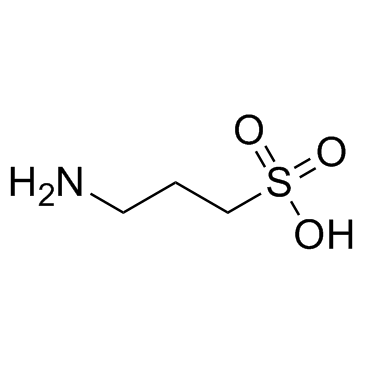
Homotaurine
CAS No. 3687-18-1
Homotaurine( Homotaurine | NC 531 | NC 758 | NSC 77071 | 3-Sulfopropylamine )
Catalog No. M14268 CAS No. 3687-18-1
Because of its similarity in structure to the neurotransmitter gamma-aminobutyric acid (GABA), it has GABAergic effects and may be useful as an anticonvulsant.
Purity : >98% (HPLC)
 COA
Datasheet
HNMR
HPLC
MSDS
Handing Instructions
COA
Datasheet
HNMR
HPLC
MSDS
Handing Instructions
| Size | Price / USD | Stock | Quantity |
| 100MG | Get Quote | In Stock |


|
| 200MG | Get Quote | In Stock |
|
| 500MG | 39 | In Stock |
|
| 1G | 47 | In Stock |
|
Biological Information
-
Product NameHomotaurine
-
NoteResearch use only, not for human use.
-
Brief DescriptionBecause of its similarity in structure to the neurotransmitter gamma-aminobutyric acid (GABA), it has GABAergic effects and may be useful as an anticonvulsant.
-
DescriptionBecause of its similarity in structure to the neurotransmitter gamma-aminobutyric acid (GABA), it has GABAergic effects and may be useful as an anticonvulsant. Homotaurine has also been investigated as a potential treatment for Alzheimer's disease. It binds to soluble amyloid beta and inhibits the formation of neurotoxic aggregates that lead to amyloid plaque deposition in the brain. However, clinical trials failed to show improvement compared to placebo.(In Vitro):Tramiprosate (200 μg/mL, 40 μg/mL, 8 μg/mL and 1.6 μg/mL; 1 hours) significantly attenuates oxygen/glucose deprivation (OGD)- or NMDA-induced injury in NGF-differentiated PC12 cells and primary cortical neurons. Tramiprosate decreases the intensity of the association between nNOS and PSD95, and Tramiprosate also inhibits the translocation of nNOS from the cytosol to the membrane.(In Vivo):Tramiprosate (6.25-50 mg/kg; intraperitoneal injection; once) treatment dose-dependently reduces the infarct volume after MCAO. Tramiprosate (50 mg/kg) treatment shows a significant neurological functional recovery.
-
In VitroTramiprosate (200 μg/mL, 40 μg/mL, 8 μg/mL and 1.6 μg/mL; 1 hours) significantly attenuates oxygen/glucose deprivation (OGD)- or NMDA-induced injury in NGF-differentiated PC12 cells and primary cortical neurons. Tramiprosate decreases the intensity of the association between nNOS and PSD95, and Tramiprosate also inhibits the translocation of nNOS from the cytosol to the membrane.
-
In VivoTramiprosate (6.25-50 mg/kg; intraperitoneal injection; once) treatment dose-dependently reduces the infarct volume after MCAO. Tramiprosate (50 mg/kg) treatment shows a significant neurological functional recovery. Animal Model:Adult male Sprague-Dawley rats (200-250 g) subjected to middle cerebral artery occlusion (MCAO) Dosage:50 mg/kg, 25 mg/kg, 12.5 mg/kg or 6.25 mg/kg Administration:Intraperitoneal injection; once Result:Dose-dependently reduced the infarct volume after MCAO.
-
SynonymsHomotaurine | NC 531 | NC 758 | NSC 77071 | 3-Sulfopropylamine
-
PathwayMembrane Transporter/Ion Channel
-
TargetBeta Amyloid
-
RecptorAβ| GABA
-
Research AreaCancer
-
Indication——
Chemical Information
-
CAS Number3687-18-1
-
Formula Weight139.17
-
Molecular FormulaC3H9NO3S
-
Purity>98% (HPLC)
-
SolubilityDMSO: 10 mM
-
SMILESO=S(CCCN)(O)=O
-
Chemical Name3-aminopropane-1-sulfonic acid
Shipping & Storage Information
-
Storage(-20℃)
-
ShippingWith Ice Pack
-
Stability≥ 2 years
Reference
1.Fariello RG, et al. Neurology, 1982, 32 (3): 241–5.
molnova catalog



related products
-
Hederacolchiside E
Hederacolchiside E has antioxidant activity and shows neuroprotective effects in Alzheimer's disease (AD) models via modulating oxidative stress.
-
CFMTI
CFMTI is a potent and selective metabotropic glutamate receptor (mGluR) 1 allosteric antagonist (IC50: 2.6 nM).
-
GRGDSPK acetate
GRGDSPK acetate shows inhibitory activity against integrin-fibronectin binding and can be used in research on integrins in bone formation and resorption.
