


 Cart
Cart
 sales@molnova.com



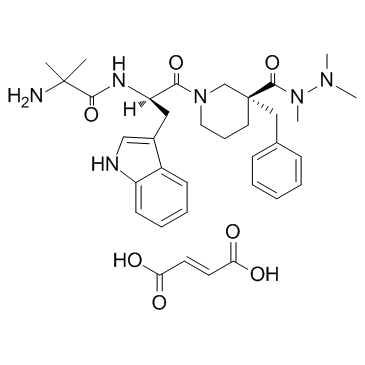
Anamorelin fumarate
CAS No. 339539-92-3
Anamorelin fumarate( RC1291 Fumarate | ONO7643 Fumarate | RC 1291 Fumarate | ONO 7643 Fumarate )
Catalog No. M14150 CAS No. 339539-92-3
A non-peptide, centrally-penetrant and selective agonist of GHSR with appetite-enhancing and anabolic effects.
Purity : >98% (HPLC)
 COA
Datasheet
HNMR
HPLC
MSDS
Handing Instructions
COA
Datasheet
HNMR
HPLC
MSDS
Handing Instructions
| Size | Price / USD | Stock | Quantity |
| 5MG | 963 | Get Quote |


|
| 50MG | 1962 | Get Quote |
|
| 100MG | 2520 | Get Quote |
|
| 200MG | Get Quote | Get Quote |
|
| 500MG | Get Quote | Get Quote |
|
| 1G | Get Quote | Get Quote |
|
Biological Information
-
Product NameAnamorelin fumarate
-
NoteResearch use only, not for human use.
-
Brief DescriptionA non-peptide, centrally-penetrant and selective agonist of GHSR with appetite-enhancing and anabolic effects.
-
DescriptionA non-peptide, centrally-penetrant and selective agonist of GHSR with appetite-enhancing and anabolic effects; orally bioactive.Growth Hormone Deficiency Phase 3 Clinical.
-
In VitroIn the FLIPR assay, Anamorelin (ANAM) shows significant agonist activity on the ghrelin receptor, with EC50 value of 0.74 nM. No significant antagonist activity is observed with Anamorelin at concentrations of up to 1,000 nM. In the binding experiments, Anamorelin binds to the ghrelin receptor with a binding affinity constant (Ki) of 0.70 nM. In the competition assay with radiolabeled ibutamoren (35S-MK-677; another ghrelin receptor agonist) Anamorelin (ANAM) is also found to bind with high affinity to the ghrelin receptor (IC50=0.69 nM). In rat pituitary cells incubated with Anamorelin, there is a dose-dependent stimulatory effect on GH release and the potency (EC50) is 1.5 nM. Anamorelin is screened for activity against a set of over 100 receptors, ion channels, transporters, and enzymes. Anamorelin demonstrates binding to the tachykinin neurokinin 2 (NK2) site (IC50=0.021 μM); however, a subsequent NK2 functional assay demonstrates no functional activity.?
-
In VivoIn rats, Anamorelin (ANAM) at an oral dose of 3, 10, or 30 mg/kg once daily significantly increases both food intake and body weight from Day 2 to Day 7 of treatment compared with the vehicle control. The cumulative change in food intake and weight gain increases dose-dependently, and these changes are significant at all dose levels (P<0.05) compared to the control. Administration of Anamorelin at a single oral dose of 3, 10, or 30 mg/kg induces a dose-dependent increase in plasma GH levels and GH AUC0-6h in rats.
-
SynonymsRC1291 Fumarate | ONO7643 Fumarate | RC 1291 Fumarate | ONO 7643 Fumarate
-
PathwayGPCR/G Protein
-
TargetGHSR
-
RecptorGHSR
-
Research AreaEndocrinology
-
IndicationGrowth Hormone Deficiency
Chemical Information
-
CAS Number339539-92-3
-
Formula Weight662.7758
-
Molecular FormulaC35H46N6O7
-
Purity>98% (HPLC)
-
Solubility10 mM in DMSO
-
SMILESCC(C)(C(=O)NC(CC1=CNC2=CC=CC=C21)C(=O)N3CCCC(C3)(CC4=CC=CC=C4)C(=O)N(C)N(C)C)N.C(=CC(=O)O)C(=O)O
-
Chemical Name3-Piperidinecarboxylic acid, 1-(2-methylalanyl-D-tryptophyl)-3-(phenylmethyl)-, trimethylhydrazide, (3R)-, (2E)-2-butenedioate (1:1) (9CI)
Shipping & Storage Information
-
Storage(-20℃)
-
ShippingWith Ice Pack
-
Stability≥ 2 years
Reference
1. Northrup R, et al. Support Care Cancer. 2013 Sep;21(9):2409-15.
2. Zhang H, et al. Expert Opin Pharmacother. 2015 Jun;16(8):1245-53.
3. Pietra C, et al. J Cachexia Sarcopenia Muscle. 2014 Dec;5(4):329-37.
molnova catalog



related products
-
NF-56-EJ40 hydrochlo...
NF-56-EJ40 hydrochloride is a potent, high-affinity, and highly selective human SUCNR1 (GPR91) antagonist with an IC50 of 25 nM and a Ki of 33 nM, and shows almost no activity towards rat SUCNR1.
-
ONC212
ONC212 a fluorinated-ONC201 analogue is a selective agonist of GPR132.
-
Pralmorelin acetate ...
Pralmorelin acetate stimulates growth hormone secretion.Pralmorelin?acetate is an oral active synthetic peptide analogue of MEK.?Pralmorelin?acetate, an auxin releasing peptide/growth hormone secretory receptor agonist, can selectively stimulate ghrelin receptor and cause growth hormone release.?
