


 Cart
Cart
 sales@molnova.com



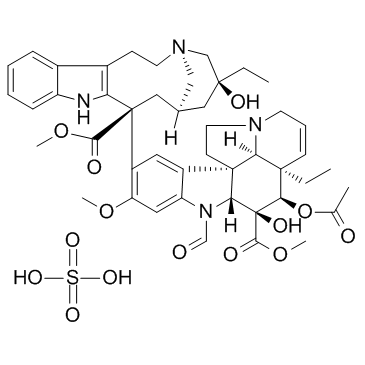
Vincristine sulfate
CAS No. 2068-78-2
Vincristine sulfate( Kyocristine | Lilly 37231 | Leurocristine | Novopharm | NSC 67574 | Oncovin | VCR )
Catalog No. M13216 CAS No. 2068-78-2
Vincristine (sulfate) is an inhibitor of polymerization of microtubules by binding to tubulin with IC50 of 32 μM.
Purity : >98% (HPLC)
 COA
Datasheet
HNMR
HPLC
MSDS
Handing Instructions
COA
Datasheet
HNMR
HPLC
MSDS
Handing Instructions
| Size | Price / USD | Stock | Quantity |
| 1 mL x 10 mM in DMSO | 48 | In Stock |


|
| 5MG | 30 | In Stock |
|
| 10MG | 42 | In Stock |
|
| 25MG | 65 | In Stock |
|
| 50MG | 86 | In Stock |
|
| 100MG | 131 | In Stock |
|
| 200MG | Get Quote | In Stock |
|
| 500MG | 323 | In Stock |
|
| 1G | Get Quote | In Stock |
|
Biological Information
-
Product NameVincristine sulfate
-
NoteResearch use only, not for human use.
-
Brief DescriptionVincristine (sulfate) is an inhibitor of polymerization of microtubules by binding to tubulin with IC50 of 32 μM.
-
DescriptionVincristine (sulfate) is an inhibitor of polymerization of microtubules by binding to tubulin with IC50 of 32 μM.(In Vitro):Vincristine inhibits net addition of tubulin dimers at assembly ends of steady-state microtubules with Ki of 85 nM. Vincristine stabilizes the spindle apparatus resulting in failure of the chromosomes to segregate leading to metaphase arrest and inhibition of mitosis at low concentrations. At higher concentrations, Vincristine may disrupt and induce total depolymerization of microtubules. Vincristine induces apoptosis in tumor cells and inhibits SH-SY5Y cell proliferation with IC50 of 0.1 μM. Vincristine induces mitotic arrest and promots the expression of caspase-3 and -9 and cyclin B, while decreasing the expression of cyclin D. Vincristine induced neurotoxicity is caused by interference with microtubule function, which results in blockage of axonal transport and thus in axonal degeneration.(In Vivo):Vincristine (3 mg/kg, i.p.) induces mean growth delay of > 120 and > 52 day, and repopulates fractions of 0.06% and 5%, administrated in mice bearing bilateral subcutaneous xenografts Rh12 or Rh18, respectively.
-
In VitroVincristine inhibits net addition of tubulin dimers at assembly ends of steady-state microtubules with Ki?of 85 nM.?Vincristine stabilizes the spindle apparatus resulting in failure of the chromosomes to segregate leading to metaphase arrest and inhibition of mitosis at low concentrations. At higher concentrations, Vincristine may disrupt and induce total depolymerization of microtubules.?Vincristine induces apoptosis in tumor cells and inhibits SH-SY5Y cell proliferation with IC50 of 0.1 μM. Vincristine induces mitotic arrest and promots the expression of caspase-3 and -9 and cyclin B, while decreasing the expression of cyclin D.?Vincristine induced neurotoxicity is caused by interference with microtubule function, which results in blockage of axonal transport and thus in axonal degeneration.
-
In VivoVincristine (3 mg/kg, i.p.) induces mean growth delay of > 120 and > 52 day, and repopulates fractions of 0.06% and 5%, administrated in mice bearing bilateral subcutaneous xenografts Rh12 or Rh18, respectively.
-
SynonymsKyocristine | Lilly 37231 | Leurocristine | Novopharm | NSC 67574 | Oncovin | VCR
-
PathwayCytoskeleton/Cell Adhesion Molecules
-
TargetMicrotubule/Tubulin
-
Recptormicrotubule
-
Research AreaCancer
-
Indication——
Chemical Information
-
CAS Number2068-78-2
-
Formula Weight923.04
-
Molecular FormulaC46H58N4O14S
-
Purity>98% (HPLC)
-
SolubilityWater: 60 mg/mL (65.0 mM); DMSO: 100 mg/mL (108.33 mM)
-
SMILESCC[C@@]1(C[C@@H]2C[C@@](C3=C(CCN(C2)C1)C4=CC=CC=C4N3)(C5=C(C=C6C(=C5)[C@]78CCN9[C@H]7[C@@](C=CC9)([C@H]([C@@]([C@@H]8N6C=O)(C(=O)OC)O)OC(=O)C)CC)OC)C(=O)OC)O.OS(=O)(=O)O
-
Chemical Name——
Shipping & Storage Information
-
Storage(-20℃)
-
ShippingWith Ice Pack
-
Stability≥ 2 years
Reference
1.Jordan MA, et al. Y Res, 1985, 45(6), 2741-2747.
molnova catalog



related products
-
4-Isopropoxybenzoic ...
4-Isopropoxybenzoic acid is a Centromere-Associated Protein E inhibitor.
-
Paclitaxel
Paclitaxel is a novel antineoplastic agent, which was discovered in a screen of extracts of thousands of plants and natural products for antineoplastic activity by a National Y Institute program.
-
Valecobulin hydrochl...
Valecobulin hydrochloride is a potent inhibitor of β-tubulin polymerization.
