


 Cart
Cart
 sales@molnova.com



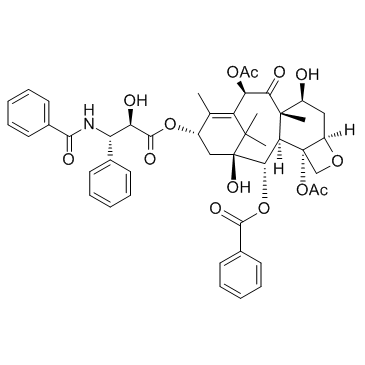
Paclitaxel
CAS No. 33069-62-4
Paclitaxel( NSC 125973 )
Catalog No. M14100 CAS No. 33069-62-4
Paclitaxel is a novel antineoplastic agent, which was discovered in a screen of extracts of thousands of plants and natural products for antineoplastic activity by a National Y Institute program.
Purity : >98% (HPLC)
 COA
Datasheet
HNMR
HPLC
MSDS
Handing Instructions
COA
Datasheet
HNMR
HPLC
MSDS
Handing Instructions
| Size | Price / USD | Stock | Quantity |
| 1 mL x 10 mM in DMSO | 48 | In Stock |


|
| 25MG | 32 | In Stock |
|
| 50MG | 45 | In Stock |
|
| 100MG | 73 | In Stock |
|
| 200MG | Get Quote | In Stock |
|
| 500MG | 110 | In Stock |
|
| 1G | 161 | In Stock |
|
Biological Information
-
Product NamePaclitaxel
-
NoteResearch use only, not for human use.
-
Brief DescriptionPaclitaxel is a novel antineoplastic agent, which was discovered in a screen of extracts of thousands of plants and natural products for antineoplastic activity by a National Y Institute program.
-
DescriptionPaclitaxel is a novel antineoplastic agent, which was discovered in a screen of extracts of thousands of plants and natural products for antineoplastic activity by a National Y Institute program. Alought it functions as a mitotic inhibitor like vinca alkaloids, paclitaxel promotes the polymerization of tubulin instead of inducing the disassembly of microtubules, which inhibits the microtubules disassembly and promotes the formation of excessively stable, dysfunctional microtubules. Paclitaxel has exhibited antitumor activity against a broad spectrum of human Ys, including ovarian, breast, head and neck, and lung Y, in a large number of studies.(In Vitro):Paclitaxel (20 nM; 48 hours) induces programmed cell death and exists a block at the G2/M phase of the cell cycle.Paclitaxel (20 nM; 48 hours) induces a consistent increase in the level of p53.(In Vivo):Paclitaxel (1-20 mg/kg; i.p.; 1 time/2 days for five cycles) obviously induces liver metastases at the low-Paclitaxel group with little influence on primary tumor growth.
-
In VitroApoptosis Analysis Cell Line:MCF-7, MDA-MB-231 cells Concentration:20 nM Incubation Time:48 hours Result:Induced programmed cell death.Cell Cycle Analysis Cell Line:MCF-7, MDA-MB-231 cells Concentration:20 nM Incubation Time:48 hours Result:>60% of MCF-7 cells and 50% of MDA-MB-231 cells were in the G2/M phase following 24 h treament.Western Blot Analysis Cell Line:MCF-7 cells (harboring wild-type p53 ) Concentration:20 nM Incubation Time:48 hours Result:Induced a consistent increase in the level of p53.
-
In VivoAnimal Model:MDA-231 xenograft-bearing miceDosage:1, 20 mg/kg Administration:Intraperitoneal injection; five cycles (1 time/2 days)Result:Liver metastases were obviously induced in the low-PTX (1 mg/kg) group with little influence on primary tumor growth compared with high-PTX group.
-
SynonymsNSC 125973
-
PathwayCytoskeleton/Cell Adhesion Molecules
-
TargetMicrotubule/Tubulin
-
Recptormicrotubule
-
Research AreaCancer
-
Indication——
Chemical Information
-
CAS Number33069-62-4
-
Formula Weight853.92
-
Molecular FormulaC47H51NO14
-
Purity>98% (HPLC)
-
SolubilityEthanol: 18 mg/mL (21.07 mM); DMSO: 171 mg/mL (200.25 mM)
-
SMILESO=C1[C@H](OC(C)=O)C(C2(C)C)=C(C)[C@@H](OC([C@H](O)[C@@H](NC(C3=CC=CC=C3)=O)C4=CC=CC=C4)=O)C[C@@]2(O)[C@@H](OC(C5=CC=CC=C5)=O)[C@@]6([H])[C@@]1(C)[C@@H](O)C[C@@]7([H])OC[C@]76OC(C)=O
-
Chemical Name(2aR,4S,4aS,6R,9S,11S,12S,12aR,12bS)-9-(((2R,3S)-3-benzamido-2-hydroxy-3-phenylpropanoyl)oxy)-12-(benzoyloxy)-4,11-dihydroxy-4a,8,13,13-tetramethyl-5-oxo-2a,3,4,4a,5,6,9,10,11,12,12a,12b-dodecahydro-1H-7,11-methanocyclodeca[3,4]benzo[1,2-b]oxete-6,12b-diyl diacetate
Shipping & Storage Information
-
Storage(-20℃)
-
ShippingWith Ice Pack
-
Stability≥ 2 years
Reference
1.Wang J, et al. anticancer Drugs. 2003, 14(1), 13-19.
molnova catalog



related products
-
Triclabendazole
Triclabendazole is a benzimidazole, it binds to tubulin impairing intracellular transport mechanisms and interferes with protein synthesis.
-
4-Isopropoxybenzoic ...
4-Isopropoxybenzoic acid is a Centromere-Associated Protein E inhibitor.
-
Parbendazole
Parbendazole is a potent inhibitor of microtubule assembly(EC50 : 8.79?nM).Parbendazole is a carbamate ester-amine. It finds applications in control or treatment of nematode infestations.
