


 Cart
Cart
 sales@molnova.com



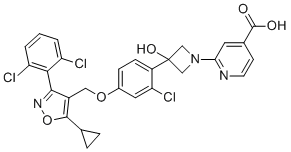
Cilofexor
CAS No. 1418274-28-8
Cilofexor( GS-9674 | GS9674 | PX-104 )
Catalog No. M11749 CAS No. 1418274-28-8
Cilofexor (GS-9674, GS9674, PX-104) is a novel specific, non-steroidal farnesoid X receptor (FXR) agonist that reduces liver fibrosis and ameliorates portal hypertension in rat NASH models.
Purity : >98% (HPLC)
 COA
Datasheet
HNMR
HPLC
MSDS
Handing Instructions
COA
Datasheet
HNMR
HPLC
MSDS
Handing Instructions
| Size | Price / USD | Stock | Quantity |
| 1 mL x 10 mM in DMSO | 153 | In Stock |


|
| 2MG | 67 | In Stock |
|
| 5MG | 120 | In Stock |
|
| 10MG | 188 | In Stock |
|
| 25MG | 376 | In Stock |
|
| 50MG | 554 | In Stock |
|
| 100MG | 732 | In Stock |
|
| 200MG | 995 | In Stock |
|
| 500MG | Get Quote | In Stock |
|
| 1G | Get Quote | In Stock |
|
Biological Information
-
Product NameCilofexor
-
NoteResearch use only, not for human use.
-
Brief DescriptionCilofexor (GS-9674, GS9674, PX-104) is a novel specific, non-steroidal farnesoid X receptor (FXR) agonist that reduces liver fibrosis and ameliorates portal hypertension in rat NASH models.
-
DescriptionCilofexor (GS-9674, GS9674, PX-104) is a novel specific, non-steroidal farnesoid X receptor (FXR) agonist that reduces liver fibrosis and ameliorates portal hypertension in rat NASH models.Steatohepatitis,Phase 2 Clinical(In Vivo):Cilofexor (GS-9674; 30 mg/kg; oral gavage; once daily; for 10 weeks; male Wistar rats) treatment significantly increases Fgf15 expression in the ileum and decreased Cyp7a1 in the liver in nonalcoholic steatohepatitis (NASH) rats. Liver fibrosis and hepatic collagen expression are significantly reduced. Cilofexor also significantly reduces hepatic stellate cell (HSC) activation and significantly decreases portal pressure, without affecting systemic hemodynamics.
-
In Vitro——
-
In VivoAnimal Model:Male Wistar rats received a choline-deficient high fat diet (CDHFD)Dosage:30 mg/kg Administration:Oral gavage; once daily; for 10 weeks Result:Significantly increased Fgf15 expression in the ileum and decreased Cyp7a1 in the liver. Liver fibrosis and hepatic collagen expression were significantly reduced.
-
SynonymsGS-9674 | GS9674 | PX-104
-
PathwayMetabolic Enzyme/Protease
-
TargetFXR
-
RecptorFXR
-
Research AreaOther Indications
-
IndicationSteatohepatitis
Chemical Information
-
CAS Number1418274-28-8
-
Formula Weight586.85
-
Molecular FormulaC28H22Cl3N3O5
-
Purity>98% (HPLC)
-
SolubilityDMSO : 125 mg/mL213.00 mM; H2O : < 0.1 mg/mL
-
SMILESOC(C1=CC=NC(N2CC(O)(C2)C3=C(C=C(C=C3)OCC4=C(ON=C4C5=C(C=CC=C5Cl)Cl)C6CC6)Cl)=C1)=O
-
Chemical Name2-[3-[2-Chloro-4-[[5-cyclopropyl-3-(2,6-dichlorophenyl)-4-isoxazolyl]methoxy]phenyl]-3-hydroxy-1-azetidinyl]-4-pyridinecarboxylic acid
Shipping & Storage Information
-
Storage(-20℃)
-
ShippingWith Ice Pack
-
Stability≥ 2 years
Reference
1. Gege C, et al. Curr Top Med Chem. 2014;14(19):2143-58.
molnova catalog



related products
-
LY-2562175
LY-2562175 (LY2562175, LY 2562175) is a novel potent, selective, partial FXR agonist with EC50 of 193 nM.
-
Ursodeoxycholic acid...
Ursodeoxycholic acid sodium is a naturally occurring secondary bile acid with anti-inflammatory and cytoprotective activities. Ursodeoxycholic acid sodium acts as signaling molecule, exerting its effects by interacting with bile acid activated receptors,
-
Chenodeoxycholic Aci...
Chenodeoxycholic Acid sodium salt (CDCA sodium salt) is a bile acid in humans that activates the nuclear receptor FXR, rescues axonal degeneration of induced pluripotent stem cell-derived neurons in patients with spastic paraplegia type 5 and cerebral xanthomatosis, and can be used to study pancreatic necrosis.
