


 Cart
Cart
 sales@molnova.com



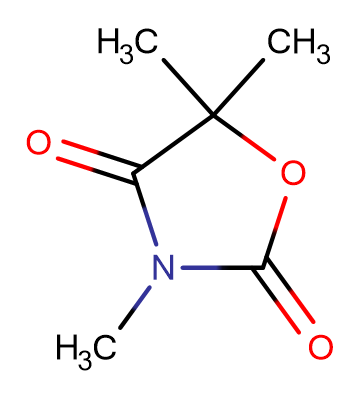
Trimethadione
CAS No. 127-48-0
Trimethadione( NSC 15799 | NSC 169503 )
Catalog No. M11145 CAS No. 127-48-0
Trimethadione is an oxazolidinedione anticonvulsant; commonly used to treat epileptic conditions.
Purity : >98% (HPLC)
 COA
Datasheet
HNMR
HPLC
MSDS
Handing Instructions
COA
Datasheet
HNMR
HPLC
MSDS
Handing Instructions
| Size | Price / USD | Stock | Quantity |
| 1 mL x 10 mM in DMSO | 29 | In Stock |


|
| 100MG | 44 | In Stock |
|
| 200MG | 63 | In Stock |
|
| 500MG | Get Quote | In Stock |
|
| 1G | Get Quote | In Stock |
|
Biological Information
-
Product NameTrimethadione
-
NoteResearch use only, not for human use.
-
Brief DescriptionTrimethadione is an oxazolidinedione anticonvulsant; commonly used to treat epileptic conditions.
-
DescriptionTrimethadione is an oxazolidinedione anticonvulsant; commonly used to treat epileptic conditions.
-
In Vitro——
-
In Vivo——
-
SynonymsNSC 15799 | NSC 169503
-
PathwayGPCR/G Protein
-
TargetCalcium Channel
-
RecptorCalcium Channel
-
Research AreaNeurological Disease
-
Indication——
Chemical Information
-
CAS Number127-48-0
-
Formula Weight143.14
-
Molecular FormulaC6H9NO3
-
Purity>98% (HPLC)
-
Solubilitysoluble in Water
-
SMILESO=C(N1C)OC(C)(C)C1=O
-
Chemical Name3,5,5-trimethyl-1,3-oxazolidine-2,4-dione
Shipping & Storage Information
-
Storage(-20℃)
-
ShippingWith Ice Pack
-
Stability≥ 2 years
Reference
1.Shen H, et al. Hear Res. 2007 Apr;226(1-2):52-60.
molnova catalog



related products
-
Trimebutine maleate
Trimebutine maleate is a drug with antimuscarinic and weak mu opioid agonist effects.
-
Yangambin
Yangambin is a selective antagonist of the cardiovascular effects of platelet activating factor (PAF); it has hypotensive effect, which is probably due to a peripheral vasodilatation that involves, at least, the inhibition the Ca2+ influx through voltage-gated Ca2+ channels. Yangambin has central nervous system activity, it presents a depressant activity in the open field, forced swimming and pentobarbital sleeping time tests.
-
AMG1
A novel specific CRAC channel inhibitor that blocks function of effector.
