


 Cart
Cart
 sales@molnova.com



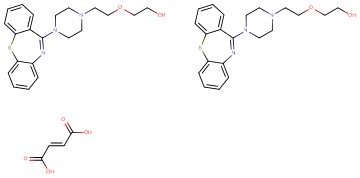
Quetiapine Fumarate
CAS No. 111974-72-2
Quetiapine Fumarate( ICI 204636 )
Catalog No. M10430 CAS No. 111974-72-2
Quetiapine Fumarate is an atypical antipsychotic used in the treatment of schizophrenia, bipolar I mania, bipolar II depression, bipolar I depression.
Purity : >98% (HPLC)
 COA
Datasheet
HNMR
HPLC
MSDS
Handing Instructions
COA
Datasheet
HNMR
HPLC
MSDS
Handing Instructions
| Size | Price / USD | Stock | Quantity |
| 1 mL x 10 mM in DMSO | 29 | In Stock |


|
| 100MG | Get Quote | In Stock |
|
| 200MG | 28 | In Stock |
|
| 500MG | 43 | In Stock |
|
| 1G | 45 | In Stock |
|
Biological Information
-
Product NameQuetiapine Fumarate
-
NoteResearch use only, not for human use.
-
Brief DescriptionQuetiapine Fumarate is an atypical antipsychotic used in the treatment of schizophrenia, bipolar I mania, bipolar II depression, bipolar I depression.
-
DescriptionQuetiapine Fumarate is an atypical antipsychotic used in the treatment of schizophrenia, bipolar I mania, bipolar II depression, bipolar I depression.(In Vitro):Quetiapine (<100 μM; 24 hours) has no significant effect on cell viabilities.Quetiapine (10 μM) inhibits NO release, which increased by LPS (0.1-100 ng/mL) in concentration-dependent manner.Quetiapine (10 μM) also inhibits TNF-α synthesis.(In Vivo):Quetiapine (10 mg/kg/day; ingested) can alleviate the recruitment and activation of microglia and promote myelin repair in Cuprizone (CPZ)-induced chronic mouse model of demyelination.
-
In VitroQuetiapine (<100?μM; 24?hours) has no significant effect on cell viabilities.Quetiapine (10?μM) inhibits NO release, which increased by LPS (0.1-100 ng/mL) in concentration-dependent manner. Quetiapine (10?μM) also inhibits TNF-α synthesis. Cell Viability Assay Cell Line:N9 microglial cells Concentration:0, 0.1, 1, 10, 50, and 100?μM Incubation Time:24?hours Result:Had no significant effect on cell viabilities at various concentrations under 100?μM, in which significant toxicity could be observed. RT-PCR Cell Line:N9 microglial cells Concentration:10?μM Incubation Time:24?hours Result:Dramatically inhibited TNF-α synthesis.
-
In VivoQuetiapine (10?mg/kg/day; ingested) can alleviate the recruitment and activation of microglia and promote myelin repair in Cuprizone (CPZ)-induced chronic mouse model of demyelination. Animal Model:C57BL/6 mice Dosage:10?mg/kg/day Administration:Ingested Result:Significantly increased in optical density of myelin basic protein (MBP) staining compared to Veh group.
-
SynonymsICI 204636
-
PathwayEndocrinology/Hormones
-
Target5-HT Receptor
-
RecptorHT| Adrenergic Receptor| Dopamine
-
Research AreaNeurological Disease
-
Indication——
Chemical Information
-
CAS Number111974-72-2
-
Formula Weight883.09
-
Molecular FormulaC46H54N6O8S2
-
Purity>98% (HPLC)
-
SolubilityDMSO: 36 mg/mL (40.76 mM)
-
SMILESC1CN(CCN1CCOCCO)C2=NC3=CC=CC=C3SC4=CC=CC=C42.C1CN(CCN1CCOCCO)C2=NC3=CC=CC=C3SC4=CC=CC=C42.C(=C/C(=O)O)\C(=O)O
-
Chemical Name——
Shipping & Storage Information
-
Storage(-20℃)
-
ShippingWith Ice Pack
-
Stability≥ 2 years
Reference
1.Nemeroff CB, et al. J Clin Psychiatry, 2002, 63 Suppl 13, 5-1
molnova catalog



related products
-
Tropisetron hydrochl...
Tropisetron is a selective 5-HT3 receptor antagonist and α7-nicotinic receptor agonist.
-
KW-2478
KW-2478 is a non-ansamycin HSP90 inhibitor with IC50 of 3.8 nM.
-
Flopropione
Flopropione is a spasmolytic or antispasmodic agent, and acts as a 5-HT1A receptor antagonist.
