


 Cart
Cart
 sales@molnova.com



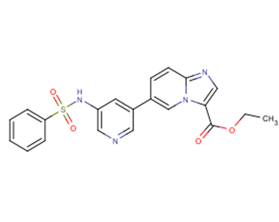
HS-173
CAS No. 1276110-06-5
HS-173( HS173 | HS 173 | HS-173 )
Catalog No. M17235 CAS No. 1276110-06-5
HS-173 is an effective PI3Kα inhibitor (IC50: 0.8 nM).
Purity : >98% (HPLC)
 COA
Datasheet
HNMR
HPLC
MSDS
Handing Instructions
COA
Datasheet
HNMR
HPLC
MSDS
Handing Instructions
| Size | Price / USD | Stock | Quantity |
| 2MG | 43 | In Stock |


|
| 5MG | 69 | In Stock |
|
| 10MG | 123 | In Stock |
|
| 25MG | 257 | In Stock |
|
| 50MG | 397 | In Stock |
|
| 100MG | 516 | In Stock |
|
| 200MG | Get Quote | In Stock |
|
| 500MG | Get Quote | In Stock |
|
| 1G | Get Quote | In Stock |
|
Biological Information
-
Product NameHS-173
-
NoteResearch use only, not for human use.
-
Brief DescriptionHS-173 is an effective PI3Kα inhibitor (IC50: 0.8 nM).
-
DescriptionHS-173 is a potent PI3Kα inhibitor with potential anticancer activity. HS-173 inhibited the PI3K signaling pathway, and showed anti-proliferative effects on cancer cells. Also, HS-173 induced cell cycle arrest at the G(2)/M phase and apoptosis. In addition, HS-173 decreased the expression HIF-1α and VEGF which play an important role in angiogenesis. This effect was confirmed by the suppression of tube formation and migration assay in vitro. Furthermore, HS-173 diminished blood vessel formation in the Matrigel plug assay in mice. Therefore, HS-173 is considered as a novel drug candidate to treat cancer patients.
-
In VitroHS-173 (0.1-10 μM) reduces the cell viability in a dose- and time-dependent manner. HS-173 shows a significant drug response by the inhibition of colony formation in pancreatic cancer cells dose-dependently. HS-173 inhibits TGF-β-induced cell migration and invasion in pancreatic cancer cells. HS-173 suppresses TGF-β-induced epithelial mesenchymal transition (EMT). HS-173 treatment reduces cell viability in two hepatic stellate cell lines in a dose and time dependent manner. HS-173 induces cell cycle arrest in the G2/M phase. HS-173 treatment increases the expression of cleaved caspase-3 and decreased that of Bcl-2 in the HSC-T6 cells. HS-173 inhibits the expression of profibrotic mediators and ECM degradation modulators in HSCs. The combination of Sorafenib and HS-173 synergistically inhibits cell proliferation in pancreatic cancer cell lines. The combination of Sorafenib and HS-173 inhibits key enzymes in both RAF/MAPK and PI3K/AKT signaling pathways.
-
In VivoHS-173 (10 mg/kg, i.p.) significantly increases expression of TUNEL, cleaves caspase-3 along with decreased expression of PCNA in tumor tissues. HS-173 treatment decreases p-AKT and p-Smad2 in tumor tissues. HS-173 (10 and 30 mg/kg) significantly decreases the metastatic burdens on the lung and liver. HS-173 (10 and 20?mg/kg) inhibits ECM accumulation and PI3K/Akt signaling in mice with CCl4-induced liver fibrosis animal model. HS-173 clearly suppresses the expression of p-Akt and p-P70S6K along with decreasing expression of collagen I and vimentin in the mice with CCl4-induced liver fibrosis.
-
SynonymsHS173 | HS 173 | HS-173
-
PathwayCytoskeleton/Cell Adhesion Molecules
-
TargetMicrotubule/Tubulin
-
RecptorPI3Kα
-
Research AreaCancer
-
Indication——
Chemical Information
-
CAS Number1276110-06-5
-
Formula Weight422.46
-
Molecular FormulaC21H18N4O4S
-
Purity>98% (HPLC)
-
SolubilityDMSO : ≥ 26 mg/mL. 61.54 mM
-
SMILESS(=O)(=O)(Nc1cc(cnc1)c1ccc2n(c1)c(cn2)C(=O)OCC)c1ccccc1
-
Chemical Nameethyl 6-(5-(phenylsulfonamido)pyridin-3-yl)imidazo[1,2-a]pyridine-3-carboxylate
Shipping & Storage Information
-
Storage(-20℃)
-
ShippingWith Ice Pack
-
Stability≥ 2 years
Reference
1. Yun SM, et al. Y Lett. 2013 May 1;331(2):250-61.
molnova catalog



related products
-
CCB02
CCB02 (CCB 02) is a specific small molecule inhibitor of CPAP-tubulin interaction with IC50 of 0.689 uM in AlphaScreen assay.
-
MPT0B098
A potent microtubule inhibitor that not only inhibits the expression levels of HIF-1α protein but also destabilizes HIF-1α mRNA.
-
Auristatin F
Auristatin F is an effective inhibitor of microtubule and vascular damaging agent. Auristatin F can be used in antibody-drug conjugates.
