


 Cart
Cart
 sales@molnova.com



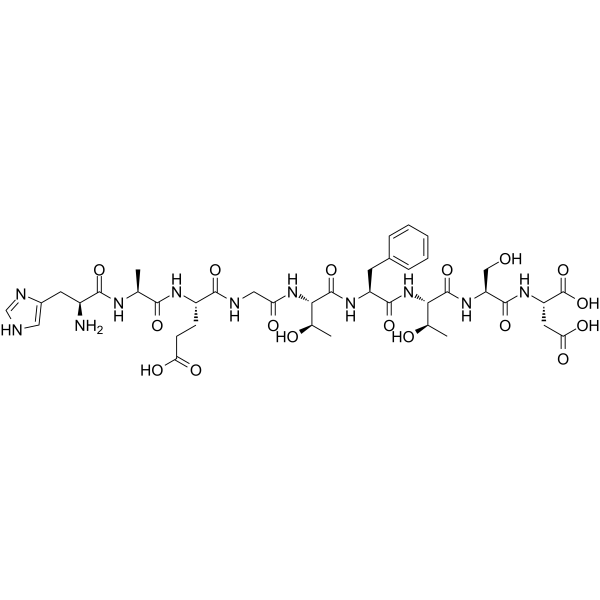
HAEGTFTSD
CAS No. 926018-45-3
HAEGTFTSD( —— )
Catalog No. M30151 CAS No. 926018-45-3
HAEGTFTSD is the first N-terminal 1-9 residues of GLP-1 peptide.The GLP-1 (7-36) amide is a product of the preproglucagon gene, which is secreted from intestinal L-cells, in response to the ingestion of food.
Purity : >98% (HPLC)
 COA
Datasheet
HNMR
HPLC
MSDS
Handing Instructions
COA
Datasheet
HNMR
HPLC
MSDS
Handing Instructions
| Size | Price / USD | Stock | Quantity |
| 5MG | 374 | Get Quote |


|
| 10MG | 598 | Get Quote |
|
| 100MG | Get Quote | Get Quote |
|
| 200MG | Get Quote | Get Quote |
|
| 500MG | Get Quote | Get Quote |
|
Biological Information
-
Product NameHAEGTFTSD
-
NoteResearch use only, not for human use.
-
Brief DescriptionHAEGTFTSD is the first N-terminal 1-9 residues of GLP-1 peptide.The GLP-1 (7-36) amide is a product of the preproglucagon gene, which is secreted from intestinal L-cells, in response to the ingestion of food.
-
DescriptionHAEGTFTSD is the first N-terminal 1-9 residues of GLP-1 peptide.The GLP-1 (7-36) amide is a product of the preproglucagon gene, which is secreted from intestinal L-cells, in response to the ingestion of food.(In Vitro):The GLP-1 (7-36) amide is a product of the preproglucagon gene, which is secreted from intestinal L-cells, in response to the ingestion of food. GLP-1 exerts multiple actions by stimulating insulin secretion from pancreatic β-cells, in a glucose dependent manner (insulinotropic action). GLP-1 lowers circulating plasma glucagon concentration, by inhibiting its secretion (production) from α-cells. GLP-1 also exhibits properties like stimulation of β-cell growth, appetite suppression, delays gastric emptying and stimulation of insulin sensitivity. The peptide analogs of GLP-1 are useful as glucagon-like peptide 1 receptor agonists.
-
In VitroThe GLP-1 (7-36) amide is a product of the preproglucagon gene, which is secreted from intestinal L-cells, in response to the ingestion of food. GLP-1 exerts multiple actions by stimulating insulin secretion from pancreatic β-cells, in a glucose dependent manner (insulinotropic action). GLP-1 lowers circulating plasma glucagon concentration, by inhibiting its secretion (production) from α-cells. GLP-1 also exhibits properties like stimulation of β-cell growth, appetite suppression, delays gastric emptying and stimulation of insulin sensitivity. The peptide analogs of GLP-1 are useful as glucagon-like peptide 1 receptor agonists.
-
In Vivo——
-
Synonyms——
-
PathwayGPCR/G Protein
-
TargetGlucagon Receptor
-
Recptor——
-
Research Area——
-
Indication——
Chemical Information
-
CAS Number926018-45-3
-
Formula Weight963.94
-
Molecular FormulaC40H57N11O17
-
Purity>98% (HPLC)
-
Solubility——
-
SMILES——
-
Chemical NameSequence:His-Ala-Glu-Gly-Thr-Phe-Thr-Ser-Asp
Shipping & Storage Information
-
Storage(-20℃)
-
ShippingWith Ice Pack
-
Stability≥ 2 years
Reference
US20120264685
molnova catalog



related products
-
Glucagon (19-29), hu...
Glucagon is a 29-amino-acid peptide hormone liberated in the alpha cells of the islets of Langerhans. Glucagon-producing alpha cells represent one of the earliest populations of detectable islet cells in the developing endocrine pancreas.
-
GLP-1R Antagonist 1
GLP-1R Antagonist 1 is an orally active, CNS penetrant and non-competitive glucagon-like peptide 1 receptor (GLP-1R) antagonist (IC50: 650 nM).
-
Lotiglipron
Lotiglipron (PF-07081532) is an orally active, potent GLP-1R agonist that reduces blood glucose and body weight, potentially aiding in the study of type 2 diabetes mellitus (T2DM) and obesity.
