


 Cart
Cart
 sales@molnova.com



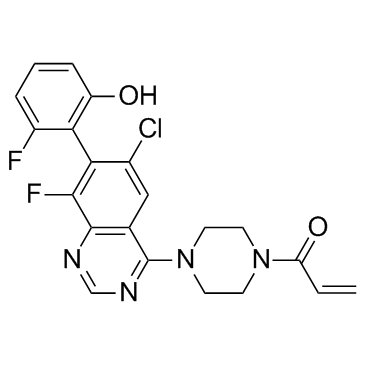
ARS-1323
CAS No. 1698024-73-5
ARS-1323( ARS1323 )
Catalog No. M12590 CAS No. 1698024-73-5
ARS1323 is a racemic mixture of ARS-1620/R-atropisomer, ARS-1620 is a potent, specific and covalent KRAS G12C inhibitor.
Purity : >98% (HPLC)
 COA
Datasheet
HNMR
HPLC
MSDS
Handing Instructions
COA
Datasheet
HNMR
HPLC
MSDS
Handing Instructions
| Size | Price / USD | Stock | Quantity |
| 5MG | 115 | Get Quote |


|
| 10MG | 192 | Get Quote |
|
| 25MG | 295 | Get Quote |
|
| 50MG | 385 | Get Quote |
|
| 100MG | 561 | Get Quote |
|
| 500MG | 1152 | Get Quote |
|
| 1G | Get Quote | Get Quote |
|
Biological Information
-
Product NameARS-1323
-
NoteResearch use only, not for human use.
-
Brief DescriptionARS1323 is a racemic mixture of ARS-1620/R-atropisomer, ARS-1620 is a potent, specific and covalent KRAS G12C inhibitor.
-
DescriptionARS1323 is a racemic mixture of ARS-1620/R-atropisomer, ARS-1620 is a potent, specific and covalent KRAS G12C inhibitor with >10-fold improved potency over the initial ARS-853.
-
In Vitro——
-
In Vivo——
-
SynonymsARS1323
-
PathwayMAPK/ERK Signaling
-
TargetRas
-
RecptorRas
-
Research AreaCancer
-
Indication——
Chemical Information
-
CAS Number1698024-73-5
-
Formula Weight430.84
-
Molecular FormulaC21H17ClF2N4O2
-
Purity>98% (HPLC)
-
SolubilityDMSO : ≥ 125 mg/mL 290.13 mM
-
SMILESC=CC(=O)N1CCN(CC1)C2=NC=NC3=C(C(=C(C=C32)Cl)C4=C(C=CC=C4F)O)F
-
Chemical Name1-(4-(6-chloro-8-fluoro-7-(2-fluoro-6-hydroxyphenyl)quinazolin-4-yl)piperazin-1-yl)prop-2-en-1-one
Shipping & Storage Information
-
Storage(-20℃)
-
ShippingWith Ice Pack
-
Stability≥ 2 years
Reference
1. Janes MR, et al. Cell. 2018 Jan 25;172(3):578-589.e17.
molnova catalog



related products
-
K-Ras G12C-IN-4
K-Ras G12C-IN-4 is a potent co-valent Inhibitor of KRAS G12C.
-
6H05 trifluoroacetat...
6H05 is a selective, allosteric inhibitor of oncogenic mutant K-Ras(G12C)。
-
KRAS G12C inhibitor ...
A potent, selective, covalent KRAS G12C inhibitor that selectively inhibit KRAS G12C-dependent signaling and cancer cell growth at sub-micromolar concentrations.
