


 Cart
Cart
 sales@molnova.com



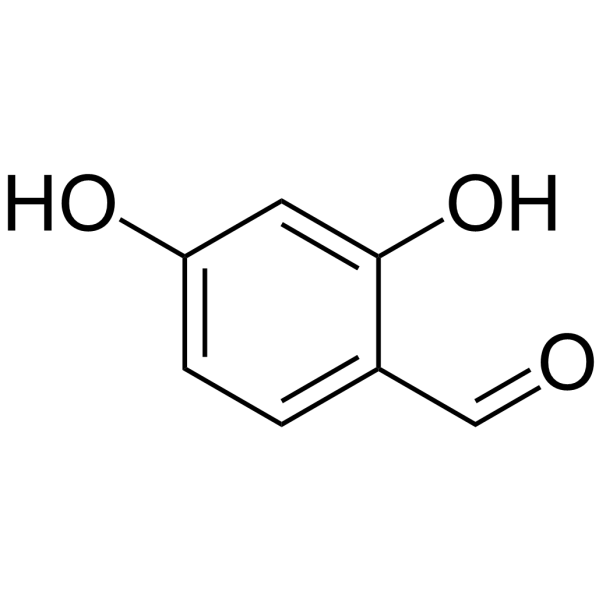
2,4-Dihydroxybenzaldehyde
CAS No. 95-01-2
2,4-Dihydroxybenzaldehyde( beta-Resorcylaldehyde | 4-Hydroxysalicylaldehyde | 4-Formylresorcinol )
Catalog No. M29441 CAS No. 95-01-2
2,4-Dihydroxybenzaldehyde is a resorcinol derivative with potent antioxidant and antibacterial activity. 2,4-Dihydroxybenzaldehyde is an endogenous metabolite.
Purity : >98% (HPLC)
 COA
Datasheet
HNMR
HPLC
MSDS
Handing Instructions
COA
Datasheet
HNMR
HPLC
MSDS
Handing Instructions
| Size | Price / USD | Stock | Quantity |
| 500MG | 35 | In Stock |


|
| 1G | Get Quote | In Stock |
|
Biological Information
-
Product Name2,4-Dihydroxybenzaldehyde
-
NoteResearch use only, not for human use.
-
Brief Description2,4-Dihydroxybenzaldehyde is a resorcinol derivative with potent antioxidant and antibacterial activity. 2,4-Dihydroxybenzaldehyde is an endogenous metabolite.
-
Description2,4-Dihydroxybenzaldehyde is a resorcinol derivative with potent antioxidant and antibacterial activity. 2,4-Dihydroxybenzaldehyde is an endogenous metabolite.
-
In Vitro——
-
In Vivo——
-
Synonymsbeta-Resorcylaldehyde | 4-Hydroxysalicylaldehyde | 4-Formylresorcinol
-
PathwayProteasome/Ubiquitin
-
TargetEndogenous Metabolite
-
RecptorEndogenous Metabolite
-
Research Area——
-
Indication——
Chemical Information
-
CAS Number95-01-2
-
Formula Weight138.122
-
Molecular FormulaC7H6O3
-
Purity>98% (HPLC)
-
SolubilityIn Vitro:?DMSO : 100 mg/mL (724.01 mM)
-
SMILESOc1ccc(C=O)c(O)c1
-
Chemical Name——
Shipping & Storage Information
-
Storage(-20℃)
-
ShippingWith Ice Pack
-
Stability≥ 2 years
Reference
molnova catalog



related products
-
4-Hydroxyphenylpyruv...
4-Hydroxyphenylpyruvic acid is an enzyme inhibitor.4-Hydroxyphenylpyruvic acid (4-HPPA) is a keto acid that is involved in the tyrosine catabolism pathway.
-
Darusentan
Darusentan is a potent inhibitor of endothelin signaling and function in both large and small arteries.
-
Cyclo(his-pro)
Cyclo(his-pro) is an endogenous cyclic dipeptide that exerts oxidative damage protection by selectively activating the transcription factor Nrf2 signalling pathway.?
