


 Cart
Cart
 sales@molnova.com



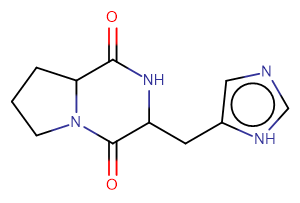
Cyclo(his-pro)
CAS No. 53109-32-3
Cyclo(his-pro)( —— )
Catalog No. M21020 CAS No. 53109-32-3
Cyclo(his-pro) is an endogenous cyclic dipeptide that exerts oxidative damage protection by selectively activating the transcription factor Nrf2 signalling pathway.
Purity : >98% (HPLC)
 COA
Datasheet
HNMR
HPLC
MSDS
Handing Instructions
COA
Datasheet
HNMR
HPLC
MSDS
Handing Instructions
| Size | Price / USD | Stock | Quantity |
| 5MG | 68 | In Stock |


|
| 10MG | 116 | In Stock |
|
| 25MG | 227 | In Stock |
|
| 50MG | 410 | In Stock |
|
| 100MG | 604 | In Stock |
|
| 200MG | Get Quote | In Stock |
|
| 500MG | Get Quote | In Stock |
|
| 1G | Get Quote | In Stock |
|
Biological Information
-
Product NameCyclo(his-pro)
-
NoteResearch use only, not for human use.
-
Brief DescriptionCyclo(his-pro) is an endogenous cyclic dipeptide that exerts oxidative damage protection by selectively activating the transcription factor Nrf2 signalling pathway.
-
DescriptionCyclo(his-pro) is an endogenous cyclic dipeptide that exerts oxidative damage protection by selectively activating the transcription factor Nrf2 signalling pathway.
-
In Vitrocyclo(his-pro) (Cyclo(histidyl-proline); 50 μM; 1-48 hours) increases the nuclear level of Nrf2 and inhibits NF-κB nuclear translocation. Cyclo(His-Pro) alone has no effect on nuclear translocation of these transcription factors. cyclo(his-pro) (50 μM; prior to PQ exposure for 48 hours) abolishes protein nitration that followed paraquat (PQ) exposure and lessenes its functional consequences, as shown by decrease in cell apoptosis, detected by caspase 3 activity and by cytochrome c release. Cyclo(his-pro) inhibits NF-κB nuclear accumulation induced by paraquat in rat pheochromocytoma PC12 cells via the Nrf2/heme oxygenase-1 pathway. Western Blot AnalysisCell Line:PC12 cells Concentration:50 μM Incubation Time:1, 2, 4, 8, 24, 48 hours Result:Increased the nuclear level of Nrf2 and inhibited NF-κB nuclear translocation.
-
In VivoCyclo(his-pro) (Cyclo(histidyl-proline); 1.8 mg/ear; topical application on the right ear; 30 min prior to TPA) reduces TPA-induced ear oedema confirming that it can exert anti-inflammatory effect. Cyclo(his-pro) exerts in vivo anti-inflammatory effects in the central nervous system by down-regulating hepatic and cerebral TNFα expression thereby counteracting LPS-induced gliosis. Moreover, by up-regulating Bip, Cyclo(his-pro) increases the ER stress sensitivity andtriggers the unfolded protein response to alleviate the ER stress. Animal Model:Sixty two/three month-old male C57BL/6 mice (25-30 g)Dosage:1.8 mg/ear Administration:Topical application on the right ear; 30 min prior to TPA Result:Reduced TPA-induced ear oedema.
-
Synonyms——
-
PathwayProteasome/Ubiquitin
-
TargetEndogenous Metabolite
-
RecptorHuman Endogenous Metabolite |NF-κB
-
Research Area——
-
Indication——
Chemical Information
-
CAS Number53109-32-3
-
Formula Weight234.25
-
Molecular FormulaC11H14N4O2
-
Purity>98% (HPLC)
-
SolubilityH2O:30 mg/mL (128.07 mM)
-
SMILESO=C1NC(Cc2cnc[nH]2)C(=O)N2CCCC12
-
Chemical Name(3S8aS)-3-((1H-imidazol-4-yl)methyl)hexahydropyrrolo[12-a]pyrazine-14-dione
Shipping & Storage Information
-
Storage(-20℃)
-
ShippingWith Ice Pack
-
Stability≥ 2 years
Reference
1.Minelli A Grottelli S Mierla A et al. Cyclo(His-Pro) exerts anti-inflammatory effects by modulating NF-κB and Nrf2 signalling[J]. International Journal of Biochemistry & Cell Biology 2012 44(3):0-535.
molnova catalog



related products
-
2-hydroxymethyl benz...
2-hydroxymethyl benzoic acid is a principal metabolite of the phthalidyl moiety in man.
-
Guanosine 5'-diphosp...
Guanosine 5'-diphosphate as Potential Iron Mobilizer Preventing the Hepcidin-Ferroportin Interaction and Modulating the Interleukin-6/Stat-3 Pathway.
-
Octadecanedioic acid
Octadecanedioic acid is an endogenous metabolite, is a long-chain dicarboxylic acid.
