


 Cart
Cart
 sales@molnova.com



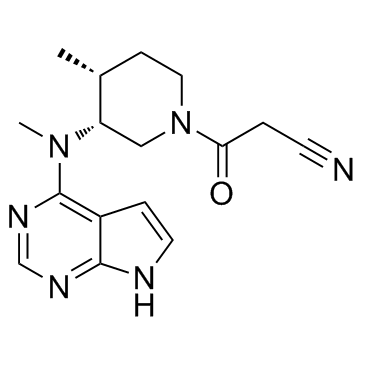
Tofacitinib
CAS No. 477600-75-2
Tofacitinib( CP-690550 )
Catalog No. M14592 CAS No. 477600-75-2
Tofacitinib (CP-690550) is a potent, specific, orally active inhibitor of JAK3 with IC50 of 1 nM in cell-free assays; displays 20- to 100-fold less potency for JAK2 and JAK1 (IC50=20 nM and 112 nM, respectively).
Purity : >98% (HPLC)
 COA
Datasheet
HNMR
HPLC
MSDS
Handing Instructions
COA
Datasheet
HNMR
HPLC
MSDS
Handing Instructions
| Size | Price / USD | Stock | Quantity |
| 5MG | 27 | In Stock |


|
| 10MG | 42 | In Stock |
|
| 25MG | 53 | In Stock |
|
| 50MG | 69 | In Stock |
|
| 100MG | 88 | In Stock |
|
| 200MG | 132 | In Stock |
|
| 500MG | 248 | In Stock |
|
| 1G | Get Quote | In Stock |
|
Biological Information
-
Product NameTofacitinib
-
NoteResearch use only, not for human use.
-
Brief DescriptionTofacitinib (CP-690550) is a potent, specific, orally active inhibitor of JAK3 with IC50 of 1 nM in cell-free assays; displays 20- to 100-fold less potency for JAK2 and JAK1 (IC50=20 nM and 112 nM, respectively).
-
DescriptionTofacitinib (CP-690550) is a potent, specific, orally active inhibitor of JAK3 with IC50 of 1 nM in cell-free assays; displays 20- to 100-fold less potency for JAK2 and JAK1 (IC50=20 nM and 112 nM, respectively), and shows no potent activity against 30 other kinases at >3 uM (CaMK1, ROCK2, Lck, MST2, etc.); effectively inhibits a murine mixed lymphocyte reaction (MLR) with IC50 of 91 nM, significantly prolonges survival in a murine model of heart transplantation and in cynomolgus monkeys receiving kidney transplants.Rheumatoid Arthritis Approved(In Vitro):Tofacitinib (CP-690550) citrate binds potentially at JAK3 and JAK2 as 2.2 nM and 5 nM (Kd). The report includes additional binding for Tofacitinib at Camk1 (Kd of 5,000 nM), DCamkL3 (Kd of 4.5 nM), Mst2 (Kd of 4,300 nM), Pkn1 (Kd of 200 nM), Rps6ka2 (Kin.Dom.2-C-terminal) (Kd of 1,400 nM), Rps6ka6 (Kin.Dom.2-C-terminal) (Kd of 1,200 nM), Snark (Kd of 420 nM), Tnk1 (Kd of 640 nM) and Tyk2 (Kd of 620 nM). (In Vivo):Animals that are treated with Tofacitinib show a significantly lower production of anti-drug antibodies (ADAs) compare with PEG-treated control mice (for five weeks after initial immunization, p<0.01, n=8). Moreover ADAs become detectable earliest on day 28. A difference of 1000- to 200-fold in titers to SS1P is apparent from days 21 through 35, respectively. Compare to SS1P, mice injected with keyhole limpet hemocyanin (KLH) generate a more rapid antibody response. Yet, the administration of Tofacitinib reduces anti-KLH titers compare to controls (p<0.05 on day 21, p<0.01 on day 28, respectively, n=5). Reductions in titers ranged from 5000- to 250-fold from days 21 through 28, respectively. Based on previous dose-response studies, a daily dose of Tofacitinib of 6.2 mg/kg is selected to provide 80% inhibition of hind paw volume and plasma exposure capable of suppressing the JAK1 and JAK3 signaling pathways for >4 hours.
-
In VitroTofacitinib (CP-690550) citrate binds potentially at JAK3 and JAK2 as 2.2 nM and 5 nM (Kd). The report includes additional binding for Tofacitinib at Camk1 (Kd of 5,000 nM), DCamkL3 (Kd of 4.5 nM), Mst2 (Kd of 4,300 nM), Pkn1 (Kd of 200 nM), Rps6ka2 (Kin.Dom.2-C-terminal) (Kd of 1,400 nM), Rps6ka6 (Kin.Dom.2-C-terminal) (Kd of 1,200 nM), Snark (Kd of 420 nM), Tnk1 (Kd of 640 nM) and Tyk2 (Kd of 620 nM).
-
In VivoAnimals that are treated with Tofacitinib show a significantly lower production of anti-drug antibodies (ADAs) compare with PEG-treated control mice (for five weeks after initial immunization, p<0.01, n=8). Moreover ADAs become detectable earliest on day 28. A difference of 1000- to 200-fold in titers to SS1P is apparent from days 21 through 35, respectively. Compare to SS1P, mice injected with keyhole limpet hemocyanin (KLH) generate a more rapid antibody response. Yet, the administration of Tofacitinib reduces anti-KLH titers compare to controls (p<0.05 on day 21, p<0.01 on day 28, respectively, n=5). Reductions in titers ranged from 5000- to 250-fold from days 21 through 28, respectively. Based on previous dose-response studies, a daily dose of Tofacitinib of 6.2 mg/kg is selected to provide 80% inhibition of hind paw volume and plasma exposure capable of suppressing the JAK1 and JAK3 signaling pathways for >4 hours.
-
SynonymsCP-690550
-
PathwayAngiogenesis
-
TargetJAK
-
RecptorJAK1|JAK2|JAK3|Lck|ROCK2
-
Research AreaInflammation/Immunology
-
IndicationRheumatoid Arthritis
Chemical Information
-
CAS Number477600-75-2
-
Formula Weight312.37
-
Molecular FormulaC16H20N6O
-
Purity>98% (HPLC)
-
SolubilityDMSO
-
SMILESC[C@@H]1CCN(C[C@@H]1N(C)C2=NC=NC3=C2C=CN3)C(=O)CC#N
-
Chemical Name1-Piperidinepropanenitrile, 4-methyl-3-(methyl-7H-pyrrolo[2,3-d]pyrimidin-4-ylamino)-.beta.-oxo-, (3R,4R)-
Shipping & Storage Information
-
Storage(-20℃)
-
ShippingWith Ice Pack
-
Stability≥ 2 years
Reference
1. Changelian PS, et al. Science. 2003 Oct 31;302(5646):875-8.
2. Jiang JK, et al. J Med Chem. 2008 Dec 25;51(24):8012-8.
3. Kudlacz E, et al. Am J Transplant. 2004 Jan;4(1):51-7.
molnova catalog



related products
-
JAK-IN-21
JAK-IN-21 is a selective and potent JAK inhibitor that inhibits JAK1, JAK2, J2V617F and TYK2 with IC50 values of 1.73, 2.04, 109 and 62.9 nM, respectively.
-
CEP-33779
CEP-33779 is a novel, selective, and orally bioavailable inhibitor of JAK2 with an IC50 of 1.8±0.6 nM.
-
JKA3 inhibitor 31
JKA3 inhibitor 31 is a highly potent, selective, reversible, covalent JAK3 inhibitor with IC50 of 49 nM.
