


 Cart
Cart
 sales@molnova.com



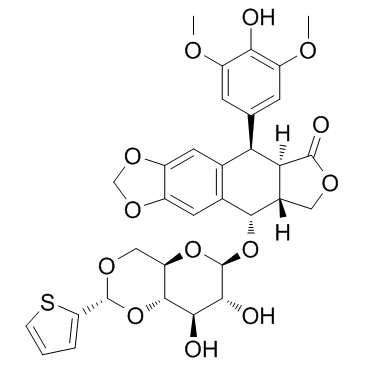
Teniposide
CAS No. 29767-20-2
Teniposide( NSC 122819 | VM-26 )
Catalog No. M13908 CAS No. 29767-20-2
Teniposide(VM-26) is a semisynthetic derivative of podophyllotoxin and are increasingly used in Y medicine.
Purity : >98% (HPLC)
 COA
Datasheet
HNMR
HPLC
MSDS
Handing Instructions
COA
Datasheet
HNMR
HPLC
MSDS
Handing Instructions
| Size | Price / USD | Stock | Quantity |
| 25MG | 49 | In Stock |


|
| 50MG | 81 | In Stock |
|
| 100MG | 131 | In Stock |
|
| 200MG | 211 | In Stock |
|
| 500MG | Get Quote | In Stock |
|
| 1G | Get Quote | In Stock |
|
Biological Information
-
Product NameTeniposide
-
NoteResearch use only, not for human use.
-
Brief DescriptionTeniposide(VM-26) is a semisynthetic derivative of podophyllotoxin and are increasingly used in Y medicine.
-
DescriptionTeniposide(VM-26) is a semisynthetic derivative of podophyllotoxin and are increasingly used in Y medicine; causing breaks in DNA via an interaction with DNA topoisomerase II.(In Vitro):Teniposide is a topoisomerase II inhibitor. Teniposide (VM-26, 0.15-45 mg/L) inhibits the proliferation of Tca8113 cells in a dose-dependent manner, with an IC50 of 0.35 mg/L. Teniposide (5 mg/L) induces apoptosis of Tca8113 cells. Teniposide (5.0 mg/L) causes cell arrested at G2/M phase in Tca8113 cells. Teniposide is active on primary cultured glioma cells from patients, when the level of miR-181b is high in the cells, with an IC50 of 1.3?±?0.34 μg/mL. Cells treated with teniposide with low MDM2 have decreased viability compared with control cells, and the IC50 decreases from 5.86?±?0.36 μg/mL to 2.90?±?0.35 μg/mL upon MDM2 suppression. Teniposide also inhibits the viability of glioma cell with high level of miR-181b, through mediation of MDM2.(In Vivo):Teniposide (0.5 mg/kg, i.p.) significantly increases micronucleated polychromatic erythrocyte (MNPCE) frequencies, which is directly related to bone marrow toxicity as significant suppression of bone marrow is noted. Teniposide (24 mg/kg, i.p.) markedly decreases the frequencies of BrdU-labelled sperm. Teniposide (12, 24 mg/kg, i.p.) also dramatically induces disomic sperm in the germ cell of male mice.
-
In VitroTeniposide is a topoisomerase II inhibitor. Teniposide (VM-26, 0.15-45 mg/L) inhibits the proliferation of Tca8113 cells in a dose-dependent manner, with an IC50 of 0.35 mg/L. Teniposide (5 mg/L) induces apoptosis of Tca8113 cells. Teniposide (5.0 mg/L) causes cell arrested at G2/M phase in Tca8113 cells. Teniposide is active on primary cultured glioma cells from patients, when the level of miR-181b is high in the cells, with an IC50 of 1.3±0.34 μg/mL. Cells treated with teniposide with low MDM2 have decreased viability compared with control cells, and the IC50 decreases from 5.86±0.36 μg/mL to 2.90±0.35 μg/mL upon MDM2 suppression. Teniposide also inhibits the viability of glioma cell with high level of miR-181b, through mediation of MDM2.
-
In VivoTeniposide (0.5 mg/kg, i.p.) significantly increases micronucleated polychromatic erythrocyte (MNPCE) frequencies, which is directly related to bone marrow toxicity as significant suppression of bone marrow is noted. Teniposide (24 mg/kg, i.p.) markedly decreases the frequencies of BrdU-labelled sperm. Teniposide (12, 24 mg/kg, i.p.) also dramatically induces disomic sperm in the germ cell of male mice.
-
SynonymsNSC 122819 | VM-26
-
PathwayCell Cycle/DNA Damage
-
TargetTopoisomerase
-
RecptorTopo II
-
Research AreaCancer
-
Indication——
Chemical Information
-
CAS Number29767-20-2
-
Formula Weight656.66
-
Molecular FormulaC32H32O13S
-
Purity>98% (HPLC)
-
SolubilityDMSO: 40 mg/mL (60.91 mM)
-
SMILESO=C1OC[C@]2([H])[C@H](O[C@H]3[C@H](O)[C@@H](O)[C@]4([H])O[C@H](C5=CC=CS5)OC[C@@]4([H])O3)C6=C(C=C7OCOC7=C6)[C@H](C8=CC(OC)=C(O)C(OC)=C8)[C@]21[H]
-
Chemical Name(5S,5aR,8aR,9S)-9-(((2R,4aR,6R,7R,8R,8aS)-7,8-dihydroxy-2-(thiophen-2-yl)hexahydropyrano[3,2-d][1,3]dioxin-6-yl)oxy)-5-(4-hydroxy-3,5-dimethoxyphenyl)-5,5a,8a,9-tetrahydrofuro[3',4':6,7]naphtho[2,3-d][1,3]dioxol-6(8H)-one
Shipping & Storage Information
-
Storage(-20℃)
-
ShippingWith Ice Pack
-
Stability≥ 2 years
Reference
1.de Lucio B, et al. Y Sci. 2005 Nov;96(11):774-83.
molnova catalog



related products
-
Simmitecan hydrochlo...
Simmitecan hydrochloride is a camptothecin derivative, a topoisomerase I inhibitor with anticancer activity, which can be used to study is solid tumors.
-
Chloroquinoxaline su...
Chloroquinoxaline sulfonamide (Chloroquinoxaline) is a topoisomerase II alpha/beta toxin with antitumor activity and immunosuppressive properties that inhibits the proliferation of B16 melanoma cells in mice, and can be used to study metastatic colorectal cancer.
-
7-Epitaxol
7-Epitaxol is the major derivative of taxol found in cells and that its presence does not alter, in a major way, the overall biological activity of taxol.
