


 Cart
Cart
 sales@molnova.com



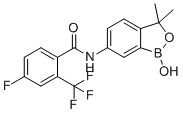
SCYX-7158
CAS No. 1266084-51-8
SCYX-7158( AN-5568 | SCYX 7158 | AN 5568 | Acoziborole )
Catalog No. M11117 CAS No. 1266084-51-8
SCYX-7158 (AN-5568, Acoziborole) is an orally-active, CNS permeable benzoxaborole antiprotozoal agent.
Purity : >98% (HPLC)
 COA
Datasheet
HNMR
HPLC
MSDS
Handing Instructions
COA
Datasheet
HNMR
HPLC
MSDS
Handing Instructions
| Size | Price / USD | Stock | Quantity |
| 5MG | 260 | Get Quote |


|
| 50MG | 1188 | Get Quote |
|
| 100MG | 1791 | Get Quote |
|
| 200MG | Get Quote | Get Quote |
|
| 500MG | Get Quote | Get Quote |
|
| 1G | Get Quote | Get Quote |
|
Biological Information
-
Product NameSCYX-7158
-
NoteResearch use only, not for human use.
-
Brief DescriptionSCYX-7158 (AN-5568, Acoziborole) is an orally-active, CNS permeable benzoxaborole antiprotozoal agent.
-
DescriptionSCYX-7158 (AN-5568, Acoziborole) is an orally-active, CNS permeable benzoxaborole antiprotozoal agent; is active in vitro against relevant strains of Trypanosoma brucei, including T. b. rhodesiense and T. b. gambiense; is efficacious in both stage 1 and stage 2 murine HAT models and has good physicochemical and ADMET properties for the treatment of stage 2 human African trypanosomiasis.Parasite Infection Phase 3 Clinical.
-
In VitroAcoziborole is active in vitro against relevant strains of Trypanosoma brucei, including T. b. rhodesiense and T. b. gambiense.In whole cell assays, Acoziborole exhibits potent activity against representative T. b. brucei, T. b. rhodesiense and T. b. gambiense strains. IC50 values for Acoziborole are approximately 0.07 μg/mL to 0.37 μg/mL following incubation of the parasite strains with Acoziborole for 72 h. In the T. b. brucei S427 strain, the MIC value for Acoziborole is 0.6 μg/mL, approximately two times the IC50 measured for this strain. In contrast to the potent activity of Acoziborole against trypanosomes, no significant inhibition of cell proliferation is observed in an in vitro mammalian cell (L929 mouse cell line) assay at drug concentrations up to 50 μg/mL. The potential for Acoziborole to inhibit cytochrome P450 (CYP) enzymes is evaluated using P450-Glo assays for the human isoforms CYP3A4, CYP1A2, CYP2C19, CYP2C9 and CYP2D6. The IC50 values for Acoziborole in these assays are all above 10 μM.
-
In VivoIn uninfected mice, 4.3 mg/kg intravenous dose of Acoziborole show an apparent elimination half-life (t1/2) of 26.6 h; systemic clearance (CL) of 0.089 L/h/kg; a volume of distribution (Vdss) of 1.69 L/kg and area under the concentration-time curve (AUC0-24 h) of 48 h?μg/mL. Following an oral dose of 13.4 mg/kg, which corresponds to the lowest efficacious dose in the murine stage 2 HAT model, Acoziborole is rapidly absorbed, as a Cmax of 6.96 μg/mL is achieved in plasma at 6 h after dose, with an oral clearance (Cl/F) value of 0.163 L/h/kg, an AUC0-24 h of 82 h?μg/mL and absolute oral bioavailability of 55%. After a 26 mg/kg oral dose, which corresponds to the dose giving a 100% cure rate in the murine stage 2 HAT model, Cmax increases to 9.8 μg/mL and the AUC0-24 h is 113 h?μg/mL. In uninfected rats, following oral administration of Acoziborole at a nominal dose of 25 mg/kg (dose affording a 100% cure rate in mice), Cmax increases approximately 2 fold more than that in mice (Cmax=18.2 μg/mL) and AUC0-24 h, and hence oral clearance, improves approximately 4 fold (AUC0-24 h 291 h?μg/mL and CL/F=0.092 L/kg/h). The time to maximum concentration is similar to that in mice (tmax=8 h). Uninfected male and female cynomolgus monkeys are treated with Acoziborole at 2 mg/kg (IV) on study day 1 and 10 mg/kg (NG) on study day 8. Acoziborole exhibits excellent plasma pharmacokinetics, with CL of 0.022 L/h/kg; Vdss of 0.656 L/kg and area under the concentration-time curve 78.8 h?μg/mL, and 94.4 for AUC0-24 h and AUC0-inf, respectively, following intravenous administration.
-
SynonymsAN-5568 | SCYX 7158 | AN 5568 | Acoziborole
-
PathwayMicrobiology/Virology
-
TargetParasite
-
RecptorParasite
-
Research AreaInfection
-
IndicationParasite Infection
Chemical Information
-
CAS Number1266084-51-8
-
Formula Weight367.102
-
Molecular FormulaC17H14BF4NO3
-
Purity>98% (HPLC)
-
SolubilityDMSO : ≥ 125 mg/mL 340.51 mM
-
SMILESFC1=CC(C(F)(F)F)=C(C(NC2=CC=C(C(C)(C)OB3O)C3=C2)=O)C=C1
-
Chemical Name4-fluoro-N-(1-hydroxy-3,3-dimethyl-1,3-dihydrobenzo[c][1,2]oxaborol-6-yl)-2-(trifluoromethyl)benzamide
Shipping & Storage Information
-
Storage(-20℃)
-
ShippingWith Ice Pack
-
Stability≥ 2 years
Reference
1. Jacobs RT, et al. PLoS Negl Trop Dis. 2011 Jun;5(6):e1151.
2. Jacobs RT, et al. Future Med Chem. 2011 Aug;3(10):1259-78.
3. Wring S, et al. Parasitology. 2014 Jan;141(1):104-18.
molnova catalog



related products
-
Ponazuril
Toltrazuril sulfone is an antiprotozoal agent that acts upon Coccidia parasites.
-
CRK12-IN-2
CRK12-IN-2 is a potent inhibitor of CRK12.CRK12-IN-2 inhibits the parasite, with EC50 values of 3.2 and 0.08 nM for Trypanosoma congolense and Trypanosoma vivax, respectively.
-
CpCDPK1/TgCDPK1-IN-2
CpCDPK1/TgCDPK1-IN-2 is a dual inhibitor of CpCDPK1 and TgCDPK1 with IC50 values of 12 and 5 nM for CpCDPK1 and TgCDPK1, respectively.
