


 Cart
Cart
 sales@molnova.com



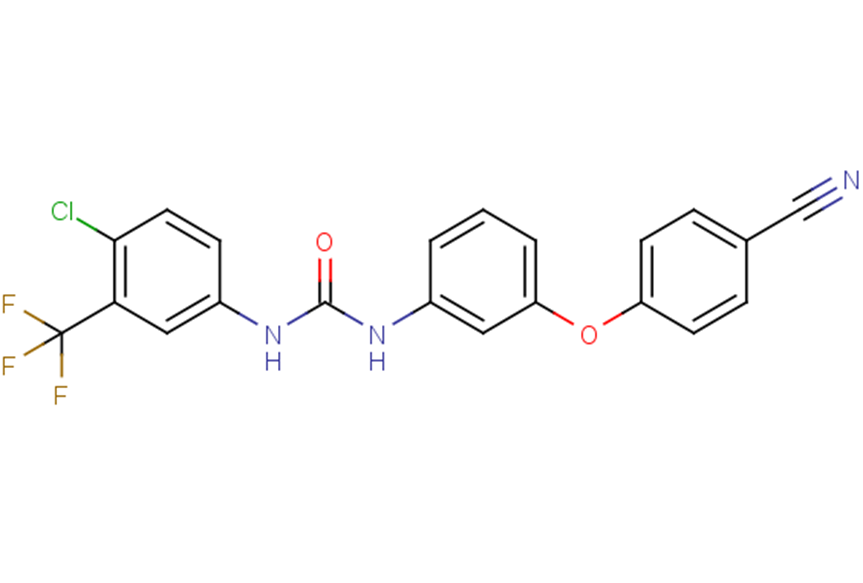
SC-43
CAS No. 1400989-25-4
SC-43( —— )
Catalog No. M22110 CAS No. 1400989-25-4
SC-43 is a potent and orally active agonist of SHP-1 (PTPN6). SC-43 inhibits the phosphorylation of STAT3 and induces cell apoptosis, and with anti-fibrotic and anticancer effects.SC-43, a sorafenib derivative.
Purity : >98% (HPLC)
 COA
Datasheet
HNMR
HPLC
MSDS
Handing Instructions
COA
Datasheet
HNMR
HPLC
MSDS
Handing Instructions
| Size | Price / USD | Stock | Quantity |
| 5MG | 177 | In Stock |


|
| 10MG | 260 | In Stock |
|
| 25MG | 483 | In Stock |
|
| 50MG | 691 | In Stock |
|
| 100MG | 888 | In Stock |
|
| 200MG | Get Quote | In Stock |
|
| 500MG | Get Quote | In Stock |
|
| 1G | Get Quote | In Stock |
|
Biological Information
-
Product NameSC-43
-
NoteResearch use only, not for human use.
-
Brief DescriptionSC-43 is a potent and orally active agonist of SHP-1 (PTPN6). SC-43 inhibits the phosphorylation of STAT3 and induces cell apoptosis, and with anti-fibrotic and anticancer effects.SC-43, a sorafenib derivative.
-
DescriptionSC-43 is a potent and orally active agonist of SHP-1 (PTPN6). SC-43 inhibits the phosphorylation of STAT3 and induces cell apoptosis, and with anti-fibrotic and anticancer effects.SC-43, a sorafenib derivative.SC-43-induced apoptosis in cholangiocarcinoma (CCA) via a novel mechanism.?Three CCA cell lines (HuCCT-1, KKU-100 and CGCCA) were treated with SC-43 to determine their sensitivity to SC-43-induced cell death and apoptosis.?SC-43 activated SH2 domain-containing phosphatase 1 (SHP-1) activity, leading to p-STAT3 and downstream cyclin B1 and Cdc2 downregulation, which induced G2-M arrest and apoptotic cell death.?Importantly, SC-43 augmented SHP-1 activity by direct binding to N-SH2 and relief of its autoinhibition.?Deletion of the N-SH2 domain (dN1) or point mutation (D61A) of SHP-1 counteracted the effect of SC-43-induced SHP-1 phosphatase activation and antiproliferation ability in CCA cells.?In vivo assay revealed that SC-43 exhibited xenograft tumor growth inhibition, p-STAT3 reduction and SHP-1 activity elevation.
-
In VitroCell Viability Assay Cell Line:HuCCT-1, KKU-100, and CGCCA cells Concentration:0 μM, 0.25 μM, 0.5 μM, 0.75 μM, 1 μM, 2.5 μM, 5 μM, 10 μM Incubation Time:24 hours, 48 hours, 72 hours Result:Revealed the anti-proliferative effects in CCA cell lines in a dose-dependent manner after treating 24, 48 and 72 hours respectively.Cell Cycle Analysis Cell Line:HuCCT-1, KKU-100, and CGCCA cells Concentration:0 μM, 1 μM, 2.5 μM, 5 μM, 10 μM Incubation Time:24 hours Result:Showed increased sub-G1 cells and G2-M arrest.Western Blot Analysis Cell Line:HuCCT-1, KKU-100, and CGCCA cells Concentration:0 μM, 1 μM, 2.5 μM, 5 μM, 10 μM Incubation Time:24 hours Result:Demonstrated significant increase in cleaved caspase-3 and PARP level.
-
In VivoAnimal Model:Male NCr athymic nude mice (5-7 weeks of age) injected with HuCCT-1 cells Dosage:10 mg/kg or 30 mg/kg Administration:Oral gavage; daily; for 23 days Result:Exhibited xenograft tumor growth inhibition, p-STAT3 reduction and SHP-1 activity elevation.
-
Synonyms——
-
PathwayMetabolic Enzyme/Protease
-
TargetPhosphatase
-
RecptorSHP-1|STAT3|apoptosis
-
Research Area——
-
Indication——
Chemical Information
-
CAS Number1400989-25-4
-
Formula Weight431.8
-
Molecular FormulaC21H13ClF3N3O2?
-
Purity>98% (HPLC)
-
SolubilityIn Vitro:?DMSO : 250 mg/mL (578.97 mM)
-
SMILESFC(F)(F)c1cc(NC(=O)Nc2cccc(Oc3ccc(cc3)C#N)c2)ccc1Cl
-
Chemical Name——
Shipping & Storage Information
-
Storage(-20℃)
-
ShippingWith Ice Pack
-
Stability≥ 2 years
Reference
1.Ming-Hung Hu, et al. Targeting SHP-1-STAT3 signaling: A promising therapeutic approach for the treatment of cholangiocarcinoma. Oncotarget. 2017 May 10;8(39):65077-65089.
molnova catalog



related products
-
CDP-Star
CDP-Star is a luminescent substrate for 1,2-dioxetane and a substrate for alkaline phosphatase.CDP-Star can be used for in vivo imaging by detecting mRNA on Northern blot.
-
MLS000544460
MLS000544460 is a highly selective and reversible Eya2 phosphatase inhibitor (Kd: 2.0 μM, IC50: 4 μM) that exhibits inhibitory effects on Eya2 phosphatase-mediated cell migration and has anticancer activity.
-
Calyculin A
Calyculin A ((-)-Calyculin A), a toxicant in the Japanese marine sponge CDiscodermia calyxC, is a selective and potent inhibitor of protein phosphatase 1 (PP1) and protein phosphatase 2A (PP2A).
