


 Cart
Cart
 sales@molnova.com



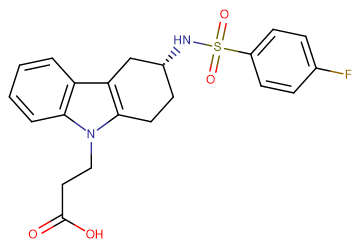
Ramatroban
CAS No. 116649-85-5
Ramatroban( Ramatroban )
Catalog No. M10569 CAS No. 116649-85-5
Ramatroban (BAY u3405) is a thromboxane A(2) (TxA(2)) antagonist marketed for allergic rhinitis.
Purity : >98% (HPLC)
 COA
Datasheet
HNMR
HPLC
MSDS
Handing Instructions
COA
Datasheet
HNMR
HPLC
MSDS
Handing Instructions
| Size | Price / USD | Stock | Quantity |
| 5MG | 29 | Get Quote |


|
| 10MG | 47 | Get Quote |
|
| 25MG | 86 | Get Quote |
|
| 50MG | 156 | Get Quote |
|
| 100MG | 259 | Get Quote |
|
| 200MG | 336 | Get Quote |
|
| 500MG | 566 | Get Quote |
|
| 1G | Get Quote | Get Quote |
|
Biological Information
-
Product NameRamatroban
-
NoteResearch use only, not for human use.
-
Brief DescriptionRamatroban (BAY u3405) is a thromboxane A(2) (TxA(2)) antagonist marketed for allergic rhinitis.
-
DescriptionRamatroban (BAY u3405) is a thromboxane A(2) (TxA(2)) antagonist marketed for allergic rhinitis.(In Vitro):Ramatroban is a potent human thromboxane receptor (hTP) antagonist with an IC50 of 18 nM in a human TP binding assay. Ramatroban inhibits prostaglandin D2 receptor DP2 (CRTH2) with an IC50 of 113 nM in a human DP2 binding assay. Ramatroban also inhibits human CYP isoform CYP2C9 with an IC50 of 15 μM. Ramatroban is a selective thromboxane-type prostanoid (TP) receptor antagonist. PGD2-stimulated human eosinophil migration is shown to be mediated exclusively through activation of CRTH2, and surprisingly, these effects are completely inhibited by Ramatroban. Ramatroban is an antagonist for CRTH2, and inhibits PGD2-induced migration of eosinophils via CRTH2 blockade. 3H-labeled PGD2 binds to a single site on CRTH2 transfectants with high affinity (KD=6.3 nM, Bmax=450 pM). Nonlabeled PGD2 inhibits the binding of 3H-labeled PGD2 to CRTH2 transfectants in a concentration-dependent manner with an EC50 value of 2.7 nM. Ramatroban shows significant inhibitory effects on the binding of 3H-labeled PGD2 to CRTH2, albeit with much lower potency (IC50=100 nM). Ramatroban also inhibits PGD2-induced Ca2+ mobilization in CRTH2 transfectants to almost the same extent with an IC50 value of 30 nM. Ramatroban completely inhibits the PGD2-induced migration of eosinophils in a concentration-dependent manner with an IC50 value of 170 nM.(In Vivo):Ramatroban is an orally bioavailable small molecule antagonist of CRTH2. Systemic administration of Ramatroban (30 mg/kg) in CRTH2+/+ mice produces the same effects as seen in CRTH2 deficiency. Ramatroban completely blocks LPS-induced decreases in social and object exploratory behavior (p<0.01). In addition, tumor-impaired social interaction and object exploratory behavior in CRTH2+/+ mice are completely reversed by a single injection of Ramatroban, even when the tumor is enlarged.
-
In VitroRamatroban is a potent human thromboxane receptor (hTP) antagonist with an IC50 of 18 nM in a human TP binding assay. Ramatroban inhibits prostaglandin D2 receptor DP2 (CRTH2) with an IC50 of 113 nM in a human DP2 binding assay. Ramatroban also inhibits human CYP isoform CYP2C9 with an IC50 of 15 μM. Ramatroban is a selective thromboxane-type prostanoid (TP) receptor antagonist.PGD2-stimulated human eosinophil migration is shown to be mediated exclusively through activation of CRTH2, and surprisingly, these effects are completely inhibited by Ramatroban. Ramatroban is an antagonist for CRTH2, and inhibits PGD2-induced migration of eosinophils via CRTH2 blockade. 3H-labeled PGD2 binds to a single site on CRTH2 transfectants with high affinity (KD=6.3 nM, Bmax=450 pM). Nonlabeled PGD2 inhibits the binding of 3H-labeled PGD2 to CRTH2 transfectants in a concentration-dependent manner with an EC50 value of 2.7 nM. Ramatroban shows significant inhibitory effects on the binding of 3H-labeled PGD2 to CRTH2, albeit with much lower potency (IC50=100 nM). Ramatroban also inhibits PGD2-induced Ca2+ mobilization in CRTH2 transfectants to almost the same extent with an IC50 value of 30 nM. Ramatroban completely inhibits the PGD2-induced migration of eosinophils in a concentration-dependent manner with an IC50 value of 170 nM.
-
In VivoRamatroban is an orally bioavailable small molecule antagonist of CRTH2. Systemic administration of Ramatroban (30 mg/kg) in CRTH2+/+ mice produces the same effects as seen in CRTH2 deficiency. Ramatroban completely blocks LPS-induced decreases in social and object exploratory behavior (p<0.01). In addition, tumor-impaired social interaction and object exploratory behavior in CRTH2+/+ mice are completely reversed by a single injection of Ramatroban, even when the tumor is enlarged.
-
SynonymsRamatroban
-
PathwayCell Cycle/DNA Damage
-
TargetGPR
-
RecptorCRTh2| TXA2R
-
Research AreaInflammation/Immunology
-
Indication——
Chemical Information
-
CAS Number116649-85-5
-
Formula Weight416.47
-
Molecular FormulaC21H21FN2O4S
-
Purity>98% (HPLC)
-
SolubilityDMSO, Ethanol: 100 mM
-
SMILESO=C(O)CCN1C2=C(C3=C1C=CC=C3)C[C@H](NS(=O)(C4=CC=C(F)C=C4)=O)CC2
-
Chemical Name(+)-(3R)-3-(p-Fluorobenzenesulfonamido)-1,2,3,4-tetrahydrocarbazole-9-propionic acid
Shipping & Storage Information
-
Storage(-20℃)
-
ShippingWith Ice Pack
-
Stability≥ 2 years
Reference
1.Sugimoto H., et al. J Pharmacol Exp Ther, 2003. 305(1): p. 347-52.
molnova catalog



related products
-
Dihydromunduletone
Dihydromunduletone (DHM) is an adhesion G protein-coupled receptor (aGPCR) antagonist that acts as a chemical probe for the inhibition of GPR56 and GPR114/ADGRG5, which have similar tethered agonists.
-
PSN 375963
PSN 375963 hydrochloride is a synthetic agonist of the endogenous ligand for GPR119.
-
G-1
G-1 is a nonsteroidal, high-affinity and selective GPR30 agonist (Ki: 11 nM).
