


 Cart
Cart
 sales@molnova.com



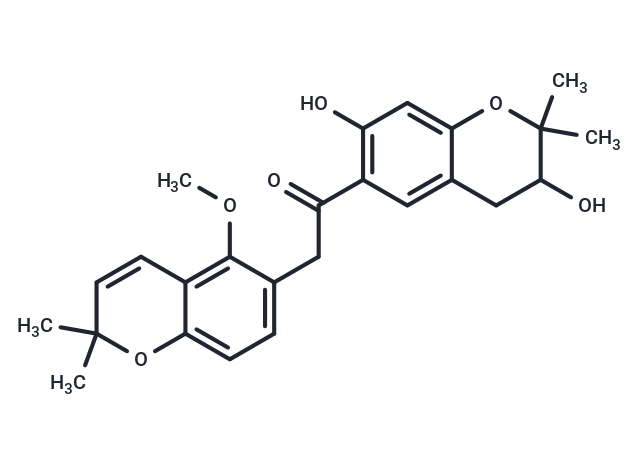
Dihydromunduletone
CAS No. 674786-20-0
Dihydromunduletone( —— )
Catalog No. M32887 CAS No. 674786-20-0
Dihydromunduletone (DHM) is an adhesion G protein-coupled receptor (aGPCR) antagonist that acts as a chemical probe for the inhibition of GPR56 and GPR114/ADGRG5, which have similar tethered agonists.
Purity : >98% (HPLC)
 COA
Datasheet
HNMR
HPLC
MSDS
Handing Instructions
COA
Datasheet
HNMR
HPLC
MSDS
Handing Instructions
| Size | Price / USD | Stock | Quantity |
| 2MG | 272 | Get Quote |


|
| 500MG | Get Quote | Get Quote |
|
| 1G | Get Quote | Get Quote |
|
Biological Information
-
Product NameDihydromunduletone
-
NoteResearch use only, not for human use.
-
Brief DescriptionDihydromunduletone (DHM) is an adhesion G protein-coupled receptor (aGPCR) antagonist that acts as a chemical probe for the inhibition of GPR56 and GPR114/ADGRG5, which have similar tethered agonists.
-
DescriptionDihydromunduletone (DHM) is a rotenoid derivative and a selective, potent adhesion G protein-coupled receptor (aGPCR) (GPR56 and GPR114/ADGRG5) antagonist with an IC 50 of 20.9 μM for GPR56, but not inhibit GPR110 or class A GPCRs.
-
In VitroAssays are initiated by the addition of [35S]GTPγS, and the rates of aGPCR-stimulated G protein activation ([35S]GTPγS binding to Gα) are measured with or without the influence of added compounds. Dihydromunduletone (DHM) inhibits the kinetics of GPR56 7TM-stimulated G13 GTPγS binding to varying degrees. Dihydromunduletone is the best inhibitory compound and reduced the rate at which GPR56 7TM activated G13 >75% (from 0.18 to 0.04 minute?1).At a concentration of Dihydromunduletone (DHM) that maximally inhibits GPR56 (50 μM), the rate of GPR114 7TM-stimulated Gs activity is also inhibited dramatically. When Dihydromunduletone (50 μM) is applied to the GPR110 7TM, it fails to inhibit GPR110 stimulation of Gq GTPγS binding.Cells transfected with GPR56 A386M 7TM are incubated with increasing concentrations of Dihydromunduletone. P7 peptide agonist is added, and SRE-luciferase activity is measured. Dihydromunduletone inhibits the P7 peptide-induced luciferase activity in a concentration-dependent manner. Cells are also treated with a fixed concentration of 3 μM Dihydromunduletone and then stimulated with an increasing concentration of P7 peptide agonist. Dihydromunduletone treatment blunts P7 peptide activation at each concentration. In conclusion, Dihydromunduletone antagonizes synthetic-peptide agonist and tethered-peptide agonist-mediated aGPCR activation in isolated membranes and HEK293T cell-based assays, but it does not inhibit basal receptor signaling.
-
In Vivo——
-
Synonyms——
-
PathwayCell Cycle/DNA Damage
-
TargetGPR
-
RecptorGPR
-
Research Area——
-
Indication——
Chemical Information
-
CAS Number674786-20-0
-
Formula Weight424.49
-
Molecular FormulaC25H28O6
-
Purity>98% (HPLC)
-
SolubilityIn Vitro:?DMSO : 250 mg/mL (588.94 mM; Ultrasonic )
-
SMILESO(C)C1=C2C(=CC=C1CC(=O)C=3C=C4C(=CC3O)OC(C)(C)C(O)C4)OC(C)(C)C=C2
-
Chemical Name——
Shipping & Storage Information
-
Storage(-20℃)
-
ShippingWith Ice Pack
-
Stability≥ 2 years
Reference
1. Hannah M. Stoveken, et al. Dihydromunduletone Is a Small-Molecule Selective Adhesion G Protein–Coupled Receptor Antagonist. Mol Pharmacol. 2016 Sep; 90(3): 214–224.?
molnova catalog



related products
-
BI-671800
BI-671800 is a highly specific and potent antagonist of chemoattractant receptor-homologous molecule on Th2 cells (DP2/CRTH2).
-
BigLEN (rat)
Potent GPR171 agonist (EC50 = 1.6 nM). ProSAAS-derived peptide. Regulates body weight in mice and promotes the outgrowth of neurites in Neuro2A cells.
-
CVN424
CVN424 is a selective and novel GPR6 Inverse agonist effective in models of Parkinson Disease.
