


 Cart
Cart
 sales@molnova.com



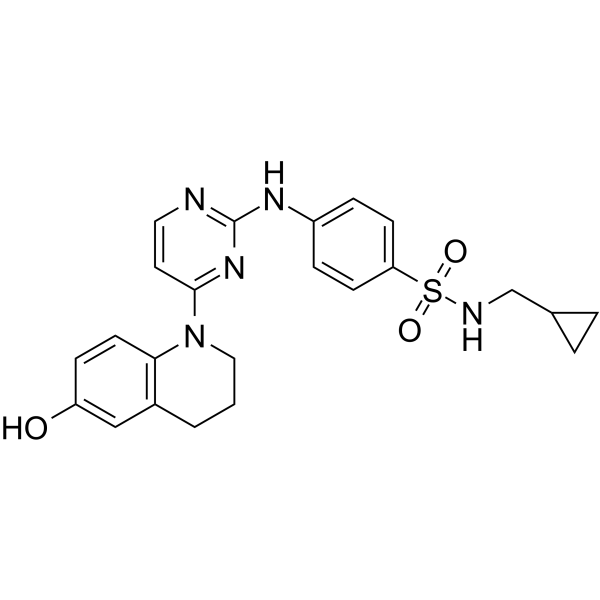
Pyrintegrin
CAS No. 1228445-38-2
Pyrintegrin( —— )
Catalog No. M26801 CAS No. 1228445-38-2
Pyrintegrin is an β1-integrin agonist that promotes embryonic stem cells' survival. Pyrintegrin can be used as a podocyte-protective agent.
Purity : >98% (HPLC)
 COA
Datasheet
HNMR
HPLC
MSDS
Handing Instructions
COA
Datasheet
HNMR
HPLC
MSDS
Handing Instructions
| Size | Price / USD | Stock | Quantity |
| 2MG | 87 | Get Quote |


|
| 5MG | 146 | Get Quote |
|
| 10MG | 214 | Get Quote |
|
| 25MG | 412 | Get Quote |
|
| 50MG | 615 | Get Quote |
|
| 100MG | 876 | Get Quote |
|
| 200MG | Get Quote | Get Quote |
|
| 500MG | Get Quote | Get Quote |
|
| 1G | Get Quote | Get Quote |
|
Biological Information
-
Product NamePyrintegrin
-
NoteResearch use only, not for human use.
-
Brief DescriptionPyrintegrin is an β1-integrin agonist that promotes embryonic stem cells' survival. Pyrintegrin can be used as a podocyte-protective agent.
-
DescriptionPyrintegrin is an β1-integrin agonist that promotes embryonic stem cells' survival. Pyrintegrin can be used as a podocyte-protective agent. Pyrintegrin enhances cell-extracellular matrix adhesion-mediated integrin signaling.(In Vitro):Pyrintegrin decreases Runx2 and Osx via BMP-mediated SMAD1/5 phosphorylation. Pyrintegrin treatment prevents damage-induced decreases in F-actin stress fibers, focal adhesions, and active β1-integrin levels in cultured cells. Pyrintegrin stimulates human adipose stem/progenitor cells (hASCs) to differentiate into lipid-laden adipocytes by upregulating peroxisome proliferator-activated receptor (PPARγ) and CCAAT/enhancer-binding protein-α (C/EBPα), with differentiated cells increasingly secreting adiponectin, leptin, glycerol, and total triglycerides. Pyrintegrin (0-10 μM; 1 hour; hASCs) treatment inhibits BMP4-mediated phosphorylation of BMP responsive SMAD1/5 in a dose-dependent manner (IC50?of?1.14?μM) .(In Vivo):Pyrintegrin induces postnatal adipose tissue formation in vivo of transplanted adipose stem/progenitor cells (ASCs) and recruited endogenous cells. Pyrintegrin decreases peak proteinuria caused by puromycin aminonucleoside-induced nephropathy. Pyrintegrin-treated human adipose stem/progenitor cells (ASCs) in 3D-bioprinted scaffolds, when transplanted in the dorsum of athymic mice, yielded ectopically formed adipose tissue that expressed human PPARγ. Pyrintegrin-adsorbed collagen gel implanted in the inguinal fat pad promoted adipogenesis formed by host endogenous cells, suggesting its ability to induce in situ adipogenesis without the need for cell transplantation. Pyrintegrin (10 mg/kg; intraperitoneal injection; once; C57BL/6J mice) treatment protects mice from LPS-induced podocyte foot process effacement and proteinuria. LPS administration decreases the levels of active β1 integrin in the podocytes, which is prevented by cotreatment with Pyrintegrin .
-
In VitroPyrintegrin (0-10 μM; 1 hour; hASCs) treatment inhibits BMP4-mediated phosphorylation of BMP responsive SMAD1/5 in a dose-dependent manner (IC50?of?1.14μM). In vitro, Pyrintegrin stimulats human adipose stem/progenitor cells (hASCs) to differentiate into lipid-laden adipocytes by upregulating peroxisome proliferator-activated receptor (PPARγ) and CCAAT/enhancer-binding protein-α (C/EBPα), with differentiated cells increasingly secreting adiponectin, leptin, glycerol and total triglycerides. Pyrintegrin attenuates Runx2 and Osx via BMP-mediated SMAD1/5 phosphorylation.Treatment with Pyrintegrin prevents damage-induced decreases in F-actin stress fibers, focal adhesions, and active β1-integrin levels in cultured cells. Western Blot Analysis Cell Line:Human adipose stem/progenitor cells (hASCs)Concentration:0 μM, 0.2 μM, 0.5 μM, 1 μM, 2 μM, 5 μM, 10 μM Incubation Time:1 hour Result:Inhibited BMP4-mediated phosphorylation of BMP responsive SMAD1/5 in a dose-dependent manner.
-
In VivoPyrintegrin (10 mg/kg; intraperitoneal injection; once; C57BL/6J mice) treatment protects mice from LPS-induced podocyte foot process effacement and proteinuria. Analysis of the murine glomeruli shows that LPS administration reduces the levels of active β1 integrin in the podocytes, which is prevented by cotreatment with Pyrintegrin.?In rats, Pyrintegrin reduces peak proteinuria caused by puromycin aminonucleoside-induced nephropathy.Pyrintegrin induces postnatal adipose tissue formation in vivo of transplanted adipose stem/progenitor cells (ASCs) and recruited endogenous cells. In vivo, Pyrintegrin-treated human adipose stem/progenitor cells (ASCs) in 3D-bioprinted scaffolds, when transplanted in the dorsum of athymic mice, yielded ectopically formed adipose tissue that expressed human PPARγ. Remarkably, Pyrintegrin-adsorbed collagen gel implanted in the inguinal fat pad promoted adipogenesis formed by host endogenous cells, suggesting its ability to induce in situ adipogenesis without the need for cell transplantation. Animal Model:Female wild type C57BL/6J mice (10-week-old) injected with LPS Dosage:10 mg/kg Administration:Intraperitoneal injection; once Result:Provided a significant protection for these animals from LPS-induced proteinuria and foot processe (FP) effacement.
-
Synonyms——
-
PathwayCell Cycle/DNA Damage
-
TargetIntegrin
-
RecptorHIF-1α/von Hippel-Lindau
-
Research Area——
-
Indication——
Chemical Information
-
CAS Number1228445-38-2
-
Formula Weight451.55
-
Molecular FormulaC23H25N5O3S
-
Purity>98% (HPLC)
-
SolubilityIn Vitro:?DMSO : 250 mg/mL (553.66 mM)
-
SMILESOc1ccc2N(CCCc2c1)c1ccnc(Nc2ccc(cc2)S(=O)(=O)NCC2CC2)n1
-
Chemical Name——
Shipping & Storage Information
-
Storage(-20℃)
-
ShippingWith Ice Pack
-
Stability≥ 2 years
Reference
1.Xue X, et al. Discovery of novel inhibitors disrupting HIF-1α/von Hippel-Lindau interaction through shape-based screening and cascade docking. PeerJ. 2016 Dec 15;4:e2757.
molnova catalog



related products
-
Zaurategrast
A potent and selective, orally bioavailable α4 integrin (α4β1/VLA-4 and, to a lesser extent, α4β7 integrin) antagonist.
-
Bersanlimab
Bersanlimab (BI-505) is a fully human monoclonal antibody targeting Intercellular Adhesion Molecule-1 (ICAM-1), demonstrating anticancer properties and applicable for studying relapsed/refractory multiple myeloma.
-
Cyclo(RADfK)
Cyclo(RADfK) is a selective α(v)β(3) integrin ligand that has been extensively used for research, therapy, and diagnosis of neoangiogenesis.Cyclo(RADfK) is a negative control for the cyclo (-RGDfK-), the RGD peptide.
