


 Cart
Cart
 sales@molnova.com



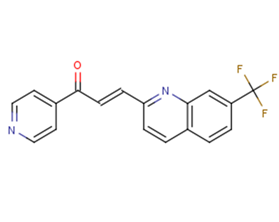
PFK-158
CAS No. 1462249-75-7
PFK-158( PFK158 | PFK 158 | PFK158 | ACTPFK158 )
Catalog No. M17311 CAS No. 1462249-75-7
PFK-158 is an effective and specific inhibitor PFKFB3.
Purity : >98% (HPLC)
 COA
Datasheet
HNMR
HPLC
MSDS
Handing Instructions
COA
Datasheet
HNMR
HPLC
MSDS
Handing Instructions
| Size | Price / USD | Stock | Quantity |
| 2MG | 36 | In Stock |


|
| 5MG | 58 | In Stock |
|
| 10MG | 87 | In Stock |
|
| 25MG | 165 | In Stock |
|
| 50MG | 258 | In Stock |
|
| 100MG | 410 | In Stock |
|
| 200MG | Get Quote | In Stock |
|
| 500MG | Get Quote | In Stock |
|
| 1G | Get Quote | In Stock |
|
Biological Information
-
Product NamePFK-158
-
NoteResearch use only, not for human use.
-
Brief DescriptionPFK-158 is an effective and specific inhibitor PFKFB3.
-
DescriptionPFK-158, also known as ACT-PFK-158, is an inhibitor of 6-phosphofructo-2-kinase/fructose-2,6-bisphosphatases (PFK-2/FBPase) isoform 3 (PFKFB3) with potential antineoplastic activity. Upon administration, PFKFB3 inhibitor PFK-158 binds to and inhibits the activity of PFKFB3, which leads to the inhibition of both the glycolytic pathway in and glucose uptake by cancer cells. This prevents the production of macromolecules and energy that causes the enhanced cellular proliferation in cancer cells as compared to that of normal, healthy cells. Depriving cancer cells of nutrients and energy leads to the inhibition of cancer cell growth.(In Vitro):PFK-158 (10 μM ; 24 hours; OV2008 and C13 cells) combined with Carboplatin (CBPt; 77-453 μM) results in significant increase in apoptosis in C13 (45%) and OV2008 cells (24.6%).PFK-158 (0-10 μM ; 24 hours; C13 and HeyA8MDR cells) treatment results in a dose-dependent decrease in p-PFKFB3, p-cPLA2 and lipid droplet (LD) levels.PFK-158 (10 μM; 24 hours) has synergistic anti-proliferative effects in vitro when combined with Cisplatin in C13 and HeyA8MDR cells compared to OV2008 and HeyA8, respectively.PFK-158 (0‐10 μM; 24 h) treatment shows a dose-dependent downregulation of p62/SQSTM1 and upregulation of LC3BII, two markers of autophagy induction, in both C13 and HeyA8MDR cells. PFK-158 treatment also reduces the numbers of LDs.(In Vivo):PFK-158 (15 mg/kg; intraperitoneal injection; once a week; for 4 weeks; female athymic nude mice) plus CBPt (51 mg/kg) treatment leads to significantly enhanced antitumor activity in a gynecologic cancer mouse model.
-
In VitroPFK-158 (10 μM ; 24 hours; OV2008 and C13 cells) combined with Carboplatin (CBPt; 77-453 μM) results in significant increase in apoptosis in C13 (45%) and OV2008 cells (24.6%).PFK-158 (0-10 μM ; 24 hours; C13 and HeyA8MDR cells) treatment results in a dose-dependent decrease in p-PFKFB3, p-cPLA2 and lipid droplet (LD) levels.PFK-158 (10 μM; 24 hours) has synergistic anti-proliferative effects in vitro when combined with Cisplatin in C13 and HeyA8MDR cells compared to OV2008 and HeyA8, respectively.PFK-158 (0‐10 μM; 24 h) treatment shows a dose-dependent downregulation of p62/SQSTM1 and upregulation of LC3BII, two markers of autophagy induction, in both C13 and HeyA8MDR cells. PFK-158 treatment also reduces the numbers of LDs. Apoptosis Analysis Cell Line: OV2008 and C13 cells Concentration:10 μM Incubation Time:24 hours Result:Combined with Carboplatin (CBPt) treatment resulted in significant increase in apoptosis.Western Blot Analysis Cell Line:C13 and HeyA8MDR cells Concentration:0 μM, 5 μM, 10 μM Incubation Time:24 hours Result:Demonstrated a dose-dependent decrease in p-PFKFB3, p-cPLA2 and lipid droplet (LD) levels.
-
In VivoPFK-158 (15 mg/kg; intraperitoneal injection; once a week; for 4 weeks; female athymic nude mice) plus CBPt (51 mg/kg) treatment leads to significantly enhanced antitumor activity in a gynecologic cancer mouse model. Animal Model:Female athymic nude mice (nu/nu) (5-6 weeks old) injected with HeyA8MDR cells Dosage:15 mg/kg Administration:Intraperitoneal injection; once a week; for 4 weeks Result:A marked reduction of tumor growth was observed in the combination treatment.
-
SynonymsPFK158 | PFK 158 | PFK158 | ACTPFK158
-
PathwayCell Cycle/DNA Damage
-
TargetGPR
-
RecptorPFKFB3
-
Research AreaCancer
-
Indication——
Chemical Information
-
CAS Number1462249-75-7
-
Formula Weight328.29
-
Molecular FormulaC18H11F3N2O
-
Purity>98% (HPLC)
-
SolubilityDMSO : ≥ 30 mg/mL; 91.38 mM
-
SMILESc12c(ccc(n1)C(F)(F)F)ccc(c2)/C=C/C(=O)c1ccncc1
-
Chemical Name(E)-1-(pyridin-4-yl)-3-(7-(trifluoromethyl)quinolin-2-yl)prop-2-en-1-one
Shipping & Storage Information
-
Storage(-20℃)
-
ShippingWith Ice Pack
-
Stability≥ 2 years
Reference
1. Rebecca Redman, et al. Y Res August 1, 2015 75; CT206.
molnova catalog



related products
-
CAY10595
CAY10595 is an antagonist of the CRTh2 (DP2) receptor with a Ki of 10 nM.
-
CRTh2 antagonist 1
CRTh2 antagonist 1 is a CRTh2 antagonist [IC50: 89 nM].
-
CID 2745687
CID 2745687 is a GPR35 antagonist that inhibited the effects at human GPR35 of cromolyn disodium and zaprinast, two agonists that share an overlapping binding site.
