


 Cart
Cart
 sales@molnova.com



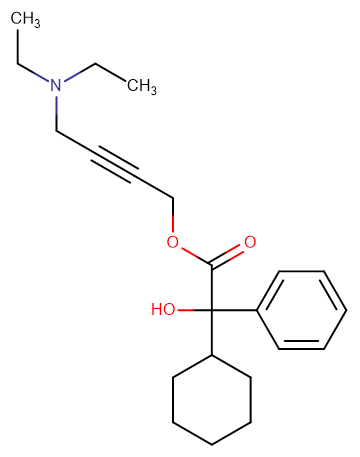
Oxybutynin
CAS No. 5633-20-5
Oxybutynin( —— )
Catalog No. M15049 CAS No. 5633-20-5
Oxybutynin is an anticholinergic medication used to relieve urinary and bladder difficulties.
Purity : >98% (HPLC)
 COA
Datasheet
HNMR
HPLC
MSDS
Handing Instructions
COA
Datasheet
HNMR
HPLC
MSDS
Handing Instructions
| Size | Price / USD | Stock | Quantity |
| 100MG | 42 | In Stock |


|
| 200MG | 58 | In Stock |
|
| 500MG | Get Quote | In Stock |
|
| 1G | Get Quote | In Stock |
|
Biological Information
-
Product NameOxybutynin
-
NoteResearch use only, not for human use.
-
Brief DescriptionOxybutynin is an anticholinergic medication used to relieve urinary and bladder difficulties.
-
DescriptionOxybutynin is an anticholinergic medication used to relieve urinary and bladder difficulties.(In Vitro):Oxybutynin (0.1, 0.3, 1, 3, 10, 30, 100 μM; 200 ms) inhibits vascular Kv channels in a concentration-dependent manner independent of anticholinergic effect in coronary arterial smooth muscle cells.(In Vivo):Oxybutynin (27.2 mg/kg; p.o.; single) exhibits significant binding of mouse brain muscarinic receptors that about a 2-fold increase in Kd?values for specific [3H]N-methylscopolamine binding 0.5 and 2 h later.
-
In VitroOxybutynin (0.1, 0.3, 1, 3, 10, 30, 100 μM; 200 ms) inhibits vascular Kv channels in a concentration-dependent manner independent of anticholinergic effect in coronary arterial smooth muscle cells. Cell Viability Assay Cell Line:Coronary arterial smooth muscle cells (from male New Zealand White rabbits)Concentration:10 μM Incubation Time:200 ms Result:Rapidly inhibited the Kv current within 2 min and reduced the Kv current by 44% at +60 Mv.Inhibited the Kv current by changing the gating properties of Kv channels.Cell Viability Assay Cell Line:Coronary arterial smooth muscle cells (from male New Zealand White rabbits) Concentration:0.1, 0.3, 1, 3, 10, 30, 100 μM Incubation Time:200 ms Result:Reduced the Kv current amplitude in a concentration-dependent manner, with an IC50 value of 11.51 μM.
-
In VivoOxybutynin (27.2 mg/kg; p.o.; single) exhibits significant binding of mouse brain muscarinic receptors that about a 2-fold increase in Kd values for specific [3H]N-methylscopolamine binding 0.5 and 2 h later. Animal Model:Male ddY strain mice (9 to 13-week-old).Dosage:27.2 mg/kg (76.1 μmol/kg) Administration:Oral administration; single.Result:Significant increased Kd values for specific [3H]NMS binding in mouse bladder with values of 54.7% and 40.6% when at 0.5 and 2 hours, respectively.Significant increased Kd values for specific [3H]NMS binding in mouse cerebral cortex with values of 120% and 71.2% when at 0.5 and 2 hours, respectively.
-
Synonyms——
-
PathwayEndocrinology/Hormones
-
TargetAChR
-
RecptormAChR
-
Research AreaNeurological Disease
-
Indication——
Chemical Information
-
CAS Number5633-20-5
-
Formula Weight357.49
-
Molecular FormulaC22H31NO3
-
Purity>98% (HPLC)
-
SolubilityEthanol: 71 mg/mL (198.6 mM); DMSO: 71 mg/mL (198.6 mM)
-
SMILESCCN(CC)CC#CCOC(=O)C(O)(C1CCCCC1)C1=CC=CC=C1
-
Chemical Name——
Shipping & Storage Information
-
Storage(-20℃)
-
ShippingWith Ice Pack
-
Stability≥ 2 years
Reference
1.Ito Y, et al. Eur J Pharmacol. 2009 Aug 1;615(1-3):201-6.
molnova catalog



related products
-
Vinblastine sulfate
Vinblastine sulfate can inhibit the formation of microtubule, it also inhibit nAChR(IC50=8.9 uM).
-
RPI-1
RPI-1 is a competitive, potent ATP-dependent Ret kinase inhibitor.
-
Theobromine
3,7-Dimethylxanthine. The principle alkaloid in Theobroma cacao (the cacao bean) and other plants.
