


 Cart
Cart
 sales@molnova.com



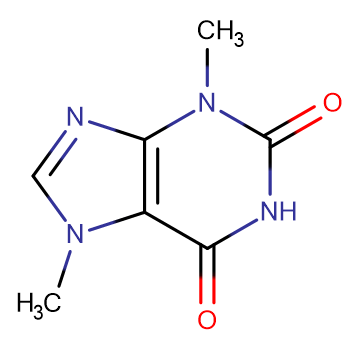
Theobromine
CAS No. 83-67-0
Theobromine( Diurobromine | NSC 5039 | SC-15090 )
Catalog No. M16101 CAS No. 83-67-0
3,7-Dimethylxanthine. The principle alkaloid in Theobroma cacao (the cacao bean) and other plants.
Purity : >98% (HPLC)
 COA
Datasheet
HNMR
HPLC
MSDS
Handing Instructions
COA
Datasheet
HNMR
HPLC
MSDS
Handing Instructions
| Size | Price / USD | Stock | Quantity |
| 100MG | 45 | In Stock |


|
| 200MG | Get Quote | In Stock |
|
| 500MG | Get Quote | In Stock |
|
| 1G | Get Quote | In Stock |
|
Biological Information
-
Product NameTheobromine
-
NoteResearch use only, not for human use.
-
Brief Description3,7-Dimethylxanthine. The principle alkaloid in Theobroma cacao (the cacao bean) and other plants.
-
Description3,7-Dimethylxanthine. The principle alkaloid in Theobroma cacao (the cacao bean) and other plants. A xanthine alkaloid that is used as a bronchodilator and as a vasodilator. It has a weaker diuretic activity than THEOPHYLLINE and is also a less powerful stimulant of smooth muscle. It has practically no stimulant effect on the central nervous system. It was formerly used as a diuretic and in the treatment of angina pectoris and hypertension. (In Vitro):Theobromine, at concentrations above 25 μM, decreases lipid accumulation in these cells. Cell viability is not affected by Theobromine. Theobromine, at concentrations above 25 μM, suppresses protein expression of PPARγ, C/EBPα and adipogenic genes. The mRNA levels of these genes are also decreased by Theobromine.(In Vivo):Body weights are lower in the Theobromine group than in the vehicle group. In addition, Theobromine suppresses gains in weight of epididymal and perirenal adipose tissues. The mean adipocyte area is smaller in the Theobromine group than in the vehicle group. Theobromine group shows lower counts than the other groups when considering the number of bacteria per fecal weight (p=0.021 and p=0.055 compare to the reference (RF) and the cocoa (CC) groups, respectively). The Theobromine diet leads to higher pH values than those found after the RF and CC diets. Fecal concentrations of lactic acid are not signi?cantly affected by the experimental diets (4.26±1.54 mM in RF group; 1.96±0.41 mM in CC group; 2.69±0.73 mM in Theobromine group).
-
In VitroTheobromine, at concentrations above 25 μM, decreases lipid accumulation in these cells. Cell viability is not affected by Theobromine. Theobromine, at concentrations above 25 μM, suppresses protein expression of PPARγ, C/EBPα and adipogenic genes. The mRNA levels of these genes are also decreased by Theobromine.
-
In VivoBody weights are lower in the Theobromine group than in the vehicle group. In addition, Theobromine suppresses gains in weight of epididymal and perirenal adipose tissues. The mean adipocyte area is smaller in the Theobromine group than in the vehicle group. Theobromine group shows lower counts than the other groups when considering the number of bacteria per fecal weight (p=0.021 and p=0.055 compare to the reference (RF) and the cocoa (CC) groups, respectively). The Theobromine diet leads to higher pH values than those found after the RF and CC diets. Fecal concentrations of lactic acid are not signi?cantly affected by the experimental diets (4.26±1.54 mM in RF group; 1.96±0.41 mM in CC group; 2.69±0.73 mM in Theobromine group).
-
SynonymsDiurobromine | NSC 5039 | SC-15090
-
PathwayEndocrinology/Hormones
-
TargetAChR
-
RecptorAdenosine receptor| PDE
-
Research AreaCancer
-
Indication——
Chemical Information
-
CAS Number83-67-0
-
Formula Weight180.16
-
Molecular FormulaC7H8N4O2
-
Purity>98% (HPLC)
-
SolubilityWater: 330 mg/L
-
SMILESO=C(N1)N(C)C2=C(N(C)C=N2)C1=O
-
Chemical Name3,7-dimethyl-1H-purine-2,6-dione
Shipping & Storage Information
-
Storage(-20℃)
-
ShippingWith Ice Pack
-
Stability≥ 2 years
Reference
1.Chou CC, Vickroy TW. Am J Vet Res. 2003 Feb;64(2):216-24.
molnova catalog



related products
-
Ribavirin
Ribavirin is a nucleoside antimetabolite antiviral agent that blocks nucleic acid synthesis and is used against both RNA and DNA viruses.
-
Darifenacin HBr
Darifenacin is a selective muscarinic receptor antagonist.
-
α-Conotoxin PnIA
Selective antagonist of α3β2 nAChR receptors (IC50 values are 9.56 and 252 nM for α3β2 and α7 receptors respectively).
