


 Cart
Cart
 sales@molnova.com



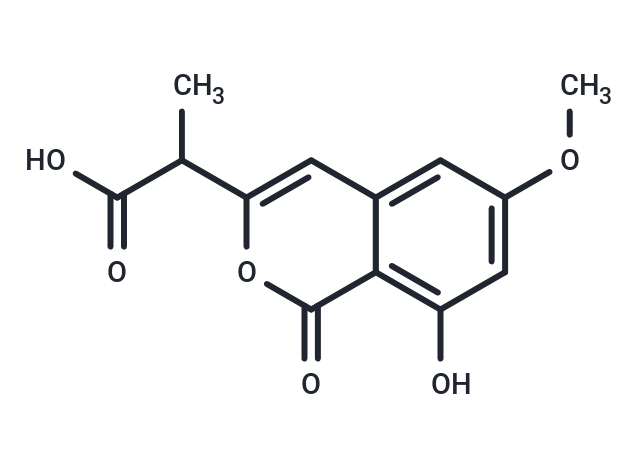
NM-3
CAS No. 181427-78-1
NM-3( —— )
Catalog No. M34669 CAS No. 181427-78-1
NM-3 is an orally available anti-angiogenic inhibitor with anti-tumour activity.NM-3 is used as a radiation modulator in vitro and in vivo.
Purity : >98% (HPLC)
 COA
Datasheet
HNMR
HPLC
MSDS
Handing Instructions
COA
Datasheet
HNMR
HPLC
MSDS
Handing Instructions
| Size | Price / USD | Stock | Quantity |
| 2MG | 289 | Get Quote |


|
| 5MG | 456 | Get Quote |
|
| 10MG | 653 | Get Quote |
|
| 25MG | 994 | Get Quote |
|
| 50MG | 1362 | Get Quote |
|
| 100MG | 1791 | Get Quote |
|
| 500MG | 3528 | Get Quote |
|
| 1G | Get Quote | Get Quote |
|
Biological Information
-
Product NameNM-3
-
NoteResearch use only, not for human use.
-
Brief DescriptionNM-3 is an orally available anti-angiogenic inhibitor with anti-tumour activity.NM-3 is used as a radiation modulator in vitro and in vivo.
-
DescriptionNM-3 is an isocoumarin with antiarthritic and antiangiogenic effects. NM-3 is an orally active antiangiogenic agent with low toxicity.
-
In Vitro——
-
In Vivo——
-
Synonyms——
-
PathwayApoptosis
-
TargetApoptosis
-
RecptorApoptosis | Reactive Oxygen Species
-
Research Area——
-
Indication——
Chemical Information
-
CAS Number181427-78-1
-
Formula Weight264.23
-
Molecular FormulaC13H12O6
-
Purity>98% (HPLC)
-
Solubility——
-
SMILESO=C1C=2C(C=C(C(C(O)=O)C)O1)=CC(OC)=CC2O
-
Chemical Name——
Shipping & Storage Information
-
Storage(-20℃)
-
ShippingWith Ice Pack
-
Stability≥ 2 years
Reference
1. T Nakashima, et al. Inhibition of angiogenesis by a new isocoumarin, NM-3. J Antibiot (Tokyo). 1999 Apr;52(4):426-8. ?
molnova catalog



related products
-
Voreloxin hydrochlor...
Voreloxin hydrochloride is a potent inhibitor of Topoisomerase II with broad-spectrum anti-tumor activity.
-
Sodium taurochenodeo...
Sodium taurochenodeoxycholate is one of the main bioactive substances of animals' bile acid.?Sodium taurochenodeoxycholate induces apoptosis and shows obvious anti-inflammatory and immune regulation properties. It can increase glucose-induced insulin secretion and stimulate the electrical activity of α2-cells and enhance cytosolic Ca(2+) concentration ([Ca(2+)](c)).
-
Oenothein B
Oenothein B is a specific inhibitor of poly(ADP-ribose) glycohydrolase. Oenothein B shows antioxidant, anti-inflammatory, antifungal, anti-HCV, and antitumor properties.
