


 Cart
Cart
 sales@molnova.com



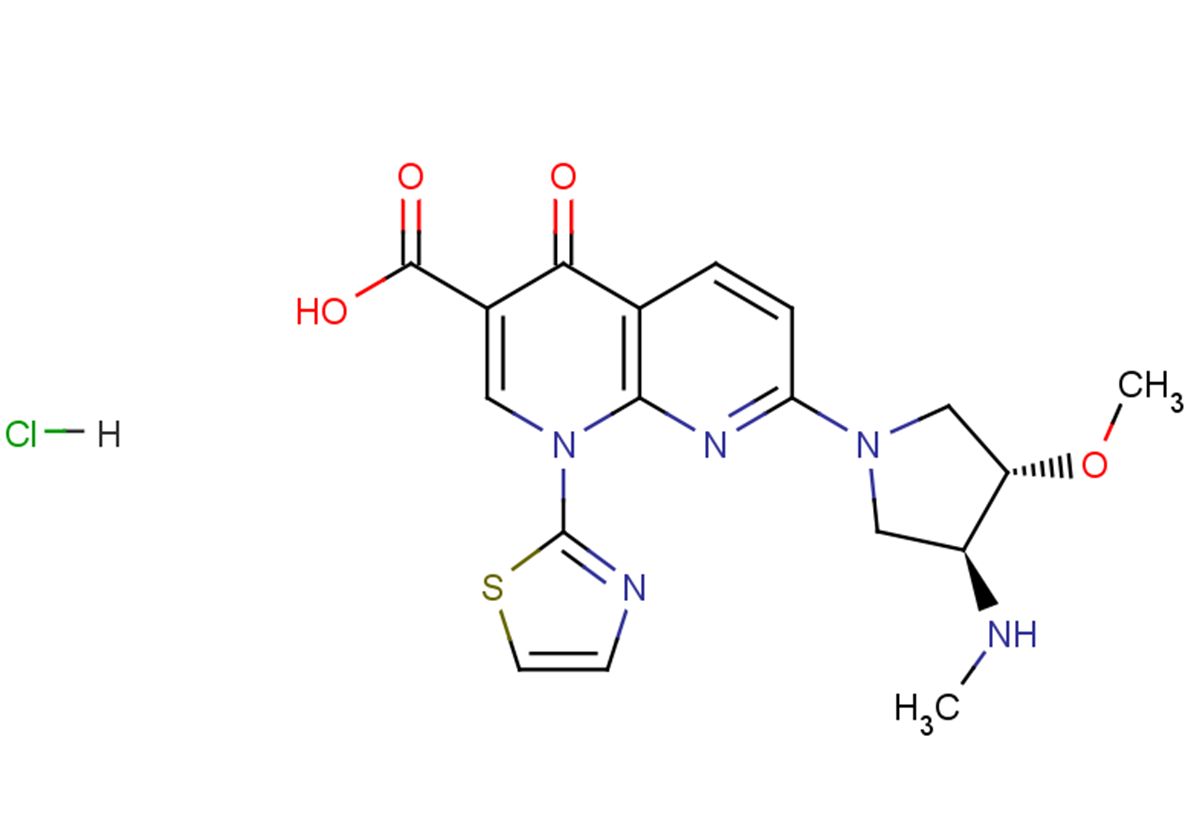
Voreloxin hydrochloride
CAS No. 175519-16-1
Voreloxin hydrochloride( Vosaroxin | SNS-595 hydrochloride )
Catalog No. M23789 CAS No. 175519-16-1
Voreloxin hydrochloride is a potent inhibitor of Topoisomerase II with broad-spectrum anti-tumor activity.
Purity : >98% (HPLC)
 COA
Datasheet
HNMR
HPLC
MSDS
Handing Instructions
COA
Datasheet
HNMR
HPLC
MSDS
Handing Instructions
| Size | Price / USD | Stock | Quantity |
| 2MG | 33 | In Stock |


|
| 5MG | 55 | In Stock |
|
| 10MG | 98 | In Stock |
|
| 25MG | 158 | In Stock |
|
| 50MG | 256 | In Stock |
|
| 100MG | Get Quote | In Stock |
|
| 200MG | Get Quote | In Stock |
|
| 500MG | Get Quote | In Stock |
|
| 1G | Get Quote | In Stock |
|
Biological Information
-
Product NameVoreloxin hydrochloride
-
NoteResearch use only, not for human use.
-
Brief DescriptionVoreloxin hydrochloride is a potent inhibitor of Topoisomerase II with broad-spectrum anti-tumor activity.
-
DescriptionVoreloxin hydrochloride is a potent inhibitor of Topoisomerase II with broad-spectrum anti-tumor activity.
-
In VitroVoreloxin Hydrochloride is a first-in-class topoisomerase II poison and inhibitor that intercalates DNA and induces site-selective DNA DSB, G2 arrest, and apoptosis. Voreloxin (0.1-20 μM) inhibits topoisomerase II activity and induces site-selective DNA DSB in CCRF-CEM cells. Voreloxin (0.11, 0.33, 1, 3 μM) induces G2 arrest partially through topoisomerase II in A549 lung cancer cell line. Voreloxin cytotoxic activity requires DNA intercalation. However, Voreloxin (1-9 μM) does not generate significant levels of ROS. Voreloxin has potent cytotoxic activity in AML cell lines MV4-11 and HL-60, with IC50s of 95 ± 8 nM and 884 ± 114 nM, respectively. Voreloxin in combination with cytarabine shows additive or synergistic activity in acute leukemia cell lines. Voreloxin is active on the primary acute myeloid leukemia (AML) with a mean LD50 of 2.3 μM. The LD50 for voreloxin in myeloid cell lines NB4 and HL-60 is 0.59 μM ± 0.25 μM. Voreloxin causes accumulation of cells in the S and G2 phases of the cell cycle and acts on topoisomerase II.
-
In VivoVoreloxin (20 mg/kg, i.v.) alone results in 80% reduction in bone marrow cellularity of CD-1 mice by administration one dose every 4 days repeated twice (q4d ×2). voreloxin at 10 mg/kg in combination with cytarabine causes ablation of the marrow, dilation of sinusoids, and infiltration of adipocytes in mice. Voreloxin (20 mg/kg, i.v.) combined with cytarabine causes a reversible decrease in myeloid and lymphoid cells in bone marrow and peripheral blood CD-1 mice. voreloxin (10 mg/kg, q4d ×2) and cytarabine in combination causes reversible neutropenia with a more modest impact on platelets CD-1 mice.
-
SynonymsVosaroxin | SNS-595 hydrochloride
-
PathwayApoptosis
-
TargetApoptosis
-
RecptorApoptosis|Topo II
-
Research Area——
-
Indication——
Chemical Information
-
CAS Number175519-16-1
-
Formula Weight437.9
-
Molecular FormulaC18H20ClN5O4S
-
Purity>98% (HPLC)
-
SolubilityDMSO:20 mg/ml (45.67 mM)
-
SMILES[H]Cl.O=C(C1=CN(C2=NC=CS2)C3=C(C=CC(N4C[C@H](OC)[C@@H](NC)C4)=N3)C1=O)O
-
Chemical Name——
Shipping & Storage Information
-
Storage(-20℃)
-
ShippingWith Ice Pack
-
Stability≥ 2 years
Reference
1.Tsuzuki Y, et al. J Med Chem. 2004, 47(8), 2097-2109.
molnova catalog



related products
-
BTM-3528
BTM-3528 is an activator of the mitochondrial protease OMA1 with anticancer activity.BTM-3528 activates the ISR via the mitochondrial protease OMA1, inducing OMA1-dependent cleavage of DELE1 and OPA1 and mitochondrial fragmentation.
-
Oenothein B
Oenothein B is a specific inhibitor of poly(ADP-ribose) glycohydrolase. Oenothein B shows antioxidant, anti-inflammatory, antifungal, anti-HCV, and antitumor properties.
-
Phenformin
Phenformin (BRN 1977317) is a biguanide compound with anticancer and anti-glycemic activity, inhibits skin tumor growth and promotes keratinocyte differentiation and apoptosis.
