


 Cart
Cart
 sales@molnova.com



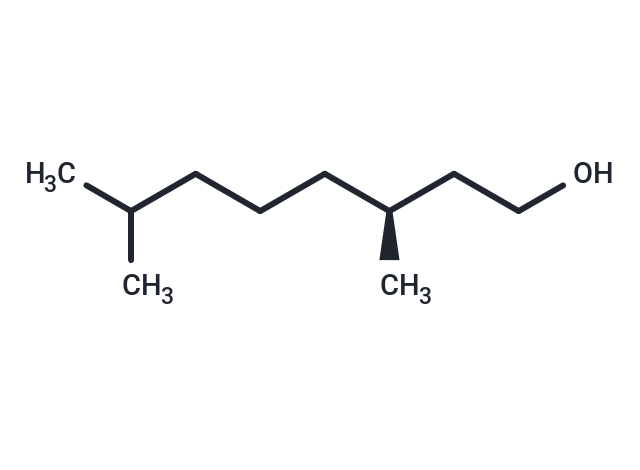
(3S)-3,7-dimethyloctan-1-ol
CAS No. 68680-98-8
(3S)-3,7-dimethyloctan-1-ol( —— )
Catalog No. M37395 CAS No. 68680-98-8
(3S)-3,7-dimethyloctan-1-ol ((S)-3,7-dimethyl-1-octanol) can be used to synthesize liquid crystal compounds and nanoparticles.
Purity : >98% (HPLC)
 COA
Datasheet
HNMR
HPLC
MSDS
Handing Instructions
COA
Datasheet
HNMR
HPLC
MSDS
Handing Instructions
| Size | Price / USD | Stock | Quantity |
| 25MG | 29 | In Stock |


|
| 50MG | 37 | In Stock |
|
| 100MG | 53 | In Stock |
|
| 200MG | 77 | In Stock |
|
| 500MG | Get Quote | In Stock |
|
| 1G | Get Quote | In Stock |
|
Biological Information
-
Product Name(3S)-3,7-dimethyloctan-1-ol
-
NoteResearch use only, not for human use.
-
Brief Description(3S)-3,7-dimethyloctan-1-ol ((S)-3,7-dimethyl-1-octanol) can be used to synthesize liquid crystal compounds and nanoparticles.
-
Description(3S)-3,7-dimethyloctan-1-ol ((S)-3,7-dimethyl-1-octanol) can be used to synthesize liquid crystal compounds and nanoparticles.
-
In Vitro——
-
In Vivo——
-
Synonyms——
-
PathwayOthers
-
TargetOther Targets
-
RecptorOthers
-
Research Area——
-
Indication——
Chemical Information
-
CAS Number68680-98-8
-
Formula Weight158.28
-
Molecular FormulaC10H22O
-
Purity>98% (HPLC)
-
Solubility——
-
SMILES[C@H](CCCC(C)C)(CCO)C
-
Chemical Name——
Shipping & Storage Information
-
Storage(-20℃)
-
ShippingWith Ice Pack
-
Stability≥ 2 years
Reference
molnova catalog



related products
-
Vatalanib hydrochlor...
Vatalanib hydrochloride (PTK787; ZK-222584; CGP-797870) functions as an inhibitor of VEGFR2/KDR, displaying an IC50 value of 37 nM .
-
Dynorphin B (1-9)
Dynorphin B (1-9) is a neuropeptide and N-terminal cleavage product of dynorphin B. The formation of dynorphin B (1-9) is blocked by N-ethylmaleimide (NEM), a non-selective inhibitor of cysteine peptidases.
-
Mesna
Mesna(Uromitexan, Mesnex), a sulfhydryl compound that is used to reduce the incidence of hemorrhagic cystitis associated with certain chemotherapeutic agents.
