


 Cart
Cart
 sales@molnova.com



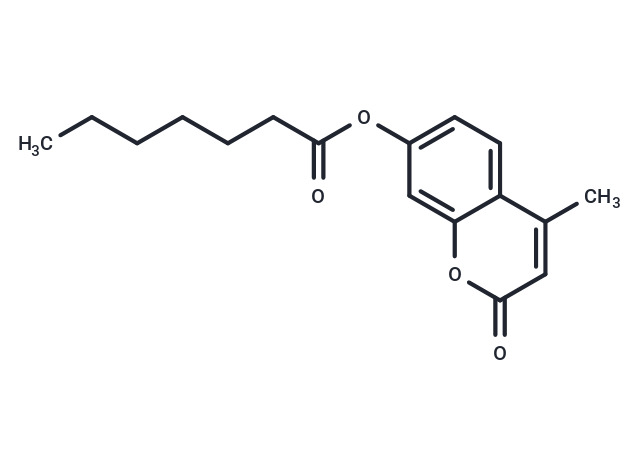
4-Methylumbelliferyl heptanoate
CAS No. 18319-92-1
4-Methylumbelliferyl heptanoate( —— )
Catalog No. M37342 CAS No. 18319-92-1
4-Methylumbelliferyl heptanoate (4-Methylumbelliferyl enanthate) is a lipase fluorescent substrate that detects cell-mediated cytotoxicity and cell proliferation.
Purity : >98% (HPLC)
 COA
Datasheet
HNMR
HPLC
MSDS
Handing Instructions
COA
Datasheet
HNMR
HPLC
MSDS
Handing Instructions
| Size | Price / USD | Stock | Quantity |
| 5MG | 276 | In Stock |


|
| 10MG | 394 | In Stock |
|
| 25MG | 616 | In Stock |
|
| 50MG | 830 | In Stock |
|
| 100MG | 1097 | In Stock |
|
| 200MG | 1479 | In Stock |
|
| 500MG | Get Quote | In Stock |
|
| 1G | Get Quote | In Stock |
|
Biological Information
-
Product Name4-Methylumbelliferyl heptanoate
-
NoteResearch use only, not for human use.
-
Brief Description4-Methylumbelliferyl heptanoate (4-Methylumbelliferyl enanthate) is a lipase fluorescent substrate that detects cell-mediated cytotoxicity and cell proliferation.
-
Description4-Methylumbelliferyl heptanoate is a potent fluorometric substrate of lipase.
-
In Vitro——
-
In Vivo——
-
Synonyms——
-
PathwayOthers
-
TargetOther Targets
-
RecptorOthers
-
Research Area——
-
Indication——
Chemical Information
-
CAS Number18319-92-1
-
Formula Weight288.34
-
Molecular FormulaC17H20O4
-
Purity>98% (HPLC)
-
Solubility——
-
SMILESCCCCCCC(=O)Oc1ccc2c(C)cc(=O)oc2c1
-
Chemical Name——
Shipping & Storage Information
-
Storage(-20℃)
-
ShippingWith Ice Pack
-
Stability≥ 2 years
Reference
1. Guilbault, G. G., et al. N-Methyl Indoxyl Esters As Fluorometric Substrates For Lipase. Analytical Letters, 2(4), 185–196.
molnova catalog



related products
-
D-F07
D-F07 is a novel fluorescent IRE-1 RNase inhibitor and a tricyclic chromone with potential anticancer activity.
-
Thiourea
Thiourea is a chaotropic agent that is strong denaturant. Increases solubility and recovery of proteins.
-
Regaloside D
Regaloside D is a natural product isolated from Lilium Longiflorum.
