


 Cart
Cart
 sales@molnova.com



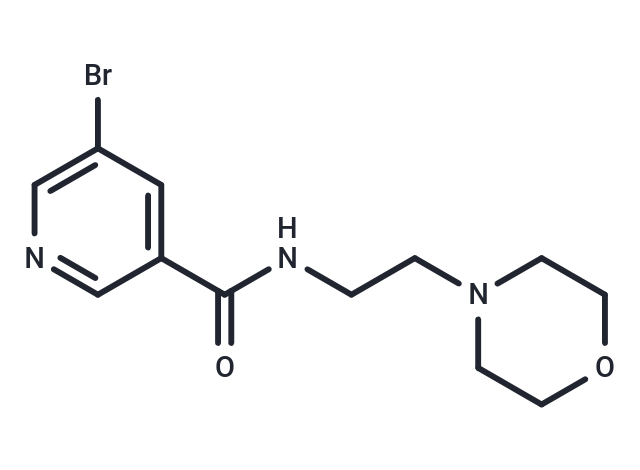
WAY-620147
CAS No. 515866-67-8
WAY-620147( —— )
Catalog No. M37287 CAS No. 515866-67-8
WAY-620147 is a derivative of N-(2-morpholinoethyl)nicotinamide, which is able to inhibit Monoamine Oxidase.
Purity : >98% (HPLC)
 COA
Datasheet
HNMR
HPLC
MSDS
Handing Instructions
COA
Datasheet
HNMR
HPLC
MSDS
Handing Instructions
| Size | Price / USD | Stock | Quantity |
| 5MG | 29 | In Stock |


|
| 10MG | 38 | In Stock |
|
| 25MG | 60 | In Stock |
|
| 50MG | 86 | In Stock |
|
| 100MG | Get Quote | In Stock |
|
| 200MG | Get Quote | In Stock |
|
| 500MG | Get Quote | In Stock |
|
| 1G | Get Quote | In Stock |
|
Biological Information
-
Product NameWAY-620147
-
NoteResearch use only, not for human use.
-
Brief DescriptionWAY-620147 is a derivative of N-(2-morpholinoethyl)nicotinamide, which is able to inhibit Monoamine Oxidase.
-
DescriptionWAY-620147 (compound 6) is an N-(2-morpholinoethyl)nicotinamide derivative that inhibits monoamine oxidase (Monoamine Oxidase). WAY-620147 inhibits MAO-A and MAO-B with IC50s of 26 μM and 55 μM, respectively.
-
In Vitro——
-
In Vivo——
-
Synonyms——
-
PathwayMetabolic Enzyme/Protease
-
TargetMAO
-
RecptorMAO
-
Research Area——
-
Indication——
Chemical Information
-
CAS Number515866-67-8
-
Formula Weight314.18
-
Molecular FormulaC12H16BrN3O2
-
Purity>98% (HPLC)
-
Solubility——
-
SMILESO=C(NCCN1CCOCC1)C=2C=NC=C(Br)C2
-
Chemical Name——
Shipping & Storage Information
-
Storage(-20℃)
-
ShippingWith Ice Pack
-
Stability≥ 2 years
Reference
1. Shi L, et al. Design of novel nicotinamides as potent and selective monoamine oxidase a inhibitors. Bioorg Med Chem. 2010 Feb 15;18(4):1659-64.?
molnova catalog



related products
-
Tetrahydroharmine
Tetrahydroharmine (Leptaflorine) is a natural product found in the stems and large branches of Banisteriopsis caapi cultivar Da Vine. Tetrahydroharmine is a Monoamine oxidase A inhibitor.
-
FCE 28073
FCE 28073 is a Monoamine oxidase B inibitor with IC50 of 0.45 uM.
-
PF-9601N
PF-9601N showed high potency and selectivity as a MAO-BI (monoamine oxidase type B inhibitor) and also demonstrated remarkable neuroprotective properties in several in vivo and cellular models of PD.
