


 Cart
Cart
 sales@molnova.com



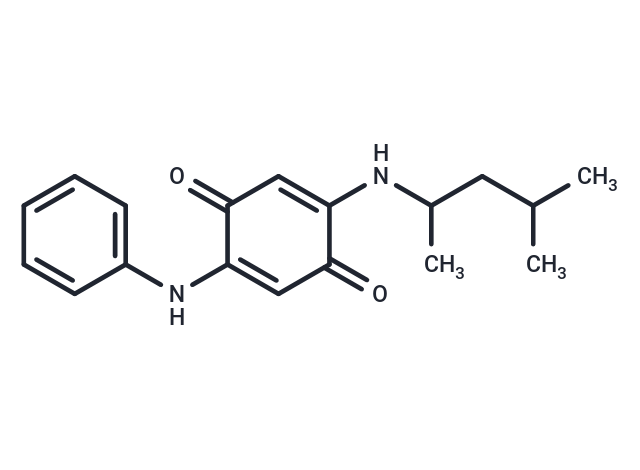
6PPD-Q
CAS No. 2754428-18-5
6PPD-Q( —— )
Catalog No. M37188 CAS No. 2754428-18-5
6PPD-Q (6PPD-Quinone), a contaminant present in the environment and soil, is a derivative of the tire antioxidant N-(1,3-dimethylbutyl)-N'-phenyl-p-phenylenediamine (6PPD), which impairs the quality of spermatozoa in mice and induces impaired male fertility.
Purity : >98% (HPLC)
 COA
Datasheet
HNMR
HPLC
MSDS
Handing Instructions
COA
Datasheet
HNMR
HPLC
MSDS
Handing Instructions
| Size | Price / USD | Stock | Quantity |
| 5MG | 119 | In Stock |


|
| 10MG | 174 | In Stock |
|
| 25MG | 282 | In Stock |
|
| 50MG | 421 | In Stock |
|
| 100MG | Get Quote | In Stock |
|
| 200MG | Get Quote | In Stock |
|
| 500MG | Get Quote | In Stock |
|
| 1G | Get Quote | In Stock |
|
Biological Information
-
Product Name6PPD-Q
-
NoteResearch use only, not for human use.
-
Brief Description6PPD-Q (6PPD-Quinone), a contaminant present in the environment and soil, is a derivative of the tire antioxidant N-(1,3-dimethylbutyl)-N'-phenyl-p-phenylenediamine (6PPD), which impairs the quality of spermatozoa in mice and induces impaired male fertility.
-
Description6PPD-Q (6PPD-Quinone) is an endogenous metabolite that can be found in human urine and can also commonly found in the environment.
-
In Vitro——
-
In Vivo——
-
Synonyms——
-
PathwayProteasome/Ubiquitin
-
TargetEndogenous Metabolite
-
RecptorEndogenous Metabolite
-
Research Area——
-
Indication——
Chemical Information
-
CAS Number2754428-18-5
-
Formula Weight298.38
-
Molecular FormulaC18H22N2O2
-
Purity>98% (HPLC)
-
SolubilityIn Vitro:?DMSO : 5 mg/mL (16.76 mM; Ultrasonic (<60°C)
-
SMILESO=C1C=C(NC(C)CC(C)C)C(=O)C=C1NC=2C=CC=CC2
-
Chemical Name——
Shipping & Storage Information
-
Storage(-20℃)
-
ShippingWith Ice Pack
-
Stability≥ 2 years
Reference
1. Du B, et al. First report on the occurrence of N-(1, 3-dimethylbutyl)-N’-phenyl-p-phenylenediamine (6PPD) and 6PPD-quinone as pervasive pollutants in human urine from south China. Environ Sci Technol Lett, 2022, 9(12): 1056-1062.
molnova catalog



related products
-
Sphingosine-1-phosph...
Sphingosine-1-phosphate (S1P) is an agonist for S1P1-5 receptors and a ligand for GPR3, GPR6, and GPR12. As an intracellular second messenger, it mobilizes Ca2+ and acts as an extracellular ligand for G-protein coupled receptors.
-
5'-Guanylic acid
5'-Guanylic acid is involved in several metabolic disorders, including AICA-ribosiduria pathway, ?adenosine deaminase deficiency,adenine phosphoribosyltransferase deficiency (aprt), and the 2-hydroxyglutric aciduria pathway.
-
Cyclic-di-GMP disodi...
Cyclic-di-GMP disodium (5GP-5GP disodium) is a STING agonist and a second messenger in bacteria.
