


 Cart
Cart
 sales@molnova.com



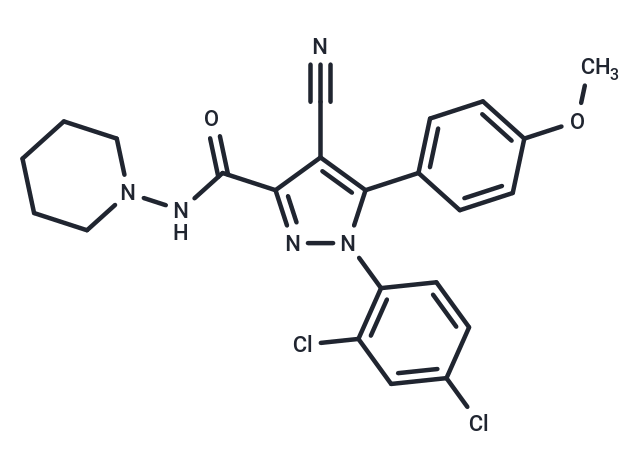
JHU 75528
CAS No. 947696-17-5
JHU 75528( —— )
Catalog No. M37005 CAS No. 947696-17-5
JHU 75528 (JHU-75528) is a novel PET tracer with inhibitory effects on CB that can be used to study the cannabinoid system in schizophrenic patients.
Purity : >98% (HPLC)
 COA
Datasheet
HNMR
HPLC
MSDS
Handing Instructions
COA
Datasheet
HNMR
HPLC
MSDS
Handing Instructions
| Size | Price / USD | Stock | Quantity |
| 5MG | 409 | In Stock |


|
| 10MG | 604 | In Stock |
|
| 25MG | 938 | In Stock |
|
| 50MG | 1265 | In Stock |
|
| 100MG | 1702 | In Stock |
|
| 200MG | Get Quote | In Stock |
|
| 500MG | 3422 | In Stock |
|
| 1G | Get Quote | In Stock |
|
Biological Information
-
Product NameJHU 75528
-
NoteResearch use only, not for human use.
-
Brief DescriptionJHU 75528 (JHU-75528) is a novel PET tracer with inhibitory effects on CB that can be used to study the cannabinoid system in schizophrenic patients.
-
DescriptionJHU 75528 (JHU-75528) is a novel PET tracer with inhibitory effects on CB that can be used to study the cannabinoid system in schizophrenic patients.
-
In Vitro——
-
In Vivo——
-
Synonyms——
-
PathwayGPCR/G Protein
-
TargetCannabinoid Receptor
-
RecptorCannabinoid Receptor
-
Research Area——
-
Indication——
Chemical Information
-
CAS Number947696-17-5
-
Formula Weight470.35
-
Molecular FormulaC23H21Cl2N5O2
-
Purity>98% (HPLC)
-
Solubility——
-
SMILESC(#N)C1=C(N(N=C1C(NN2CCCCC2)=O)C3=C(Cl)C=C(Cl)C=C3)C4=CC=C(OC)C=C4
-
Chemical Name——
Shipping & Storage Information
-
Storage(-20℃)
-
ShippingWith Ice Pack
-
Stability≥ 2 years
Reference
molnova catalog



related products
-
Cannabichromene
Cannabichromene is a major non-psychotropic phytocannabinoid that inhibits endocannabinoid inactivation and activates the transient receptor potential ankyrin-1 (TRPA1).
-
Hemopressin (human, ...
Bioactive endogenous peptide substrate for endopeptidase 24.15 (ep24.15), neurolysin (ep24.16) and ACE. Ki values are 27.76, 3.43 and 1.87 μM respectively. Potent hypotensive in vivo. Also acts as a selective CB1 receptor inverse agonist. Displays antinociceptive activity in vivo.
-
JTE907
A potent, selective, orally active cannabinoid CB2 receptor inverse agonist with Ki of 35.9, 1.55 and 0.38 nM for human, mouse and rat CB2, respectively.
