


 Cart
Cart
 sales@molnova.com



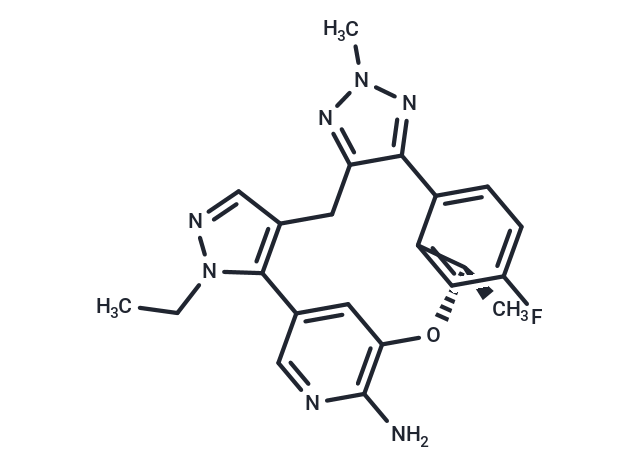
Zidesamtinib
CAS No. 2739829-00-4
Zidesamtinib( —— )
Catalog No. M36481 CAS No. 2739829-00-4
Zidesamtinib (NVL-520) is an orally active, selective, potent, and blood-brain-barrier-crossing inhibitor of ROS1 fusion and resistance mutations, inhibits ROS1 and ROS1 G2032R, and can be used in the study of non-small-cell lung cancer and solid tumors.
Purity : >98% (HPLC)
 COA
Datasheet
HNMR
HPLC
MSDS
Handing Instructions
COA
Datasheet
HNMR
HPLC
MSDS
Handing Instructions
| Size | Price / USD | Stock | Quantity |
| 1 mL x 10 mM in DMSO | 170 | In Stock |


|
| 5MG | 155 | In Stock |
|
| 10MG | 250 | In Stock |
|
| 25MG | 506 | In Stock |
|
| 50MG | 793 | In Stock |
|
| 100MG | 1265 | In Stock |
|
| 200MG | 1702 | In Stock |
|
| 500MG | Get Quote | In Stock |
|
| 1G | Get Quote | In Stock |
|
Biological Information
-
Product NameZidesamtinib
-
NoteResearch use only, not for human use.
-
Brief DescriptionZidesamtinib (NVL-520) is an orally active, selective, potent, and blood-brain-barrier-crossing inhibitor of ROS1 fusion and resistance mutations, inhibits ROS1 and ROS1 G2032R, and can be used in the study of non-small-cell lung cancer and solid tumors.
-
DescriptionZidesamtinib (NVL-520) is a potent, selective, orally active and brain-penetrant inhibitor of diverse ROS1 fusions and resistance mutations, with IC50s of 0.7 and 7.9 nM for wild-type ROS1 and ROS1 G2032R, respectively, and spares TRK inhibition. Zidesamtinib can be used for the research of cancer.
-
In VitroZidesamtinib (72 h) inhibits the growth of seven cell lines expressing wild-type ROS1 fusions, with average IC50s of 0.4 nM.Zidesamtinib (72 h) inhibits the growth of six cell lines harboring ROS1 fusions with the G2032R mutation, with average IC50s of 1.6 nM.Zidesamtinib (72 h) potently inhibits the non-G2032R ROS1 mutants, with IC50s ≤ 1.5 nM.Zidesamtinib (10-1000 nM; 4 weeks) suppresses colony formation in NIH3T3 cells expressing wild-type ROS1 fusions and expressing ROS1 fusions with G2032R.
-
In VivoZidesamtinib (0.04-15 mg/kg; p.o. twice daily for 28 d) induces tumor regression at all doses ≥0.2 mg/kg in wild-type ROS1 xenograft models.Animal Model:Female athymic Nude-Foxn1nu mice were implanted subcutaneously with tumor fragments from model CTG-0848.Dosage:0.04, 0.2, 1, 5, 15 mg/kg Administration:Oral gavage twice daily for 21 days Result:Inhibited the tumor volumes.
-
Synonyms——
-
PathwayImmunology/Inflammation
-
TargetROS
-
RecptorROS Kinase
-
Research Area——
-
Indication——
Chemical Information
-
CAS Number2739829-00-4
-
Formula Weight419.455
-
Molecular FormulaC22H22FN7O
-
Purity>98% (HPLC)
-
SolubilityIn Vitro:?DMSO : 50 mg/mL (119.20 mM; Ultrasonic ( 65°C)
-
SMILESC(C)N1C2=C(CC=3C(C=4C([C@@H](C)OC=5C=C2C=NC5N)=CC(F)=CC4)=NN(C)N3)C=N1
-
Chemical Name——
Shipping & Storage Information
-
Storage(-20℃)
-
ShippingWith Ice Pack
-
Stability≥ 2 years
Reference
1. Drilon A, et, al. NVL-520 is a selective, TRK-sparing, and brain-penetrant inhibitor of ROS1 fusions and secondary resistance mutations. Cancer Discov. 2022 Dec 13;CD-22-0968.?
molnova catalog



related products
-
Gypenoside L
Gypenoside L inhibits autophagic flux and induces cell death in human esophageal cancer cells through endoplasm reticulum stress-mediated Ca2+ release.
-
Baicalein
The flavonoid component of Nepalese and Sino-Japanese crude drugs.1,2 Baicalein,a major flavone of Scutellariae baicalensis,inhibits the 12-lipoxygenase (12-LOX) pathway of arachidonic acid metabolism,which inhibits Y cell proliferation and induce.
-
Lycopene
Extracted from Papaya fruit, marigold flower petals;Store the product in sealed, cool and dry condition.
