


 Cart
Cart
 sales@molnova.com



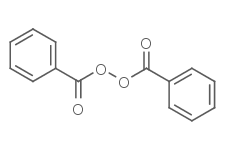
Benzoyl peroxide
CAS No. 94-36-0
Benzoyl peroxide( —— )
Catalog No. M19506 CAS No. 94-36-0
A peroxide derivative that has been used topically for BURNS and as a dermatologic agent in the treatment of ACNE and POISON IVY DERMATITIS.
Purity : >98% (HPLC)
 COA
Datasheet
HNMR
HPLC
MSDS
Handing Instructions
COA
Datasheet
HNMR
HPLC
MSDS
Handing Instructions
| Size | Price / USD | Stock | Quantity |
| 100MG | Get Quote | In Stock |


|
| 200MG | Get Quote | In Stock |
|
| 500MG | Get Quote | In Stock |
|
| 1G | Get Quote | In Stock |
|
Biological Information
-
Product NameBenzoyl peroxide
-
NoteResearch use only, not for human use.
-
Brief DescriptionA peroxide derivative that has been used topically for BURNS and as a dermatologic agent in the treatment of ACNE and POISON IVY DERMATITIS.
-
DescriptionA peroxide derivative that has been used topically for BURNS and as a dermatologic agent in the treatment of ACNE and POISON IVY DERMATITIS. It is used also as a bleach in the food industry.
-
In Vitro——
-
In Vivo——
-
Synonyms——
-
PathwayImmunology/Inflammation
-
TargetROS
-
RecptorROS activator
-
Research Area——
-
IndicationRosacea
Chemical Information
-
CAS Number94-36-0
-
Formula Weight242.23
-
Molecular FormulaC14H10O4
-
Purity>98% (HPLC)
-
SolubilityDMSO:>10 mM
-
SMILESO=C(OOC(=O)C1=CC=CC=C1)C1=CC=CC=C1
-
Chemical Namebenzoic peroxyanhydride
Shipping & Storage Information
-
Storage(-20℃)
-
ShippingWith Ice Pack
-
Stability≥ 2 years
Reference
1.Bojar RA et al. Br J Dermatol. 1995 Feb;132(2):204-8.
molnova catalog



related products
-
5-Hydroxyoxindole
5-Hydroxyoxindole has been identified as a urinary metabolite of indole, which is produced from tryptophane via the tryptophanase activity of gut bacteria.
-
DS-6051b
DS-6051b is a new-generation selective inhibitor of ROS1/NTRK including ROS1,NTRK1,NTRK2 and NTRK3 with IC50 of 0.207 nM,0.622 nM,2.28 nM and 0.980 nM, respectively.DS-6051b inhibited the growth of the ROS1 fusion-positive HCC78 cancer cell line and the CD74-ROS1 overexpressed Ba/F3 cells.
-
Febuxostat
Febuxostat is a Xanthine Oxidase Inhibitor. The mechanism of action of febuxostat is as a Xanthine Oxidase Inhibitor.
