


 Cart
Cart
 sales@molnova.com



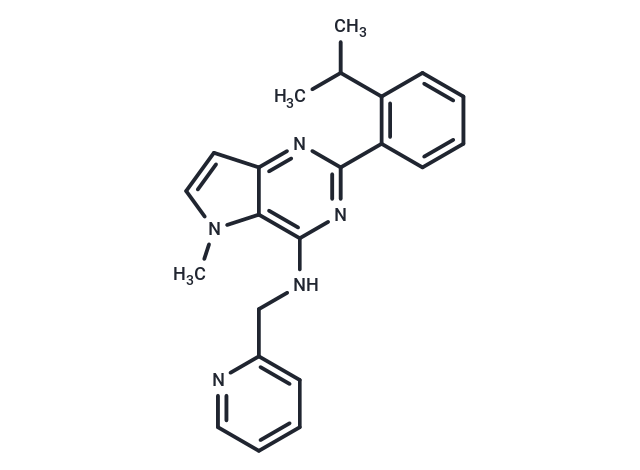
PI5P4Ks-IN-2
CAS No. 2766854-03-7
PI5P4Ks-IN-2( —— )
Catalog No. M36403 CAS No. 2766854-03-7
PI5P4Ks-IN-2 is an inhibitor of the phosphatidylinositol 5-phosphate 4-kinase PI5P4Kγ.
Purity : >98% (HPLC)
 COA
Datasheet
HNMR
HPLC
MSDS
Handing Instructions
COA
Datasheet
HNMR
HPLC
MSDS
Handing Instructions
| Size | Price / USD | Stock | Quantity |
| 1 mL x 10 mM in DMSO | 370 | In Stock |


|
| 5MG | 337 | In Stock |
|
| 10MG | 503 | In Stock |
|
| 25MG | 848 | In Stock |
|
| 50MG | 1088 | In Stock |
|
| 100MG | 1423 | In Stock |
|
| 200MG | Get Quote | In Stock |
|
| 500MG | Get Quote | In Stock |
|
| 1G | Get Quote | In Stock |
|
Biological Information
-
Product NamePI5P4Ks-IN-2
-
NoteResearch use only, not for human use.
-
Brief DescriptionPI5P4Ks-IN-2 is an inhibitor of the phosphatidylinositol 5-phosphate 4-kinase PI5P4Kγ.
-
DescriptionPI5P4Ks-IN-2 is a inhibitor of phosphatidylinositol 5-phosphate 4-kinase γ (PI5P4Kγ). PI5P4Ks-IN-2 targets to PI5P4K isoforms with pIC50 values of <4.3 (PI5P4Kα), <4.6 (PI5P4Kβ), 6.2 (PI5P4Kγ), 0.32 (PI5P4Kγ+), respectively.
-
In Vitro——
-
In Vivo——
-
Synonyms——
-
PathwayPI3K/Akt/mTOR signaling
-
TargetPI3K
-
RecptorPI3K
-
Research Area——
-
Indication——
Chemical Information
-
CAS Number2766854-03-7
-
Formula Weight357.45
-
Molecular FormulaC22H23N5
-
Purity>98% (HPLC)
-
Solubility——
-
SMILESN(CC1=CC=CC=N1)C2=C3C(=NC(=N2)C4=C(C(C)C)C=CC=C4)C=CN3C
-
Chemical Name——
Shipping & Storage Information
-
Storage(-20℃)
-
ShippingWith Ice Pack
-
Stability≥ 2 years
Reference
1. Boffey HK, et al. Development of Selective Phosphatidylinositol 5-Phosphate 4-Kinase γ Inhibitors with a Non-ATP-competitive, Allosteric Binding Mode. J Med Chem. 2022 Feb 24;65(4):3359-3370. ?
molnova catalog



related products
-
IHMT-PI3Kδ-372 S-iso...
IHMT-PI3Kδ-372 S-isomer is a potent and selective PI3Kδ inhibitor with an IC50 of 14 nM. IHMT-PI3Kδ-372 S-isomer shows high selectivity over other class I PI3Ks (56~83 fold) and other protein kinases.
-
RLY-2608
RLY-2608 is a selective mutant PI3Kα inhibitor that inhibits tumor growth in a PIK3CA mutant xenograft model.
-
PI3K-IN-16
PI3K-IN-16 is a potent and selective, orally bioavailable PI3Kβ and PI3Kδ inhibitor.
