


 Cart
Cart
 sales@molnova.com



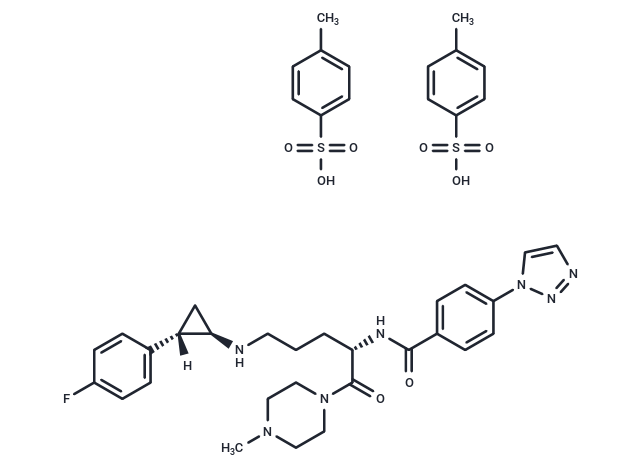
Bomedemstat ditosylate
CAS No. 1990504-72-7
Bomedemstat ditosylate( —— )
Catalog No. M36319 CAS No. 1990504-72-7
Bomedemstat ditosylate (IMG-7289 ditosylate) is an orally active lysine-specific demethylase 1 (LSD1) inhibitor with antitumor activity that potentiates the response to PD-1 inhibition in a homozygous model of SCLC, inhibits cancer cell proliferation, and induces apoptosis.
Purity : >98% (HPLC)
 COA
Datasheet
HNMR
HPLC
MSDS
Handing Instructions
COA
Datasheet
HNMR
HPLC
MSDS
Handing Instructions
| Size | Price / USD | Stock | Quantity |
| 1 mL x 10 mM in DMSO | 264 | In Stock |


|
| 5MG | 187 | In Stock |
|
| 10MG | 278 | In Stock |
|
| 25MG | 468 | In Stock |
|
| 50MG | 662 | In Stock |
|
| 100MG | 923 | In Stock |
|
| 200MG | Get Quote | In Stock |
|
| 500MG | Get Quote | In Stock |
|
| 1G | Get Quote | In Stock |
|
Biological Information
-
Product NameBomedemstat ditosylate
-
NoteResearch use only, not for human use.
-
Brief DescriptionBomedemstat ditosylate (IMG-7289 ditosylate) is an orally active lysine-specific demethylase 1 (LSD1) inhibitor with antitumor activity that potentiates the response to PD-1 inhibition in a homozygous model of SCLC, inhibits cancer cell proliferation, and induces apoptosis.
-
DescriptionBomedemstat (IMG-7289) ditosylate is an orally active and irreversible lysine-specific demethylase 1 (LSD1) inhibitor. Bomedemstat ditosylate can increase H3K4 and H3K9 methylation, and then alter gene expression. Bomedemstat ditosylate shows anti-cancer activities, inhibits cancer cell proliferation and induces apoptosis.
-
In VitroBomedemstat selectively inhibits proliferation and induces apoptosis of Jak2V617F cells by concomitantly increasing expression and methylation of p53.Bomedemstat (50 nM-1 μM; 96 h) enhances survival, induces apoptosis via BCL-XL and PUMA in a TP53-dependent manner, and leads to cell cycle arrest.Apoptosis AnalysisCell Line:SET-2 cells Concentration:50?nM, 100?nM, and 1?μM Incubation Time:96 hours Result:Decreased levels of the antiapoptotic protein BCL-XL and increased levels of the pro-apoptotic protein PUMA.
-
In VivoBomedemstat treatment (oral gavage; 45?mg/kg; once daily; 56 d) normalizes or improves blood cell counts, reduces spleen volumes, restores normal splenic architecture, and reduces bone marrow fibrosis.Animal Model:Mx-Jak2V617F miceDosage:45?mg/kg Administration:Oral gavage; 45?mg/kg; once daily; 56 days Result:Reduced splenomegaly significantly with a few treated mice normalizing their spleen weight, the 56-day course led to partial restoration of lymph follicles and spleen architecture by histological examination.
-
Synonyms——
-
PathwayApoptosis
-
TargetApoptosis
-
RecptorApoptosis | Histone Demethylase
-
Research Area——
-
Indication——
Chemical Information
-
CAS Number1990504-72-7
-
Formula Weight864.02
-
Molecular FormulaC42H50FN7O8S2
-
Purity>98% (HPLC)
-
SolubilityIn Vitro:?DMSO : 100 mg/mL (115.74 mM; Ultrasonic )
-
SMILESCc1ccc(cc1)S(O)(=O)=O.Cc1ccc(cc1)S(O)(=O)=O.[H][C@]1(C[C@H]1NCCC[C@H](NC(=O)c1ccc(cc1)-n1ccnn1)C(=O)N1CCN(C)CC1)c1ccc(F)cc1
-
Chemical Name——
Shipping & Storage Information
-
Storage(-20℃)
-
ShippingWith Ice Pack
-
Stability≥ 2 years
Reference
1. Jonas S Jutzi,et al. LSD1 Inhibition Prolongs Survival in Mouse Models of MPN by Selectively Targeting the Disease Clone.Hemasphere.2018 Jun 8;2(3):e54.?
molnova catalog



related products
-
(E/Z)-E64FC26
(E/Z)-E64FC26 is a potent protein disulfide isomerase (PDI) family inhibitor with potential antitumor activity and affinity for PDIA1, PDIA3, PDIA4, TXNDC5 and PDIA6. (E/Z)-E64FC26 can be used for myeloma research.
-
N-Hexanoyl-D-sphingo...
C6-ceramide, a ceramide pathway activator, shows activity against a variety of cancer cell lines. C6-ceramide can be used as an adjuvant for chemotherapeutic agents, to enhance anti-tumor effects.
-
Ceranib-2
Ceranib-2 is an inhibitor of ceramidase with an IC50 of 28 μM in SKOV3 cells.
