


 Cart
Cart
 sales@molnova.com



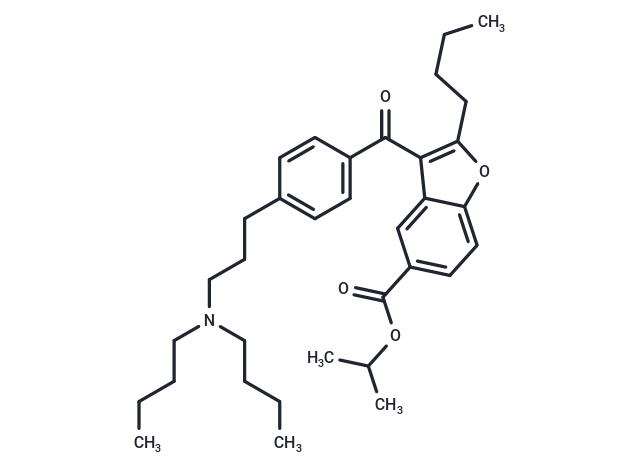
Celivarone
CAS No. 401925-43-7
Celivarone( —— )
Catalog No. M36144 CAS No. 401925-43-7
Celivarone is a potassium channel blocker used in the study of arrhythmias, atrial flutter and atrial fibrillation.
Purity : >98% (HPLC)
 COA
Datasheet
HNMR
HPLC
MSDS
Handing Instructions
COA
Datasheet
HNMR
HPLC
MSDS
Handing Instructions
| Size | Price / USD | Stock | Quantity |
| 5MG | 447 | In Stock |


|
| 10MG | 655 | In Stock |
|
| 25MG | 1026 | In Stock |
|
| 50MG | 1358 | In Stock |
|
| 100MG | 1823 | In Stock |
|
| 200MG | Get Quote | In Stock |
|
| 500MG | 3655 | In Stock |
|
| 1G | Get Quote | In Stock |
|
Biological Information
-
Product NameCelivarone
-
NoteResearch use only, not for human use.
-
Brief DescriptionCelivarone is a potassium channel blocker used in the study of arrhythmias, atrial flutter and atrial fibrillation.
-
DescriptionCelivarone is a potassium channel blocker used in the study of arrhythmias, atrial flutter and atrial fibrillation.
-
In Vitro——
-
In Vivo——
-
Synonyms——
-
PathwayCell Cycle/DNA Damage
-
TargetPotassium Channel
-
RecptorPotassium Channel
-
Research Area——
-
Indication——
Chemical Information
-
CAS Number401925-43-7
-
Formula Weight533.74
-
Molecular FormulaC34H47NO4
-
Purity>98% (HPLC)
-
Solubility——
-
SMILESC(=O)(C=1C=2C(OC1CCCC)=CC=C(C(OC(C)C)=O)C2)C3=CC=C(CCCN(CCCC)CCCC)C=C3
-
Chemical Name——
Shipping & Storage Information
-
Storage(-20℃)
-
ShippingWith Ice Pack
-
Stability≥ 2 years
Reference
molnova catalog



related products
-
Trigonelline hydroch...
Trigonelline hydrochloride is extracted from the seeds of Trigonellafoenum-graecumL.
-
Pinacidil
Pinardil (P-1134, S-1230) is a guanidine that opens potassium channels and directly dilates peripheral blood vessels in small arteries, lowering blood pressure and peripheral resistance and producing fluid retention.
-
OR-1896
OR-1896 is the active metabolite of Levosimendan, a highly specific phosphodiesterase (PDE III) inhibitor, a vasodilator with partial anti-inflammatory properties that produces vasodilation in different types of blood vessels through activation of ATP-sensitive (KATP) and other potassium channels.
