


 Cart
Cart
 sales@molnova.com



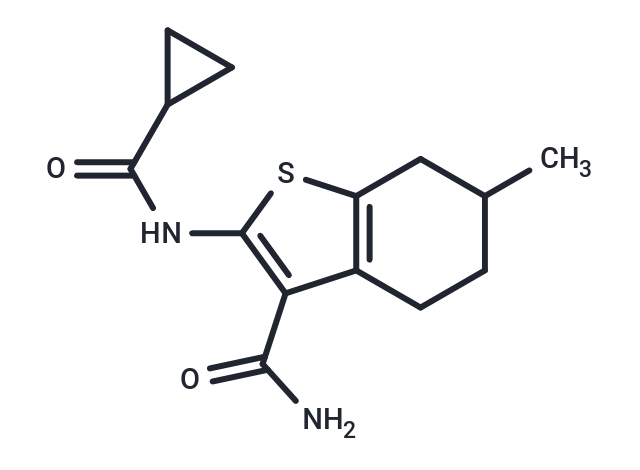
Protein kinase G inhibitor-1
CAS No. 354544-70-0
Protein kinase G inhibitor-1( —— )
Catalog No. M35962 CAS No. 354544-70-0
Protein kinase G inhibitor-1 is a potent Protein kinase G inhibitor, IC50= 0.9 uM.
Purity : >98% (HPLC)
 COA
Datasheet
HNMR
HPLC
MSDS
Handing Instructions
COA
Datasheet
HNMR
HPLC
MSDS
Handing Instructions
| Size | Price / USD | Stock | Quantity |
| 1 mL x 10 mM in DMSO | 164 | In Stock |


|
| 5MG | 179 | In Stock |
|
| 10MG | 263 | In Stock |
|
| 25MG | 392 | In Stock |
|
| 50MG | 542 | In Stock |
|
| 100MG | 728 | In Stock |
|
| 200MG | 986 | In Stock |
|
| 500MG | Get Quote | In Stock |
|
| 1G | Get Quote | In Stock |
|
Biological Information
-
Product NameProtein kinase G inhibitor-1
-
NoteResearch use only, not for human use.
-
Brief DescriptionProtein kinase G inhibitor-1 is a potent Protein kinase G inhibitor, IC50= 0.9 uM.
-
DescriptionProtein kinase G inhibitor-1 (Compound 270) is a mycobacterial protein kinase G inhibitor, with an IC50 of0.9 μM. Protein kinase G inhibitor-1 can be used for mycobacterial infection research.
-
In Vitro——
-
In Vivo——
-
Synonyms——
-
PathwayApoptosis
-
TargetPKA
-
RecptorPKA
-
Research Area——
-
Indication——
Chemical Information
-
CAS Number354544-70-0
-
Formula Weight278.37
-
Molecular FormulaC14H18N2O2S
-
Purity>98% (HPLC)
-
Solubility——
-
SMILESC(N)(=O)C=1C2=C(SC1NC(=O)C3CC3)CC(C)CC2
-
Chemical Name——
Shipping & Storage Information
-
Storage(-20℃)
-
ShippingWith Ice Pack
-
Stability≥ 2 years
Reference
1. Missio Andrea, et al. 4,5,6,7-tetrahydrobenzo[b]thiophene derivatives and methods for medical intervention against mycobacterial infections. Patent. WO2003084947. 2003-10-16.
molnova catalog



related products
-
PKI (5-24)
High affinity PKA inhibitor (Ki = 2.3 nM).
-
H 89 2HCl
H 89 2HCl is a potent PKA inhibitor with Ki of 48 nM, 10-fold selective for PKA than PKG.
-
Synaptamide
An endogenous DHA metabolite that promotes neurite growth, synaptogenesis, and synaptic function both in vitro and in vivo.
