


 Cart
Cart
 sales@molnova.com



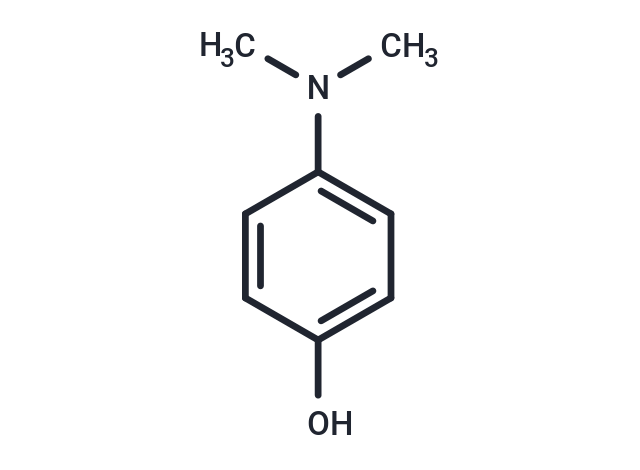
4-(Dimethylamino)phenol
CAS No. 619-60-3
4-(Dimethylamino)phenol( —— )
Catalog No. M35792 CAS No. 619-60-3
4-(Dimethylamino)phenol enhances extracellular lactate dehydrogenase (LDH) levels without significant effects on gluconeogenesis.
Purity : >98% (HPLC)
 COA
Datasheet
HNMR
HPLC
MSDS
Handing Instructions
COA
Datasheet
HNMR
HPLC
MSDS
Handing Instructions
| Size | Price / USD | Stock | Quantity |
| 100MG | Get Quote | In Stock |


|
| 200MG | Get Quote | In Stock |
|
| 500MG | Get Quote | In Stock |
|
| 1G | 27 | In Stock |
|
Biological Information
-
Product Name4-(Dimethylamino)phenol
-
NoteResearch use only, not for human use.
-
Brief Description4-(Dimethylamino)phenol enhances extracellular lactate dehydrogenase (LDH) levels without significant effects on gluconeogenesis.
-
Description4-(Dimethylamino)phenol increases the extracellular lactate dehydrogenase (LDH) without markedly affecting gluconeogenesis. 4-(Dimethylamino)phenol cannot decreases the ATP content until the membrane becomes permeable to LDH.
-
In Vitro——
-
In Vivo——
-
Synonyms——
-
PathwayOthers
-
TargetOther Targets
-
RecptorOthers
-
Research Area——
-
Indication——
Chemical Information
-
CAS Number619-60-3
-
Formula Weight137.18
-
Molecular FormulaC8H11NO
-
Purity>98% (HPLC)
-
SolubilityIn Vitro:?DMSO : 100 mg/mL (728.97 mM; Ultrasonic (<60°C)
-
SMILESCN(C)c1ccc(O)cc1
-
Chemical Name——
Shipping & Storage Information
-
Storage(-20℃)
-
ShippingWith Ice Pack
-
Stability≥ 2 years
Reference
1. Szinicz LL, et al. Effects of 4-dimethylaminophenol in rat kidneys, isolated rat kidney tubules and hepatocytes. Xenobiotica. 1980;10(7-8):611-620.?
molnova catalog



related products
-
WDR5-0102
WDR5-0102 is a compound that inhibits the WDR5-MLL1 interface (K dis = 7 μM, K d = 4 μM), selectively reducing MLL1 HMT activity without affecting the human H3K4 methyltransferase SETD7 or other HMTs, including G9a, EHMT1, SUV39H2, SETD8, PRMT3, and PRMT5.
-
Substance P 1-7
Substance P 1-7 is the major bioactive metabolite formed after proteolytic degradation of the tachykinin substance P (SP)with anti-inflammatory anti-nociceptive and anti-hyperalgesic effects.
-
TNF-α (46-65), human...
TNF-α (46-65), human (TFA) is a peptide of human TNF-α.
