


 Cart
Cart
 sales@molnova.com



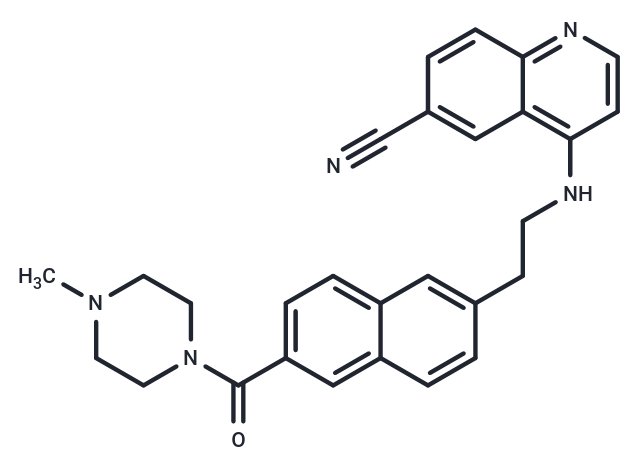
Senexin C
CAS No. 2375554-02-0
Senexin C( —— )
Catalog No. M35662 CAS No. 2375554-02-0
Senexin C is a novel orally active and specific CDK8/19 inhibitor with potential anticancer activity.Senexin C is more metabolically stable and potent than Senexin B. Senexin C inhibits the growth of MV4-11 leukaemia cells.
Purity : >98% (HPLC)
 COA
Datasheet
HNMR
HPLC
MSDS
Handing Instructions
COA
Datasheet
HNMR
HPLC
MSDS
Handing Instructions
| Size | Price / USD | Stock | Quantity |
| 1 mL x 10 mM in DMSO | 502 | In Stock |


|
| 5MG | 454 | In Stock |
|
| 10MG | 663 | In Stock |
|
| 100MG | Get Quote | In Stock |
|
| 200MG | Get Quote | In Stock |
|
| 500MG | Get Quote | In Stock |
|
| 1G | Get Quote | In Stock |
|
Biological Information
-
Product NameSenexin C
-
NoteResearch use only, not for human use.
-
Brief DescriptionSenexin C is a novel orally active and specific CDK8/19 inhibitor with potential anticancer activity.Senexin C is more metabolically stable and potent than Senexin B. Senexin C inhibits the growth of MV4-11 leukaemia cells.
-
DescriptionSenexin C is a selective and orally active CDK8/19 inhibitor. Senexin C shows a strong tumor-enrichment pharmacokinetic (PK) profile and tumor-pharmacodynamic (PD) marker responses. Senexin C inhibits the growth of MV4-11 leukemia cells with good tolerability.
-
In VitroSenexin C (compound 20a) exhibits potent CDK8/19 inhibitory activity with high selectivity (IC50s of 56 and 108 nM for 293-NFκB-Luc and MV4-11-Luc cells, respectively).Senexin C (2 μM) shows potency in different kinase assays (IC50= 3.6 nM for CD8/CycC, Kd=1.4 nM for CD8/CycC, Kd=2.9 nM for CDK19/CycC).Senexin C (1 μM, 3 h) shows inhibition on CDK8/19 dependent cellular gene expression.RT-PCR Cell Line:293 cells Concentration:1 μM Incubation Time:3 h Result:Showed inhibition on CDK8/19 dependent cellular gene expression.
-
In VivoSenexin C (2.5 mg/kg, i.v.; 100 mg/kg, p.o.) shows good oral bioavailability.Senexin C (40 mg/kg; p.o.; twice daily for 4 weeks) suppresses the systemic growth of MV4-11 AML with good tolerability.Pharmacokinetic Parameters of Senexin C in eight-week-old female Balb/c mice.Eight-week-old female Balb/c mice ( CT26 tumor mode), 2.5 mg/kg, i.v.(2.5 mg/mL Senexin C solution in 5% dextrose); 100 mg/kg, p.o.(10 mg/mL Senexin C solution in 30% propylene glycol/70% PEG-400 vehicle).Animal Model:eight-week-old female Balb/c mice ( CT26 tumor mode)Dosage:2.5 mg/kg (10 mL/kg of 2.5 mg/mL Senexin C solution in 5% dextrose), 100 mg/kg (10 mL/kg of 10 mg/mL Senexin C solution in 30% propylene glycol/70% PEG-400 vehicle) Administration:2.5 mg/kg, i.v.; 100 mg/kg, p.o.Result:Showed good oral bioavailability.Animal Model:eight-week-old female NSG mice ( AML model) Dosage:40 mg/kg Administration:p.o.; twice daily, 4 weeks Result:Suppressed the systemic growth of MV4-11 AML with good tolerability.
-
Synonyms——
-
PathwayCell Cycle/DNA Damage
-
TargetCDK
-
RecptorCDK
-
Research Area——
-
Indication——
Chemical Information
-
CAS Number2375554-02-0
-
Formula Weight449.55
-
Molecular FormulaC28H27N5O
-
Purity>98% (HPLC)
-
SolubilityIn Vitro:?DMSO : 33.33 mg/mL (74.14 mM; ultrasonic and warming and heat to 160°C )
-
SMILESN#CC=1C=CC2=NC=CC(NCCC=3C=CC4=CC(=CC=C4C3)C(=O)N5CCN(C)CC5)=C2C1
-
Chemical Name——
Shipping & Storage Information
-
Storage(-20℃)
-
ShippingWith Ice Pack
-
Stability≥ 2 years
Reference
1. Zhang L, et al. A Selective and Orally Bioavailable Quinoline-6-Carbonitrile-Based Inhibitor of CDK8/19 Mediator Kinase with Tumor-Enriched Pharmacokinetics. J Med Chem. 2022; 65(4):3420-3433.?
molnova catalog



related products
-
Riviciclib
A novel potent CDK inhibitor with IC50 of 79 nM, 63 nM and 20 nM for Cdk4/cyclin D1, Cdk1/cyclin B and Cdk9/cyclin T1, respectively.
-
SNX7
SNX7 (WAY-323879) is an inhibitor of the cell cycle protein-dependent kinase inhibitor (CDKI) pathway.
-
CDK12-IN-5
CDK12-IN-5 is a potent CDK12 inhibitor with potential anticancer and antitumor activity, and can be used orally in the study of breast and ovarian cancer.
