


 Cart
Cart
 sales@molnova.com



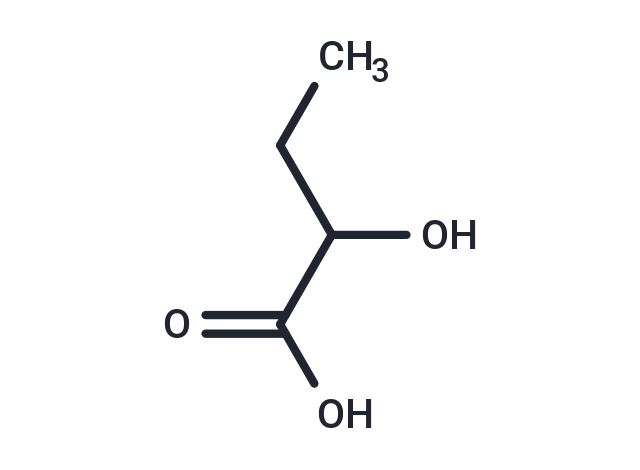
2-Hydroxybutyric acid
CAS No. 600-15-7
2-Hydroxybutyric acid( —— )
Catalog No. M35282 CAS No. 600-15-7
2-Hydroxybutyric acid (α-Hydroxybutyric acid) is a product of protein metabolism and serves as a biomarker for type 2 diabetes and pre-eclampsia.
Purity : >98% (HPLC)
 COA
Datasheet
HNMR
HPLC
MSDS
Handing Instructions
COA
Datasheet
HNMR
HPLC
MSDS
Handing Instructions
| Size | Price / USD | Stock | Quantity |
| 1 mL x 10 mM in DMSO | 35 | In Stock |


|
| 50MG | 33 | In Stock |
|
| 100MG | 49 | In Stock |
|
| 200MG | Get Quote | In Stock |
|
| 500MG | 105 | In Stock |
|
| 1G | 152 | In Stock |
|
Biological Information
-
Product Name2-Hydroxybutyric acid
-
NoteResearch use only, not for human use.
-
Brief Description2-Hydroxybutyric acid (α-Hydroxybutyric acid) is a product of protein metabolism and serves as a biomarker for type 2 diabetes and pre-eclampsia.
-
Description2-Hydroxybutyric acid (α-Hydroxybutyric acid ) is converted from 2-Aminobutyric acid, with 2-oxobutyric acid as an intermediate metabolite.
-
In Vitro——
-
In Vivo——
-
Synonyms——
-
PathwayProteasome/Ubiquitin
-
TargetEndogenous Metabolite
-
RecptorEndogenous Metabolite
-
Research Area——
-
Indication——
Chemical Information
-
CAS Number600-15-7
-
Formula Weight104.1
-
Molecular FormulaC4H8O3
-
Purity>98% (HPLC)
-
SolubilityIn Vitro:?DMSO : 100 mg/mL (960.61 mM; Ultrasonic (<50°C)
-
SMILESCCC(O)C(O)=O
-
Chemical Name——
Shipping & Storage Information
-
Storage(-20℃)
-
ShippingWith Ice Pack
-
Stability≥ 2 years
Reference
1. Landaas S, et al. The formation of 2-hydroxybutyric acid in experimental animals. Clin Chim Acta. 1975 Jan 6;58(1):23-32.?
molnova catalog



related products
-
3-Methylvaleric Acid
3-Methylvaleric Acid is an edible grade flavor present in tobacco.3-Methylvaleric Acid enhances intracellular cAMP accumulation and CRE-luciferase activity in CHO-K1 cells and HEK293 cells.
-
H-Tyr(3-I)-OH
H-Tyr(3-I)-OH is an inhibitor of tyrosine hydroxylase (Ki = 0.39 M) and an intermediate in the synthesis of thyroid hormones.
-
7-Ketolithocholic ac...
7-Ketolithocholic acid (3α-Hydroxy-7-oxo-5β-cholanic acid) can be absorbed and suppresses endogenous bile acid production and biliary cholesterol secretion.
