


 Cart
Cart
 sales@molnova.com



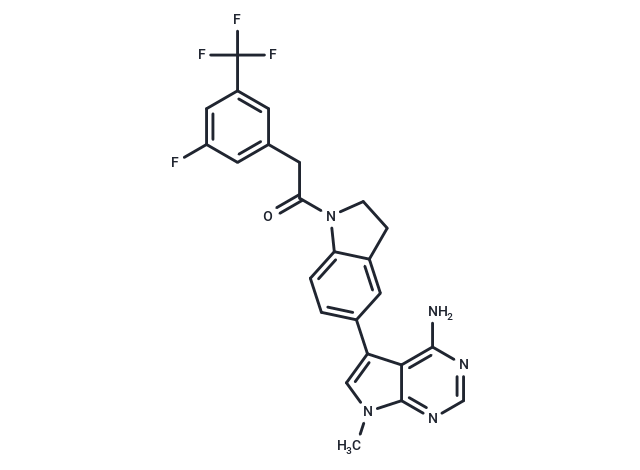
PERK-IN-4
CAS No. 1337531-89-1
PERK-IN-4( —— )
Catalog No. M35065 CAS No. 1337531-89-1
PERK-IN-4 is a potent and selective PERK inhibitor with an IC50 value of 0.3 nM, used in the study of cancer and neurological disorders.
Purity : >98% (HPLC)
 COA
Datasheet
HNMR
HPLC
MSDS
Handing Instructions
COA
Datasheet
HNMR
HPLC
MSDS
Handing Instructions
| Size | Price / USD | Stock | Quantity |
| 5MG | 140 | In Stock |


|
| 10MG | 217 | In Stock |
|
| 25MG | 407 | In Stock |
|
| 50MG | 591 | In Stock |
|
| 100MG | 825 | In Stock |
|
| 200MG | Get Quote | In Stock |
|
| 500MG | Get Quote | In Stock |
|
| 1G | Get Quote | In Stock |
|
Biological Information
-
Product NamePERK-IN-4
-
NoteResearch use only, not for human use.
-
Brief DescriptionPERK-IN-4 is a potent and selective PERK inhibitor with an IC50 value of 0.3 nM, used in the study of cancer and neurological disorders.
-
DescriptionPERK-IN-4 is a potent and selective PERK (protein kinase R (PKR)-like endoplasmic reticulum kinase) inhibitor with an IC 50 of 0.3 nM. PERK is activated in response to a variety of endoplasmic reticulum stresses implicated in numerous disease states.
-
In Vitro——
-
In Vivo——
-
Synonyms——
-
PathwayApoptosis
-
TargetPERK
-
RecptorPERK
-
Research Area——
-
Indication——
Chemical Information
-
CAS Number1337531-89-1
-
Formula Weight469.43
-
Molecular FormulaC24H19F4N5O
-
Purity>98% (HPLC)
-
SolubilityIn Vitro:?DMSO : 20.83 mg/mL (44.37 mM; Ultrasonic )
-
SMILESCn1cc(-c2ccc3N(CCc3c2)C(=O)Cc2cc(F)cc(c2)C(F)(F)F)c2c(N)ncnc12
-
Chemical Name——
Shipping & Storage Information
-
Storage(-20℃)
-
ShippingWith Ice Pack
-
Stability≥ 2 years
Reference
1. Axten JM, et al. Discovery of 7-methyl-5-(1-{[3-(trifluoromethyl)phenyl]acetyl}-2,3-dihydro-1H-indol-5-yl)-7H-pyrrolo[2,3-d]pyrimidin-4-amine (GSK2606414), a potent and selective first-in-class inhibitor of protein kinase R (PKR)-like endoplasmic reticulu?
molnova catalog



related products
-
Salubrinal
Salubrinal is a selective inhibitor of eukaryotic translation initiation factor 2 subunit α (eIF2α) dephosphorylation.
-
δ-Tocotrienol
δ-Tocotrienol is a potential angiogenic inhibitor. δ-Tocotrienol is also a nontoxic activator of mir-34a which can inhibit nonsmall cell lung cancer cells (NSCLC) cell proliferation, induce apoptosis and inhibit invasion, and thus offering a potential starting point for the design of novel anticancer agents.
-
GSK2606414
GSK2606414 is an orally available, potent, and selective PERK inhibitor with IC50 of 0.4 nM.
